ANZ Macro Daily(Beta Mode)
RBA Hike Looms, AUD Weakens
Market Snapshot
| Asset | Level | Change |
|---|---|---|
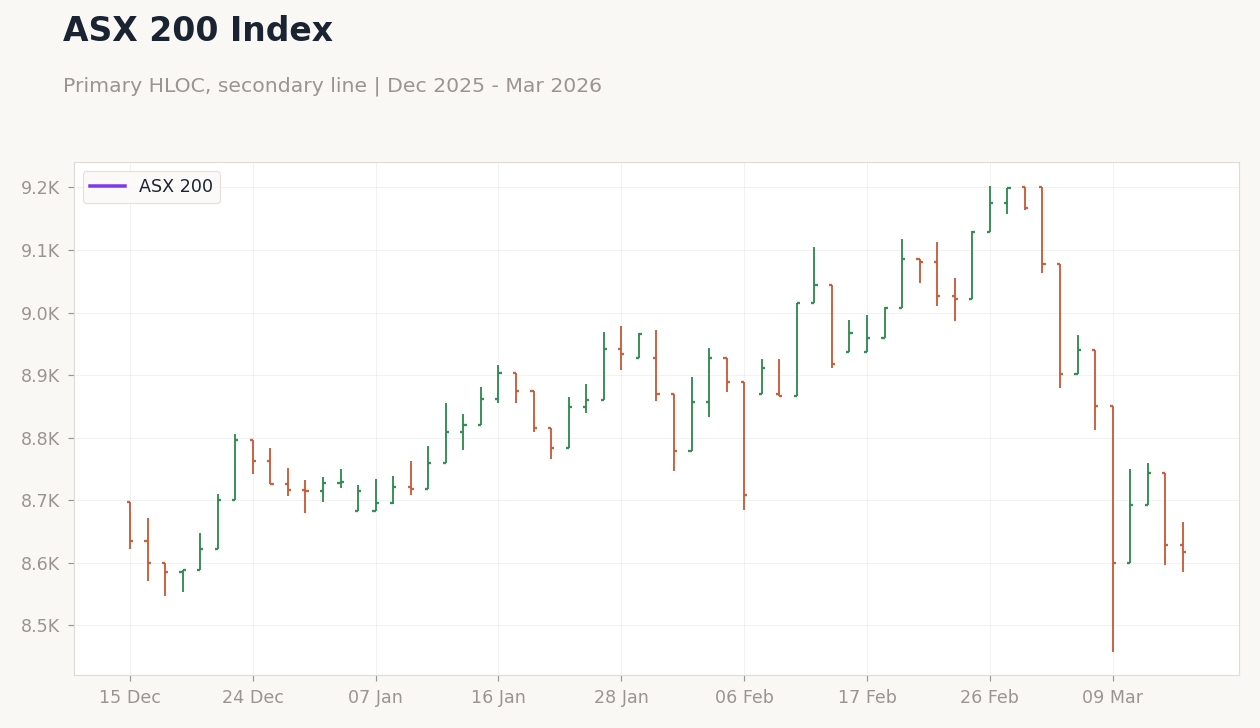
| ASX 200 | 8,617.10 | -0.14% |
| NZX 50 | 13,187.34 | -0.09% |
| AUD/USD | 0.70 | -1.22% |
| NZD/USD | 0.58 | -1.12% |
| AUD/NZD | 1.21 | -0.25% |
| BHP | 49.80 | -2.31% |
| Gold | 5,061.70 | -1.06% |
| Brent Crude | 98.91 | -1.54% |
| Bitcoin | 71,526.89 | +0.44% |
| Australia 10Y Govt Yield | 4.74% | +0.45% |
| NZ Short-term Rate | 4.33% | -9.60% |
Prior Economic Events
| Data | Prior | Cons | Actual |
|---|---|---|---|
| No events available | |||
 Brent Crude Oil | Type: market_hloc | Brent Crude: 98.91 (2026-03-13) | Range: 58.92–100.5 | Trend(5pt): 60.56,59.96,70.71,71.76,98.91
Today's Economic Events
| Data | Prior | Cons | Time |
|---|---|---|---|
| RBA Interest Rate Decision | 3.85 | 4.10 | 23:30 |
| RBA Press Conference | - | - | 00:30 |
| Current Account Balance | -8,370m | -4,850m | 17:45 |
| GDP Growth Quarter-over-Quarter | 1.10 | 0.40 | 17:45 |
| GDP Growth Year-over-Year | 1.30 | 1.50 | 17:45 |
| Employment Change | 17,800 | 20,000 | 20:30 |
| Full-Time Employment Change | 50,500 | - | 20:30 |
| Headline Unemployment Rate | 4.10 | 4.20 | 20:30 |
| Trade Balance | -519m | -470m | 17:45 |
- Markets eye RBA rate decision amid oil shocks and Middle East tensions fueling inflation.
- AUD and NZD slide versus USD, with ASX 200 and NZX 50 edging lower.
- Upcoming NZ GDP and AU jobs data to shape policy outlooks.
Yesterday's Recap
With no major data releases in Australia or New Zealand on March 14, markets reacted to global risk aversion, resulting in a 0.14% decline in the ASX 200 to 8,617.10, led by mining sector weakness including BHP's 2.31% drop to 49.80 amid softer commodity prices. The NZX 50 dipped 0.09% to 13,187.34, showing caution in export-related stocks despite steady trade expectations. AUD/USD fell 1.22% to 0.70, weighed by USD strength and RBA hike anticipation, while NZD/USD decreased 1.12% to 0.58, with the AUD/NZD cross down 0.25% to 1.21.
Australia's 10Y government bond yield increased 0.45% to 4.74%, reflecting bets on tighter policy before the RBA meeting, while New Zealand's short-term rate dropped 9.60% to 4.33%, likely from market repositioning. Commodities pressured sentiment, with gold falling 1.06% to 5,061.70 and Brent crude declining 1.54% to 98.91, exposing Australia's export vulnerabilities. Overall, absent local data amplified external factors like Middle East risks stoking inflation worries.
The Day Ahead
Focus is on the RBA interest rate decision at 23:30 ET on March 16, with consensus for a rise to 4.1% from 3.85%, followed by a press conference at 00:30 ET on March 17 for insights on inflation and housing. New Zealand's current account balance arrives at 17:45 ET on March 17, expected at -4.85 billion from -8.37 billion prior, highlighting trade trends amid dairy exports. On March 18 at 17:45 ET, New Zealand Q4 GDP is due, with quarter-over-quarter forecast at 0.4% (prior 1.1%) and year-over-year at 1.5% (prior 1.3%), key for recovery assessment.
Australia's labor data follows at 20:30 ET on March 18, including employment change projected at 20,000 (prior 17,800), full-time change (no consensus, prior 50,500), and unemployment rate at 4.2% (prior 4.1%), informing RBA views on jobs. New Zealand trade balance concludes at 17:45 ET on March 19, anticipated at -470 million (prior -519 million), emphasizing export risks to China.
Other Economic Notes
ANZ economies face ongoing inflation from oil volatility tied to Iran tensions, impacting Australia's commodity exports and New Zealand's import bills. Housing remains central, with Australia's market vulnerable to rate hikes given high debt levels, while New Zealand's building sector aids growth but strains affordability. China's demand outlook, as the primary trade partner, influences sentiment, with potential iron ore and dairy slowdowns risking trade balances for both nations.