| Asset | Level | Change |
|---|---|---|
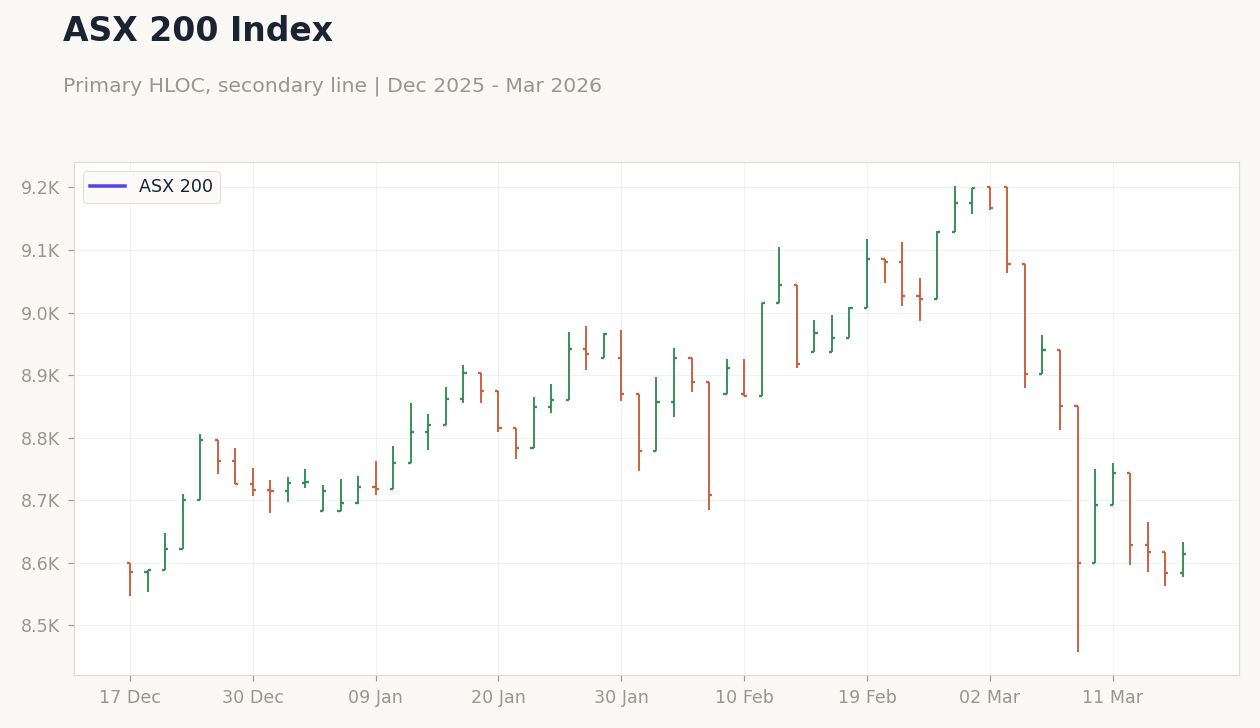
| ASX 200 | 8,614.30 | +0.36% |
| NZX 50 | 13,182.23 | +0.13% |
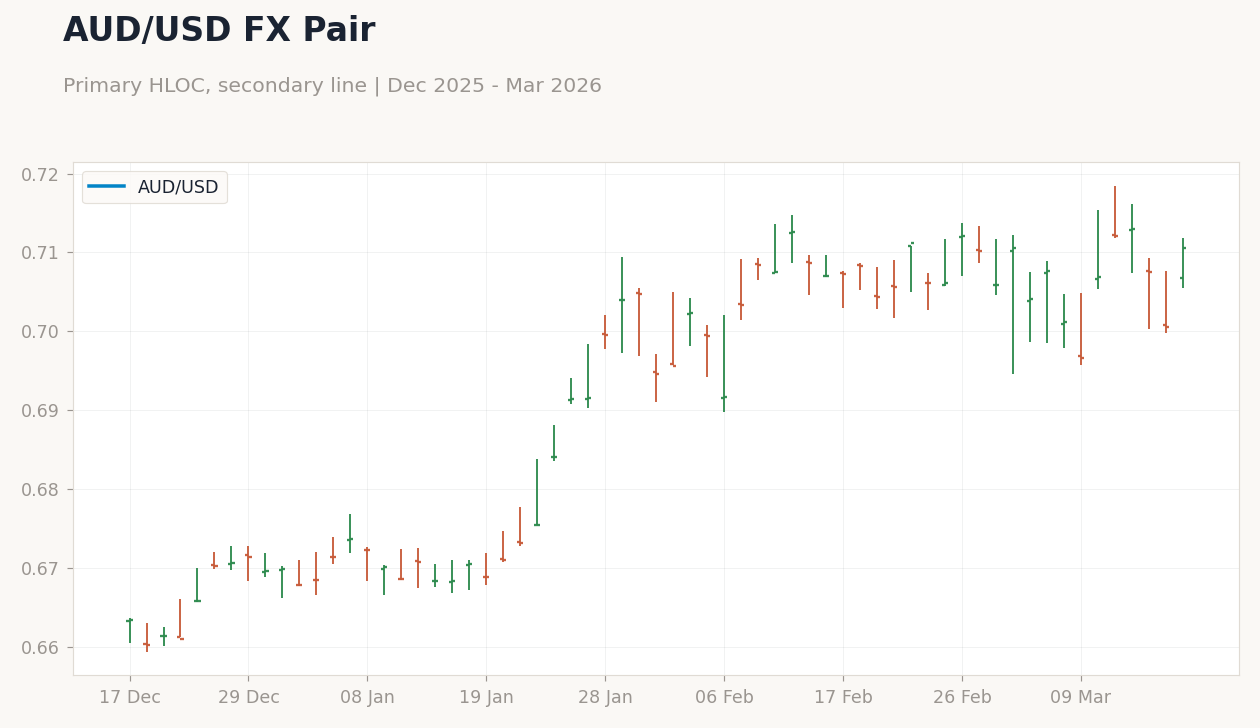
| AUD/USD | 0.71 | +1.40% |
| NZD/USD | 0.59 | +1.05% |
| AUD/NZD | 1.21 | +0.37% |
| BHP | 49.58 | +0.79% |
| Gold | 5,005.60 | +0.23% |
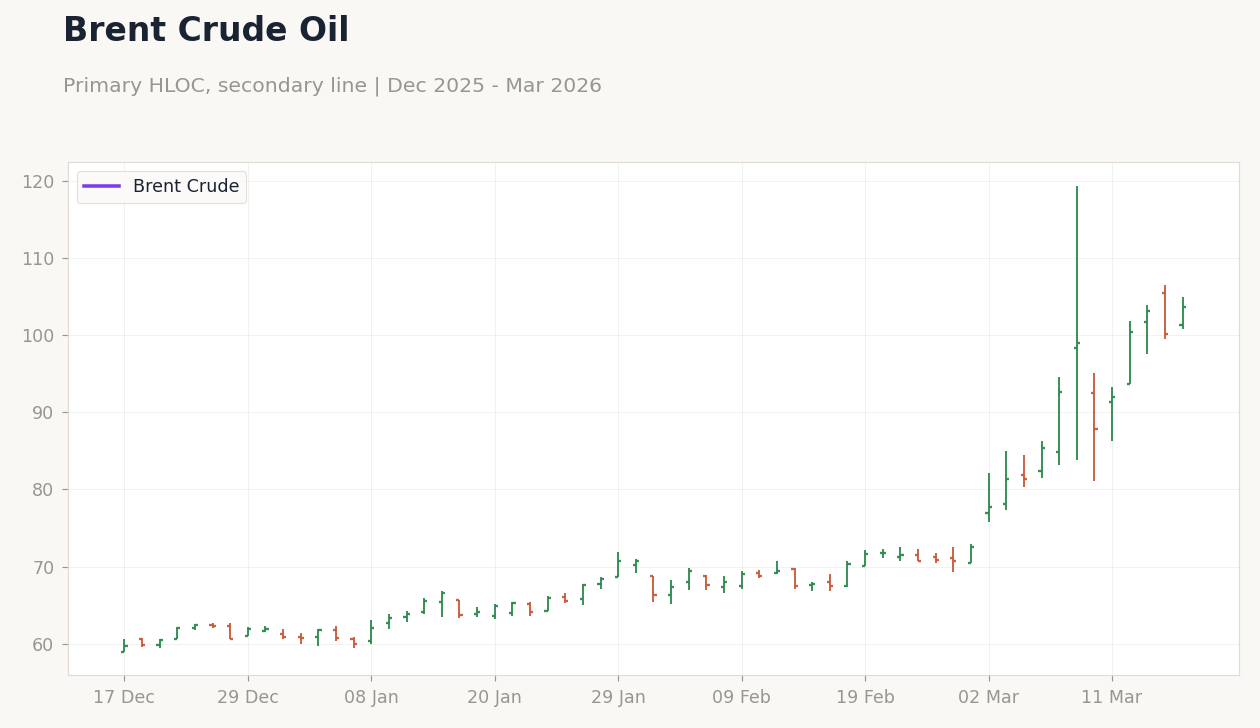
| Brent Crude | 103.42 | +3.20% |
| Bitcoin | 74,522.06 | -0.45% |
| Australia 10Y Govt Yield | 4.77% | +0.42% |
| NZ Short-term Rate | 4.33% | -9.60% |
| Data | Prior | Cons | Actual |
|---|---|---|---|
| RBA Interest Rate Decision | 3.85 | 4.10 | 4.10 |
| RBA Press Conference | - | - | - |
Australia 10Y Govt Yield | Type: macro_line | 10Y Yield (%): 4.77 (2026-02-01) | Range: 1.135–4.77 | Trend(6pt): 1.676,3.767,4.128,4.267,4.719,4.77
| Data | Prior | Cons | Time |
|---|---|---|---|
| Current Account Balance | -8,370m | -4,750m | 13:45 |
| GDP Growth Quarter-over-Quarter | 1.10 | 0.40 | 13:45 |
| GDP Growth Year-over-Year | 1.30 | 1.60 | 13:45 |
| Employment Change | 17,800 | 20,300 | 16:30 |
| Full-Time Employment Change | 50,500 | - | 16:30 |
| Headline Unemployment Rate | 4.10 | 4.20 | 16:30 |
| Trade Balance | -519m | -470m | 13:45 |
The Reserve Bank of Australia (RBA) hiked its cash rate by 25 basis points to 4.1%, meeting consensus expectations from a previous 3.85%, with the decision reflecting persistent inflation and fuel price pressures. The subsequent RBA press conference emphasized a data-dependent approach, noting risks from global oil shocks and domestic housing strains, which spurred a 1.40% rally in AUD/USD to 0.71. In Australia, the ASX 200 climbed 0.36% to 8,614.30, driven by mining sector strength as BHP shares rose 0.79% to 49.58 amid firming commodity prices.
New Zealand saw no major data releases, but the NZX 50 inched up 0.13% to 13,182.23, tempered by softer dairy export sentiment. NZD/USD advanced 1.05% to 0.59, while the AUD/NZD cross gained 0.37% to 1.21, highlighting Australia's relative currency resilience. Australia's 10-year government yield increased 0.42% to 4.77%, signaling market bets on further tightening, whereas New Zealand's short-term rate fell by 9.60% to 4.33%, possibly reflecting positioning ahead of upcoming data.
Overall, ANZ markets reacted positively to the RBA's hawkish stance, though household borrowing costs rose, with news highlighting a $2,800 annual hit to mortgage holders.
New Zealand's current account balance for the fourth quarter is due today at 13:45 ET, with consensus expecting a narrowing deficit to -4.75 billion NZD from -8.37 billion previously, potentially signaling improved trade dynamics amid dairy and tourism recovery. Tomorrow, New Zealand's GDP growth data for the fourth quarter arrives at 13:45 ET, with quarter-over-quarter consensus at 0.4% versus 1.1% prior, and year-over-year at 1.6% from 1.3%, offering insights into post-pandemic resilience. Australia's employment figures follow tomorrow at 16:30 ET, including employment change consensus of 20,300 from 17,800, full-time change without forecast from 50,500, and unemployment rate expected at 4.2% from 4.1%.
New Zealand's trade balance is slated for March 19 at 13:45 ET, with consensus at -470 million NZD from -519 million, critical for export-driven growth. These releases could influence RBNZ rate expectations, especially with housing market linkages in both nations. Markets will watch for any divergence in ANZ economic momentum amid global oil volatility.
Subscribe to ANZ Macro Daily and get each new issue delivered to your inbox.
Already a member? Visit robomacro.com to log in and manage subscriptions, or use Forgot Password to set a password.
Australia Unemployment Rate | Type: macro_line | Unemployment Rate (%): 4.075 (2026-01-01) | Range: 3.431–5.482 | Trend(6pt): 5.482,3.607,3.683,4.084,4.092,4.075
Brent Crude Oil | Type: market_hloc | Brent Crude: 103.7 (2026-03-17) | Range: 59.68–103.7 | Trend(5pt): 59.68,63.34,66.3,70.77,103.7
AUD/USD FX Pair | Type: market_hloc | AUD/USD: 0.7105 (2026-03-17) | Range: 0.6602–0.7129 | Trend(6pt): 0.6634,0.6701,0.7047,0.7056,0.7075,0.7105
ASX 200 Index | Type: market_hloc | ASX 200: 8614 (2026-03-17) | Range: 8583–9199 | Trend(5pt): 8585,8759,8857,9022,8614
Australia's commodity exports, including iron ore and coal, face tailwinds from Brent crude surging 3.20% to $103.42, though China's slowing growth remains a key risk for demand. New Zealand's dairy and tourism sectors are vulnerable to global disruptions, with recent data showing construction activity supporting domestic recovery despite weaker exports. Broader ANZ housing markets are under pressure from rate hikes, with Australian households facing increased mortgage burdens and New Zealand property prices stabilizing amid affordability concerns.
The US dollar pulled back from 10-month highs amid a busy central bank week overshadowed by Middle East conflicts, easing pressure on AUD and NZD as both currencies gained against the greenback. Iran's war escalation drove oil toward $100, stoking global stagflation fears that could benefit Australia's energy exports like LNG but challenge New Zealand's import-dependent economy. In Asia, the Korean won broke 1,500 against the dollar due to oil spikes, while the Japanese yen recovered losses ahead of Fed and BoJ decisions, influencing ANZ carry trade dynamics.
China's economic slowdown continues to weigh on ANZ commodity demand, with iron ore and coal prices sensitive to Beijing's stimulus signals. European Union-Australia trade deal momentum gathers amid US tariff risks, potentially boosting agricultural and mining flows. Globally, central banks are girding for oil shocks, as seen in the RBA's hike, with broader implications for ANZ inflation passthrough via fuel costs.
Bitcoin dipped 0.45% to 74,522.06, reflecting mixed risk sentiment, while gold rose 0.23% to 5,005.60 on safe-haven bids. These developments underscore ANZ's exposure to commodity cycles and geopolitical tensions, with China's outlook remaining pivotal.
The RBA raised its cash rate to 4.1% in a 5-4 vote, signaling hawkish resolve amid rising fuel prices and inflation risks, with the press conference highlighting potential for further hikes if data warrants. This contrasts with the RBNZ's more cautious stance, having historically been aggressive but now monitoring divergence, as New Zealand's inflation has eased faster than Australia's. Both central banks target 2-3% inflation, but Australia's larger economy and commodity ties amplify external pressures, while New Zealand's framework emphasizes employment and housing stability.
Upcoming New Zealand GDP and Australian employment data will be crucial for rate paths, with implications for housing markets where Australian mortgage stress is mounting and New Zealand prices are cooling. Divergence may widen if RBNZ holds steady amid softer growth, versus RBA's tightening bias linked to robust mining exports. Minutes from recent meetings could reveal more on vote splits and forward guidance, especially with global oil shocks influencing both.
(cont...)
Overall, ANZ monetary policy remains data-driven, with China's demand outlook a shared external driver.