| Asset | Level | Change |
|---|---|---|
| ASX 200 | 8,428.40 | -0.82% |
| NZX 50 | 12,989.99 | -0.47% |
| AUD/USD | 0.70 | -0.08% |
| NZD/USD | 0.58 | +0.64% |
| AUD/NZD | 1.20 | -0.74% |
| BHP | 47.59 | -1.57% |
| Gold | 4,500.20 | -2.18% |
| Brent Crude | 106.72 | -1.78% |
| Bitcoin | 70,041.38 | +0.18% |
| Australia 10Y Govt Yield | 4.77% | +0.42% |
| NZ Short-term Rate | 4.33% | -9.60% |
| Data | Prior | Cons | Actual |
|---|---|---|---|
| RBA Interest Rate Decision | 3.85 | 4.10 | 4.10 |
| RBA Press Conference | - | - | - |
| Current Account Balance | -8,360m | -4,750m | -5,980m |
| GDP Growth Quarter-over-Quarter | 0.90 | 0.40 | 0.20 |
| GDP Growth Year-over-Year | 1.10 | 1.70 | 1.30 |
| Employment Change | 17,800 | 20,300 | 48,900 |
| Full-Time Employment Change | 54,500 | - | -30,500 |
| Headline Unemployment Rate | 4.10 | 4.10 | 4.30 |
| Trade Balance | -627m | -740m | -257m |
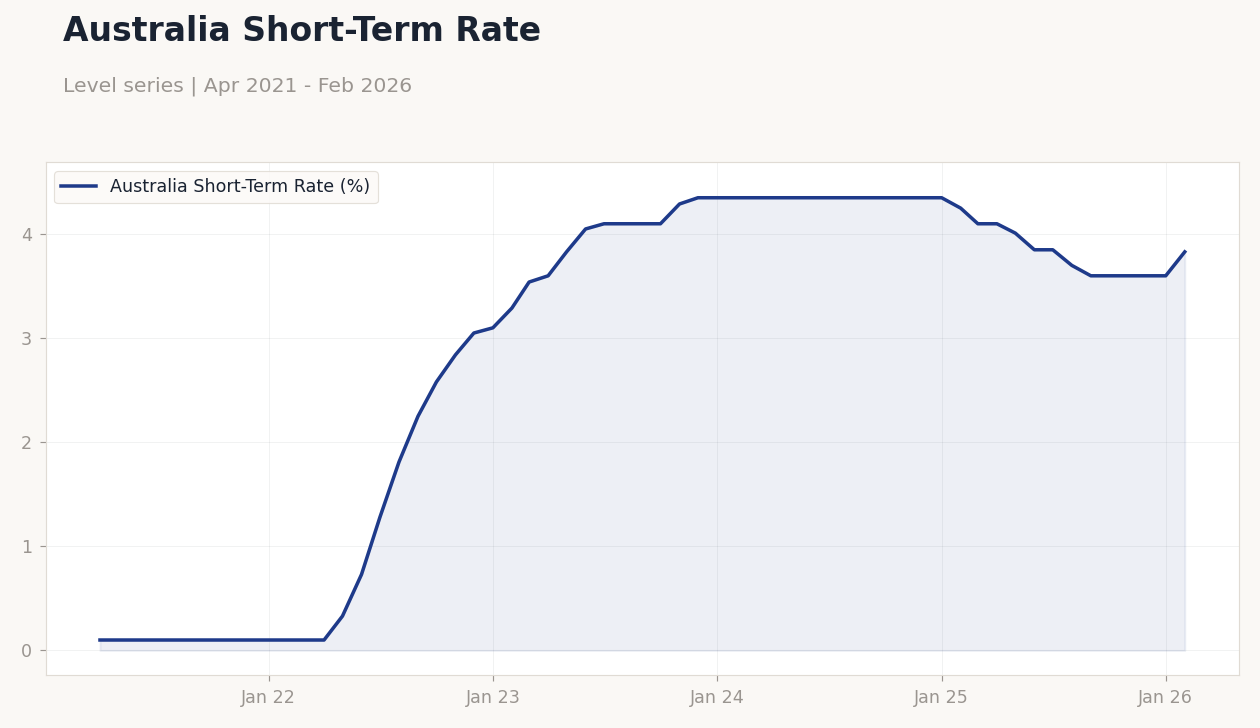
Australia Short-Term Rate | Type: macro_line | Australia Short-Term Rate (%): 3.83 (2026-02-01) | Range: 0.1–4.35 | Trend(6pt): 0.1,0.73,4.1,4.35,3.6,3.83
| Data | Prior | Cons | Time |
|---|---|---|---|
| No events available | |||
The Reserve Bank of Australia (RBA) raised its cash rate to 4.1% on March 16, matching consensus from a previous 3.85%, while highlighting risks of severe global economic shocks from the Iran war. The subsequent RBA press conference stressed readiness for Middle East disruptions, such as oil price spikes affecting Australian inflation. In New Zealand, the current account balance deteriorated to -NZ$5.98 billion on March 17, missing the -NZ$4.75 billion consensus from a prior -NZ$8.36 billion, due to export challenges.
New Zealand's GDP growth eased to 0.2% quarter-over-quarter and 1.3% year-over-year on March 18, below consensus of 0.4% and 1.7% from previous 0.9% and 1.1%, underscoring dairy and tourism weaknesses. Australia's March 18 employment data revealed a strong 48.9k job increase, beating the 20.3k consensus from 17.8k prior, but full-time employment dropped 30.5k and the unemployment rate rose to 4.3% from 4.1%, against expectations of stability. New Zealand's trade balance on March 19 improved to -NZ$257 million, outperforming the -NZ$740 million consensus from -NZ$627 million prior, supported by agricultural exports.
Markets declined, with the ASX 200 down 0.82% at 8,428.40, NZX 50 down 0.47% at 12,989.99, AUD/USD off 0.08% at 0.70, and NZD/USD up 0.64% at 0.58 amid commodity shifts.
No significant economic releases are planned for Australia or New Zealand on March 20, allowing markets to absorb the recent RBA hike and geopolitical developments. Attention may turn to any RBA follow-up on rate impacts for inflation and housing. In New Zealand, the weak GDP data could prompt informal RBNZ commentary, though none is scheduled.
Traders will watch global oil dynamics, with Malaysia warning of potential fuel supply disruptions to Australia if Middle East tensions continue. ANZ equities and currencies may take cues from Asian markets, especially China demand for commodities. A light calendar might heighten sensitivity to U.S.
dollar moves and external risks.
Subscribe to ANZ Macro Daily and get each new issue delivered to your inbox.
Already a member? Visit robomacro.com to log in and manage subscriptions, or use Forgot Password to set a password.
Australia 10Y Govt Yield | Type: macro_line | Australia 10Y Yield (%): 4.77 (2026-02-01) | Range: 1.135–4.77 | Trend(6pt): 1.676,3.767,4.128,4.267,4.719,4.77
Brent Crude Oil | Type: market_hloc | Brent Crude: 106.8 (2026-03-20) | Range: 59.96–108.7 | Trend(5pt): 62.07,66.52,67.55,72.48,106.8
AUD/USD FX Pair | Type: market_hloc | AUD/USD: 0.7024 (2026-03-20) | Range: 0.661–0.7129 | Trend(6pt): 0.661,0.6684,0.7023,0.7061,0.7109,0.7024
ASX 200 Index | Type: market_hloc | ASX 200: 8428 (2026-03-20) | Range: 8428–9199 | Trend(5pt): 8700,8862,8709,9199,8428
The RBA's hike to 4.1% adds strain to Australia's housing sector, with savings rates increasing and possibly dampening mortgage activity, particularly for older borrowers facing elevated costs. New Zealand's construction activity, a growth pillar, risks further deceleration after the GDP shortfall, compounding dairy export risks in a volatile trade environment. ANZ ties to China are crucial, where Australian iron ore and LNG could buffer oil shocks, unlike New Zealand's agriculture-heavy economy vulnerable to FX swings.
Broader war effects, including inflation from fuel prices, may widen these divergences.
Iran war tensions lead headlines, with the RBA noting elevated risks of global shocks like oil surges inflating Australian imports and threatening supplies from Malaysia. Brent crude slipped 1.78% to $106.72, but fears overshadowed the RBA decision, holding AUD/USD near 0.7090. In Asia, Japan's yen strengthened against the dollar after central banks held steady, while USD/JPY rose on U.S.
dollar gains limited by BoJ hawkishness, aiding NZD through carry trades. China's outlook, key for ANZ commodities, contends with inflation as Brazil sees war-fueled price rises pre-election. The Philippine peso reached P60 per dollar, and Nigeria's 2025 balance of payments fell 38.1%, indicating emerging market pressures that might curb Australian export demand.
Gold declined 2.18% to $4,500.20 as a haven asset, while Bitcoin rose 0.18% to $70,041.38 in mixed sentiment. Discussions on petrodollar shifts due to the war reshape energy markets, increasing ANZ exposure to Middle East instability. These elements highlight ANZ policy splits, with Australia's commodity strength versus New Zealand's agri vulnerabilities.
The RBA increased its cash rate to 4.1% on March 16 as anticipated, focusing on inflation vigilance amid Middle East war risks like petrol price jumps. This aligns with employment data showing solid gains but a 4.3% unemployment uptick and full-time losses, which might temper future hikes if housing softens. The RBNZ, meanwhile, grapples with 0.2% QoQ GDP weakness, potentially fostering dovishness relative to past aggressive moves, with no near-term actions indicated.
Differences endure, as RBA's policy suits Australia's commodity economy, while RBNZ tracks housing and a wider current account deficit. Both prioritize inflation, but RBNZ's history suggests possible cuts if NZD appreciation hurts exports. Trade gains provide slight NZ relief, yet unified oil shocks could align ANZ inflation paths.