| Asset | Level | Change |
|---|---|---|
| ASX 200 | 8,516.30 | -0.11% |
| NZX 50 | 12,935.39 | -0.32% |
| AUD/USD | 0.69 | -0.33% |
| NZD/USD | 0.57 | -0.21% |
| AUD/NZD | 1.19 | -0.13% |
| BHP | 50.37 | +0.28% |
| Gold | 4,524.30 | +3.40% |
| Brent Crude | 105.32 | -2.49% |
| Bitcoin | 66,304.15 | -0.02% |
| Australia 10Y Govt Yield | 4.77% | +0.42% |
| NZ Short-term Rate | 4.33% | -9.60% |
| Data | Prior | Cons | Actual |
|---|---|---|---|
| No events available | |||
Brent Crude Oil Price | Type: macro_line | Brent Price USD: 103.8 (2026-03-23) | Range: 59.93–133.2 | Trend(6pt): 63.28,122.2,94.46,73.75,111,103.8
| Data | Prior | Cons | Time |
|---|---|---|---|
| ANZ Business Confidence | 59.20 | - | 20:00 |
| RBA Meeting Minutes | - | - | 20:30 |
| Ai Group Industry Index | -1.50 | - | 18:00 |
| Building Permits Month-over-Month Prel | -7.20 | 6.20 | 20:30 |
| Trade Balance | 2,631m | 2,500m | 20:30 |
Australian equities softened on March 28, with the ASX 200 closing at 8,516.30 after a 0.11% decline, driven by geopolitical jitters from the US-Iran war that weighed on investor sentiment. New Zealand's NZX 50 fell 0.32% to 12,935.39, reflecting similar risk-off flows amid global uncertainty. The AUD/USD pair slipped 0.33% to 0.69, pressured by rising oil prices and safe-haven demand for the USD, while NZD/USD dropped 0.21% to 0.57.
AUD/NZD eased 0.13% to 1.19, highlighting Australia's greater exposure to commodity volatility. BHP shares rose modestly by 0.28% to 50.37, bucking the trend on gold's 3.40% surge to 4,524.30, though Brent crude fell 2.49% to 105.32 amid supply concerns. No major macro data releases occurred in Australia or New Zealand yesterday, allowing markets to focus on external shocks like the Iran escalation, which has already erased over $300 billion from Australian market value.
Bitcoin held steady with a negligible 0.02% change to 66,304.15, providing little offset to broader ANZ equity losses. Australia 10Y government yield rose 0.42% to 4.77%, while NZ short-term rate fell 9.60% to 4.33%, signaling mixed rate expectations.
Attention turns to New Zealand's ANZ Business Confidence release at 20:00 ET on March 30, with the previous reading at 59.2 signaling potential shifts in sentiment amid global risks. Australia's RBA Meeting Minutes follow at 20:30 ET on March 30, offering insights into recent rate decisions and any hawkish tilts given elevated inflation. The Ai Group Industry Index for Australia is due at 18:00 ET on March 31, with the prior -1.5 figure highlighting manufacturing pressures from trade disruptions.
Building Permits Month-over-Month Preliminary for Australia arrives at 20:30 ET on March 31, consensus at 6.2% after a -7.2% drop, crucial for assessing housing market resilience. Australia's Trade Balance rounds out at 20:30 ET on April 1, expected at 2.5 billion AUD versus prior 2.631 billion, with China linkages key amid iron ore weakness. These releases could amplify volatility in AUD and ASX amid ongoing US-Iran war impacts.
Subscribe to ANZ Macro Daily and get each new issue delivered to your inbox.
Already a member? Visit robomacro.com to log in and manage subscriptions, or use Forgot Password to set a password.
RBA Policy Rate | Type: macro_line | AU Cash Rate %: 3.83 (2026-02-01) | Range: 0.1–4.35 | Trend(6pt): 0.1,0.73,4.1,4.35,3.6,3.83
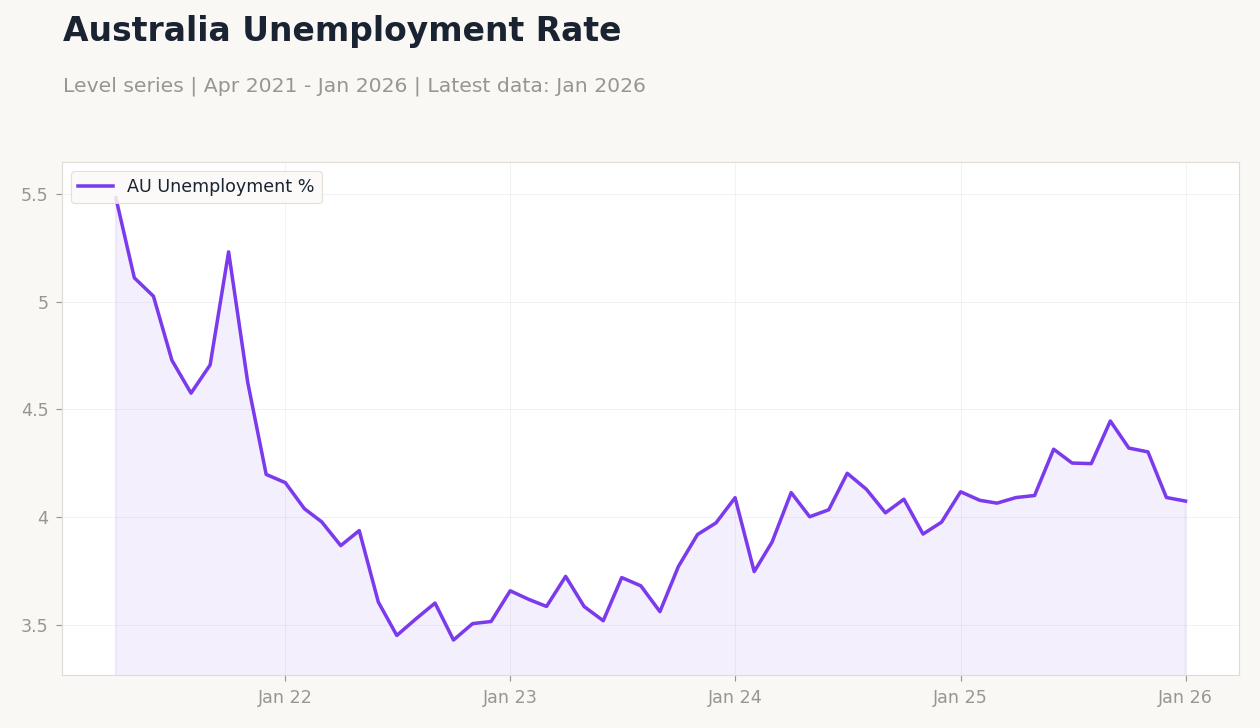
Australia Unemployment Rate | Type: macro_line | AU Unemployment %: 4.075 (2026-01-01) | Range: 3.431–5.482 | Trend(6pt): 5.482,3.607,3.683,4.084,4.092,4.075
Brent Crude Futures | Type: market_hloc | Brent Crude: 105.3 (2026-03-27) | Range: 59.96–112.2 | Trend(6pt): 61.94,65.24,69.4,85.41,108,105.3
ASX 200 Index | Type: market_hloc | ASX 200: 8516 (2026-03-27) | Range: 8366–9199 | Trend(6pt): 8726,8816,9015,8901,8558,8516
Australia's economy faces billions in losses from the US-Iran war, with petrol prices soaring to near A$2.20 per liter, exacerbating cost-of-living pressures and potentially curbing discretionary spending. New Zealand's dairy-driven exports offer some buffer, but tourism and construction sectors remain vulnerable to global risk aversion. Broader themes include persistent inflation in Australia, even before the oil shock, underscoring commodity dependence and China trade risks.
Housing markets in both countries link closely to rate paths, with former RBA insiders noting past decisions influenced by property prices.
The US-Iran war continues to disrupt global energy supplies, sending Brent crude volatility higher and impacting ANZ as major commodity exporters, with Australia's LNG and coal trades at risk from Middle East instability. Euro and yen gains against the USD, following steady central bank rates, have indirectly pressured AUD and NZD lower amid safe-haven flows. India's Sensex jumped 0.75% to 76,070.84 on March 17, but ANZ markets contrast with declines, highlighting regional divergence driven by geopolitical risks over domestic data.
China's steel production cuts signal weakening demand, a critical drag for Australia's iron ore exports, which comprise a significant revenue share. Gold's rally to 4,524.30 provides a hedge for ANZ miners like BHP, yet overall risk-off sentiment from the conflict has led to AUD/USD slipping to around 0.6980. NZD/USD backslid to near 0.5900, erasing recent gains ahead of US jobs data, as global uncertainty builds.
These dynamics underscore China's growth outlook as the pivotal external driver for ANZ, with potential PMI data to watch for restocking signals.
The RBA narrowly voted to lift interest rates in its latest decision, adding pressure on mortgages amid surging fuel prices from the Middle East war, with the cash rate at 3.83% as of February 1. This hike reflects elevated inflation persisting even before the Iran oil shock, and upcoming minutes may reveal discussions on housing market influences, as former insiders suggest property prices have factored into past decisions. In contrast, the RBNZ has shown historical aggressiveness in rate adjustments, though recent stability contrasts with RBA's move, potentially widening divergence in policy paths.
Both central banks target inflation independently, with RBNZ's framework more responsive to dairy and export dynamics, while RBA focuses on commodity and China linkages. Employment data implications remain key, as resilient Australian consumer spending could prompt further RBA tightening, whereas New Zealand's GDP contraction signals caution. Housing linkages are critical, with rate hikes risking slowdowns in both markets, but RBNZ's past boldness may lead to quicker pivots if global risks ease.