ASEAN Macro Daily(Beta Mode)
Oil Shock Fuels ASEAN CB Alert
Market Snapshot
| Asset | Level | Change |
|---|---|---|
| JCI | 7,362.12 | -0.37% |
| SET | 1,429.80 | +1.60% |
| KLCI | 1,711.01 | +0.13% |
| PSEi | 6,113.58 | -0.73% |
| STI | 4,855.33 | -0.17% |
| USD/IDR | 16,856.00 | +0.02% |
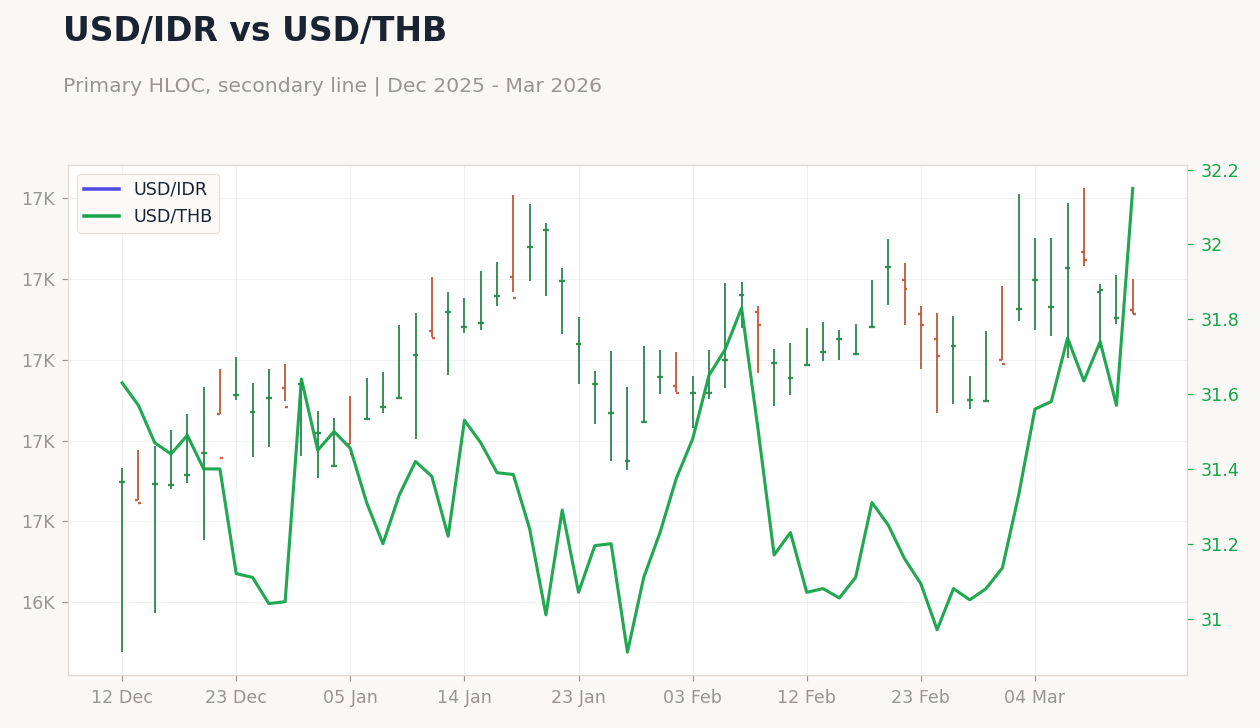
| USD/THB | 32.14 | +1.81% |
| USD/MYR | 3.92 | +0.06% |
| USD/PHP | 59.39 | +2.46% |
| USD/SGD | 1.28 | +0.42% |
| Brent Crude | 97.28 | +5.76% |
| Gold | 5,084.10 | -1.61% |
| Bitcoin | 70,257.24 | +0.07% |
| Indonesia 10Y Govt Yield | - | - |
| Thailand 10Y Govt Yield | - | - |
Prior Economic Events
| Data | Prior | Cons | Actual |
|---|---|---|---|
| No events available | |||
 USD/PHP vs USD/THB | Type: market_hloc | USD/PHP: 59.39 (2026-03-12) | Range: 57.53–59.49 | Trend(6pt): 58.78,59.11,59.04,57.9,59.14,59.39 | USD/THB: 32.15 (2026-03-12) | Range: 30.91–32.15 | Trend(6pt): 31.63,31.31,31.2,31.11,31.74,32.15
Today's Economic Events
| Data | Prior | Cons | Time |
|---|---|---|---|
| Headline Unemployment Rate | 4.40 | - | 17:00 |
| Central Bank Interest Rate Decision | 4.75 | - | 03:30 |
| Inflation Rate Month-over-Month | 0.10 | - | 00:00 |
| Inflation Rate Year-over-Year | 1.60 | - | 00:00 |
- ASEAN equities mixed amid oil surge; TH SET gains 1.60% on BoT rate cut afterglow, while PH PSEi slips 0.73%.
- Currencies weaken vs USD; PHP down 2.46%, THB 1.81%, as Brent crude jumps 5.76% on Middle East tensions.
- Central banks on watch: BoT surprises with cut, BNM holds amid inflation risks, BI decision looms.
Yesterday's Recap
ASEAN markets showed mixed performance on March 11 with no major data releases, as investors grappled with escalating oil prices from the Middle East conflict. Indonesia's JCI index closed at 7,362.12, down 0.37%, pressured by rupiah stability concerns despite commodity strength, while the USD/IDR edged up 0.02% to 16,856.00. Thailand's SET index bucked the trend, rising 1.60% to 1,429.80, buoyed by the Bank of Thailand's recent surprise rate cut to support recovery amid tariff uncertainties, though USD/THB climbed 1.81% to 32.14.
Malaysia's KLCI gained a modest 0.13% to 1,711.01, supported by palm oil export resilience, with USD/MYR up 0.06% to 3.92. The Philippines' PSEi fell 0.73% to 6,113.58 on fiscal strain from oil shocks, as USD/PHP surged 2.46% to 59.39, while Singapore's STI dipped 0.17% to 4,855.33 despite crossing the 5,000 mark recently, with USD/SGD up 0.42% to 1.28. Broader regional sentiment was dented by global energy volatility, with Brent crude soaring 5.76% to 97.28.
The Day Ahead
Today's calendar features the Philippines' headline unemployment rate release at 17:00 ET, with the previous reading at 4.4%, offering insights into labor market resilience amid remittance-dependent growth and oil-induced inflation. Looking further, Indonesia's central bank interest rate decision is slated for March 17 at 03:30 ET, where BI may hold or adjust from the prior 4.75% to defend the rupiah against capital outflows. Malaysia's inflation data, both month-over-month and year-over-year, arrives on March 19 at 00:00 ET, with previous figures at 0.1% and 1.6% respectively, critical for assessing BNM's policy path amid Middle East risks.
No immediate events for Thailand, Singapore, or Vietnam, but markets will monitor any spillover from global oil dynamics. Investors should watch for potential FX interventions across the region as currencies face pressure.
Other Economic Notes
The oil shock from the Middle East conflict is straining ASEAN's energy-importing economies, with countries like the Philippines and Thailand implementing measures such as fuel limits to mitigate supply disruptions and inflation. Supply chain shifts continue to benefit manufacturing hubs like Vietnam and Indonesia, where FDI inflows in electronics and commodities bolster resilience against global trade tensions. Broader themes include fiscal pressures on cash-strapped governments, as highlighted by Fitch's negative outlook downgrade for Indonesia, underscoring the need for prudent debt management amid rising borrowing costs.