ASEAN Macro Daily(Beta Mode)
ASEAN Stocks Tumble on Oil Surge
Market Snapshot
| Asset | Level | Change |
|---|---|---|
| JCI | 7,137.21 | -3.05% |
| SET | 1,409.35 | -1.43% |
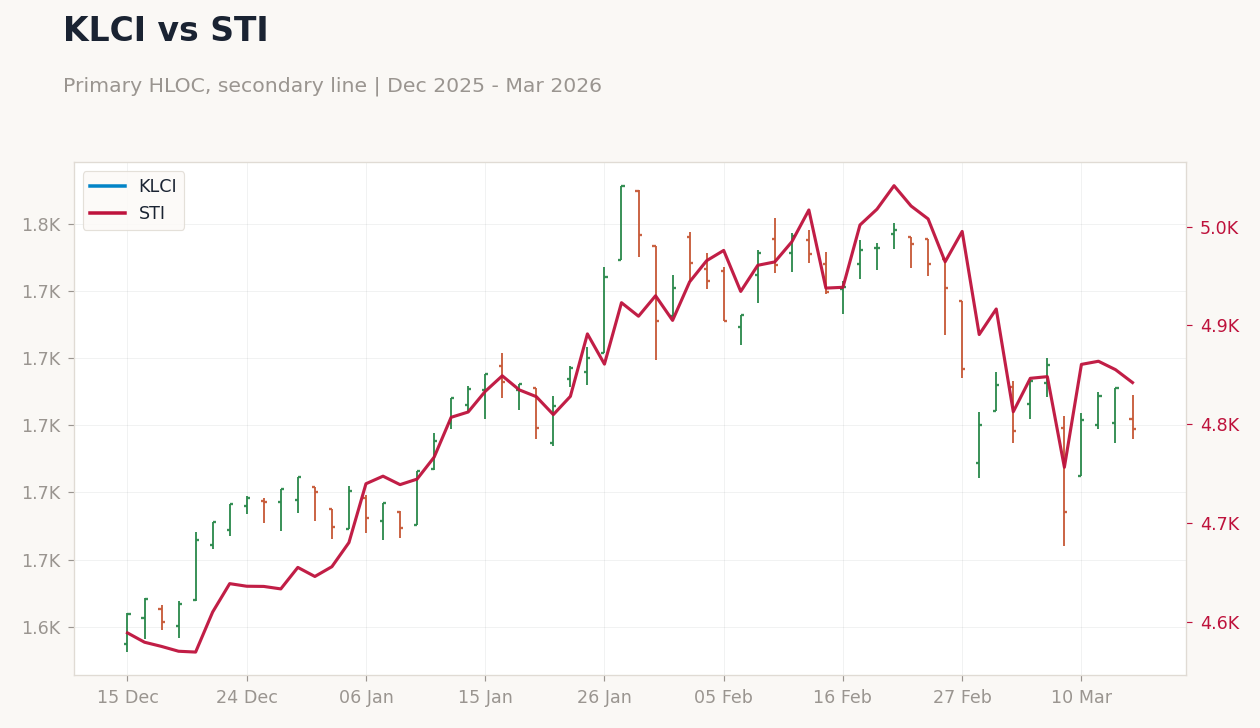
| KLCI | 1,698.85 | -0.71% |
| PSEi | 6,058.94 | -0.89% |
| STI | 4,842.27 | -0.27% |
| USD/IDR | 16,929.00 | +0.27% |
| USD/THB | 32.37 | +1.35% |
| USD/MYR | 3.94 | +0.57% |
| USD/PHP | 59.72 | +0.80% |
| USD/SGD | 1.28 | +0.37% |
| Brent Crude | 103.86 | +3.38% |
| Gold | 5,023.10 | -1.81% |
| Bitcoin | 70,755.20 | +0.37% |
| Indonesia 10Y Govt Yield | - | - |
| Thailand 10Y Govt Yield | - | - |
Prior Economic Events
| Data | Prior | Cons | Actual |
|---|---|---|---|
| Headline Unemployment Rate | 4.40 | - | 5.80 |
 Brent Crude Oil Price | Type: market_hloc | Brent Price (USD): 103.9 (2026-03-13) | Range: 58.92–103.9 | Trend(5pt): 60.56,59.96,70.71,71.76,103.9
Today's Economic Events
| Data | Prior | Cons | Time |
|---|---|---|---|
| Central Bank Interest Rate Decision | 4.75 | - | 03:30 |
| Inflation Rate Month-over-Month | 0.10 | - | 00:00 |
| Inflation Rate Year-over-Year | 1.60 | - | 00:00 |
- Philippines unemployment rate rose to 5.8% in February, up from 4.4%, amid service sector strains and remittance slowdowns.
- ASEAN equities declined sharply, led by Indonesia's JCI down 3.05% to 7,137.21, as rupiah weakened on Middle East tensions and oil price spikes.
- Regional currencies depreciated against USD, with Brent crude up 3.38% to $103.86, pressuring import-heavy economies like Thailand and Philippines.
Yesterday's Recap
ASEAN markets experienced widespread declines on March 12 amid Middle East conflicts boosting oil prices and weakening regional currencies. In the Philippines, the headline unemployment rate climbed to 5.8% from 4.4%, highlighting labor market pressures from reduced remittances and global uncertainties, contributing to the PSEi falling 0.89% to 6,058.94. Indonesia's JCI dropped 3.05% to 7,137.21, driven by rupiah depreciation of 0.27% to 16,929 per USD, as rising oil costs strained imports and hit commodity stocks.
Thailand's SET declined 1.43% to 1,409.35, with the baht weakening 1.35% to 32.37 per USD, exacerbated by tourism disruptions stranding over 40,000 visitors due to flight issues from regional instability. Malaysia's KLCI fell 0.71% to 1,698.85, with the ringgit down 0.57% to 3.94 per USD, though its oil exporter role offered some buffer. Singapore's STI decreased 0.27% to 4,842.27, as the SGD depreciated 0.37% to 1.28 per USD.
Broader sentiment reflected FX volatility and energy shocks, with Brent crude rising 3.38% to $103.86, gold falling 1.81% to $5,023.10, and Bitcoin edging up 0.37% to $70,755.20.
The Day Ahead
No economic releases are scheduled for March 13 or 14. Key upcoming events include Bank Indonesia's interest rate decision on March 17, with a Reuters poll anticipating a hold at 4.75% to support the rupiah against oil-driven pressures and Middle East impacts. Malaysia's February inflation data, due March 19, will show month-over-month and year-over-year rates, following previous figures of 0.1% and 1.6%, potentially guiding Bank Negara Malaysia's policy.
Markets will monitor US trade probes into Indonesia and Thailand, with hearings set for May 5, alongside reports of resilient foreign inflows in Indonesia despite currency strains. Attention remains on global oil dynamics and their effects on ASEAN fiscal balances.
Other Economic Notes
Brent crude's surge to $103.86 highlights ASEAN's mixed exposures, aiding Malaysia as an oil exporter via ringgit stability, while burdening net importers like Indonesia and Thailand with elevated import costs and budget strains nearing 3% GDP deficit caps. US trade investigations into Indonesia and Thailand pose risks to export sectors, possibly shifting supply chains toward Vietnam. (cont...)