| Asset | Level | Change |
|---|---|---|
| JCI | 7,106.84 | +1.20% |
| SET | 1,432.99 | +1.10% |
| KLCI | 1,720.71 | -0.53% |
| PSEi | 6,018.62 | -0.61% |
| STI | 4,948.87 | -0.38% |
| USD/IDR | 16,978.00 | +0.37% |
| USD/THB | 32.77 | +0.83% |
| USD/MYR | 3.94 | -0.01% |
| USD/PHP | 59.80 | +0.06% |
| USD/SGD | 1.28 | +0.35% |
| Brent Crude | 106.41 | -2.06% |
| Gold | 4,574.90 | -0.56% |
| Bitcoin | 67,799.59 | -1.33% |
| Indonesia 10Y Govt Yield | - | - |
| Thailand 10Y Govt Yield | - | - |
| Data | Prior | Cons | Actual |
|---|---|---|---|
| Central Bank Interest Rate Decision | 4.75 | 4.75 | 4.75 |
| Inflation Rate Month-over-Month | 0.10 | - | 0.20 |
| Inflation Rate Year-over-Year | 1.60 | 1.60 | 1.40 |
Indonesia Policy Rate | Type: macro_line | Indonesia Short-Term Rate %: 3.96 (2026-02-01) | Range: 2.79–6.3 | Trend(6pt): 2.79,2.79,5.62,6.17,4.13,3.96
| Data | Prior | Cons | Time |
|---|---|---|---|
| No events available | |||
Bank Indonesia (BI) held its key interest rate steady at 4.75% as expected, emphasizing rupiah defense amid global turmoil, including the Iran conflict, which could pressure commodity exports. BI clarified new rules on foreign currency transactions, while analysts expect rates to remain at 4.75% for longer, limiting rupiah gains. PT Bank Rakyat Indonesia prepared for a Lebaran 2026 surge with 1.2 million agents, boosting banking sector sentiment.
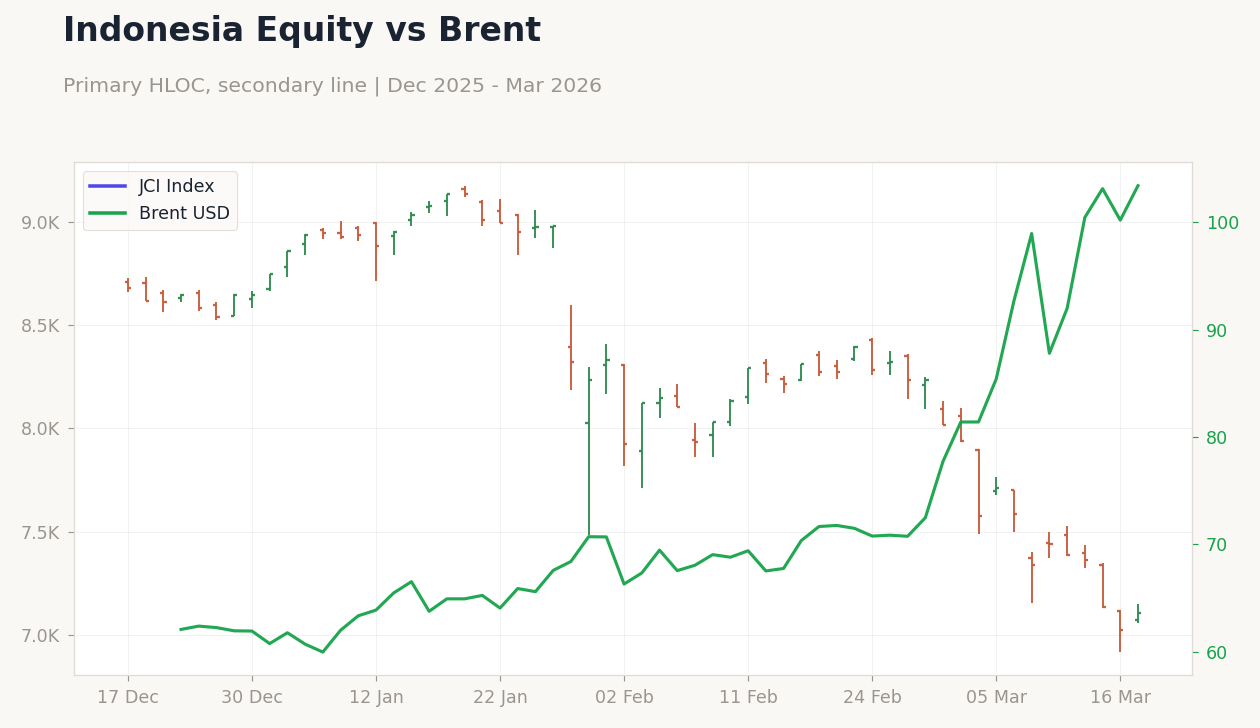
Indonesia eyes $5 billion in budget savings to cushion Iran war impacts. Malaysia reported softer-than-anticipated inflation, with February YoY CPI at 1.4% (down from 1.6% prior, below consensus of 1.6%) and MoM at 0.2% (up from 0.1%), reflecting easing food and energy costs in the manufacturing-heavy economy. Indonesia's JCI index rose 1.20% to 7,106.84, driven by banking sector strength ahead of Lebaran festivities, while Thailand's SET climbed 1.10% to 1,432.99 on tourism recovery hopes.
In contrast, Malaysia's KLCI fell 0.53% to 1,720.71 amid semiconductor headwinds, the Philippines' PSEi dropped 0.61% to 6,018.62 on remittance slowdown concerns, and Singapore's STI eased 0.38% to 4,948.87 as financials corrected. Currencies weakened broadly against the USD, with USD/IDR up 0.37% to 16,978.00 and USD/THB rising 0.83% to 32.77, USD/MYR nearly flat with a -0.01% change to 3.94, USD/PHP up 0.06% to 59.80, and USD/SGD up 0.35% to 1.28. Brent crude fell 2.06% to 106.41, gold dipped 0.56% to 4,574.90, and Bitcoin declined 1.33% to 67,799.59.
Vietnam saw no major data releases but benefited from ongoing FDI inflows in manufacturing, supporting its export growth narrative.
The ASEAN calendar remains light today with no major data releases or events scheduled across the six economies, allowing markets to digest yesterday's BI decision and Malaysia inflation figures. Investors will monitor global cues, particularly energy price volatility from the Iran war, which could influence commodity-dependent Indonesia and Malaysia. Tomorrow also features an empty slate, shifting focus to potential FX interventions by central banks like BI amid USD strength.
Attention may turn to Singapore's exchange rate band adjustments by MAS, though no immediate policy meeting is set. Broader sentiment could be swayed by any updates on US-China trade ties, given ASEAN's role in supply chain diversification. Overall, expect subdued trading volumes ahead of the weekend, with ringgit stability projected near 3.95 against the USD next week.
Subscribe to ASEAN Macro Daily and get each new issue delivered to your inbox.
Already a member? Visit robomacro.com to log in and manage subscriptions, or use Forgot Password to set a password.
Brent Crude Oil Prices | Type: macro_line | Brent Price USD/Barrel: 101 (2026-03-16) | Range: 59.93–133.2 | Trend(6pt): 59.96,118.5,96.11,73.52,102.4,101
USD/IDR vs USD/THB | Type: market_hloc | USD/IDR: 1.698e+04 (2026-03-22) | Range: 1.667e+04–1.704e+04 | Trend(5pt): 1.668e+04,1.685e+04,1.688e+04,1.68e+04,1.698e+04 | USD/THB: 32.91 (2026-03-22) | Range: 30.91–32.91 | Trend(5pt): 31.4,31.47,31.83,31.14,32.91
Thailand vs Singapore Equities | Type: market_hloc | SET Index: 1433 (2026-03-20) | Range: 1235–1534 | Trend(5pt): 1270,1276,1354,1528,1433 | STI Index: 4949 (2026-03-20) | Range: 4610–5041 | Trend(5pt): 4610,4813,4966,4995,4949
Indonesia Equity vs Brent | Type: market_hloc | JCI Index: 7107 (2026-03-17) | Range: 7022–9135 | Trend(6pt): 8677,8885,7923,8281,7022,7107 | Brent USD: 106.4 (2026-03-22) | Range: 59.96–112.2 | Trend(6pt): 62.07,66.52,67.55,72.48,112.2,106.4
ASEAN economies continue to leverage "China+1" supply chain shifts, with Vietnam attracting robust FDI in electronics and manufacturing, bolstering its position as the region's fastest-growing exporter. Indonesia's commodity-driven growth faces risks from global energy fluctuations, prompting budget savings measures to cushion Iran war impacts on fiscal stability. Regional tourism recovery in Thailand and remittance inflows to the Philippines provide buffers against external shocks, while Malaysia and Singapore emphasize tech and financial sectors for resilience.
The Philippines' Landbank reported digital transactions soaring to P4.4 trillion last year, highlighting improved digital adoption amid rising economic activity.
Global markets grappled with the Fed's decision to hold rates steady amid Iran conflict disruptions, heightening inflation risks from elevated energy costs that could spill over to ASEAN's import-dependent economies like Singapore and the Philippines. Brent crude fell 2.06% to 106.41, reflecting supply concerns, which may benefit Indonesia's oil exports but pressure Thailand's tourism fuel costs. Central banks worldwide, including the Bank of England urging straight talk on the UK economy and the ECB facing euro area balances, warned of prolonged high rates due to geopolitical tensions, potentially limiting capital inflows to emerging ASEAN markets.
Gold dipped 0.56% to 4,574.90 as a safe-haven asset, while Bitcoin declined 1.33% to 67,799.59 amid risk-off sentiment. The Irish central bank highlighted relative economic resilience to Iran risks, contrasting with broader European vulnerabilities that could redirect FDI toward stable ASEAN destinations. In Asia, Korea's central bank appointments signal policy continuity, indirectly supporting regional stability through trade linkages.
Brazil's economy projections to 2030 and Nigeria's CBN award for economic turnaround underscore global divergence, with ASEAN positioned for manufacturing gains amid stabilizing trade ties.
Bank Indonesia (BI) kept rates at 4.75%, with analysts expecting a prolonged hold to defend the rupiah amid limited gains and global turmoil, including FX intervention to manage capital outflows. Bank of Thailand (BoT) remains on watch for inflation dynamics, with no recent changes but potential easing if tourism rebounds further, though reserve adequacy supports baht stability. Bank Negara Malaysia (BNM) benefits from cooling inflation at 1.4% YoY, likely maintaining its neutral stance to balance growth in manufacturing while monitoring ringgit stability near 3.95 against the USD.
Bangko Sentral ng Pilipinas (BSP) focuses on remittance-driven inflation control, with adequate reserves allowing flexibility in peso management amid slight USD/PHP appreciation. (cont...)
The Monetary Authority of Singapore (MAS) continues to target exchange rate bands via the NEER for policy transmission, with recent USD/SGD moves at +0.35% prompting vigilance on imported inflation without direct rate tools. State Bank of Vietnam (SBV) emphasizes FX stability and capital flow management, intervening as needed to support dong amid strong FDI inflows, highlighting policy divergence from BI's aggressive rupiah defense. Overall, divergences persist, with commodity exporters like Indonesia adopting hawkish tones compared to manufacturing-focused Vietnam's growth-oriented approach.