ASEAN Macro Daily(Beta Mode)
Rupiah Faces Mideast War Risks
Market Snapshot
| Asset | Level | Change |
|---|---|---|
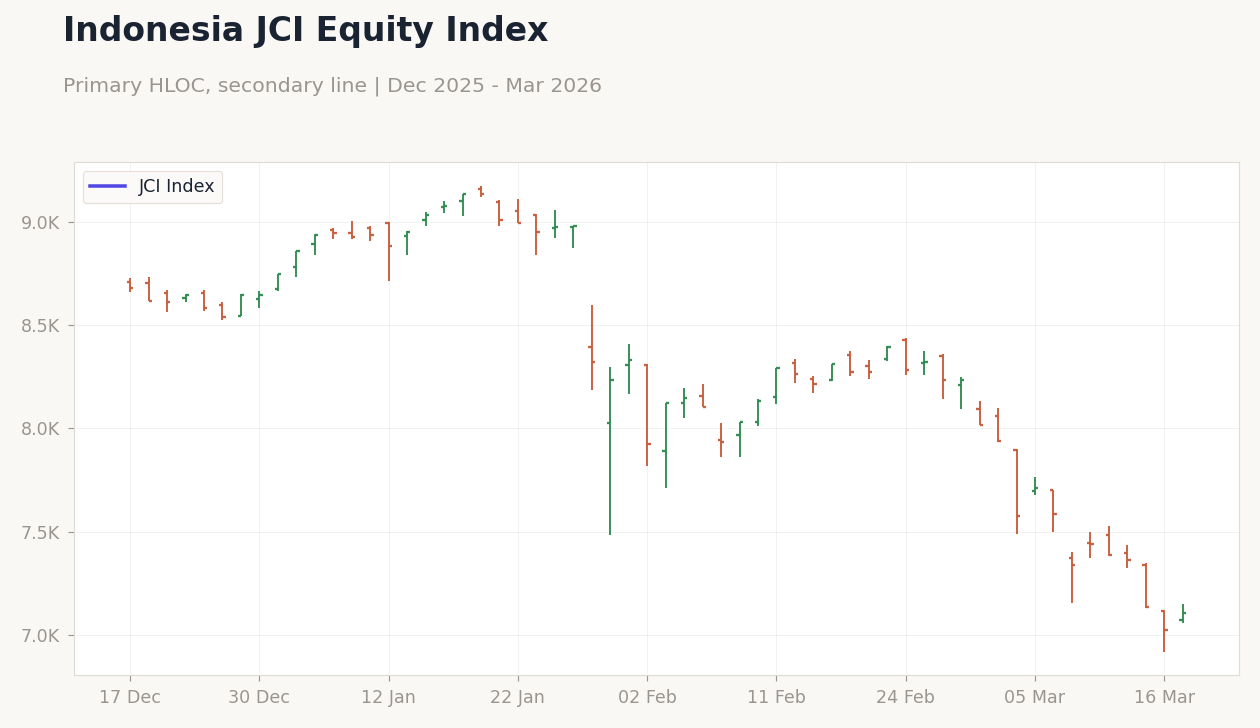
| JCI | 7,106.84 | +1.20% |
| SET | 1,421.81 | +1.75% |
| KLCI | 1,706.62 | -0.82% |
| PSEi | 5,928.27 | +0.49% |
| STI | 4,847.55 | +0.13% |
| USD/IDR | 16,977.00 | +0.10% |
| USD/THB | 32.88 | +1.18% |
| USD/MYR | 3.94 | +0.17% |
| USD/PHP | 60.01 | +0.94% |
| USD/SGD | 1.28 | -0.28% |
| Brent Crude | 103.90 | -7.39% |
| Gold | 4,359.80 | -4.61% |
| Bitcoin | 70,516.55 | +3.94% |
| Indonesia 10Y Govt Yield | - | - |
| Thailand 10Y Govt Yield | - | - |
Prior Economic Events
| Data | Prior | Cons | Actual |
|---|---|---|---|
| No events available | |||
 Brent Crude Oil Prices | Type: macro_line | Brent Price USD: 101 (2026-03-16) | Range: 59.93–133.2 | Trend(5pt): 61.21,114.5,93.7,74.3,101
Today's Economic Events
| Data | Prior | Cons | Time |
|---|---|---|---|
| No events available | |||
- Indonesian rupiah risks weakening to 20,000/USD amid Middle East conflicts, with BI signaling prolonged hold at 4.75% rate.
- Thai bond market hit by $1bn foreign outflows, pressuring baht as BoT vows volatility curbs and monitors war impacts.
- ASEAN equities mixed, Indonesia's JCI up 1.2% on commodity support, but Brent crude's 7.4% drop pressured regional sentiment.
Yesterday's Recap
ASEAN equity markets displayed mixed results amid currency fluctuations and commodity price shifts, with Indonesia's JCI rising 1.20% to 7,106.84, bolstered by resilient nickel and coal exports despite rupiah pressures. Thailand's SET gained 1.75% to 1,421.81, supported by tourism recovery indicators, though bond market outflows signaled investor wariness. Malaysia's KLCI fell 0.82% to 1,706.62, affected by palm oil price weakness tied to declining Brent crude.
The Philippines' PSEi increased 0.49% to 5,928.27, aided by remittance inflows, while Singapore's STI advanced 0.13% to 4,847.55 as a financial center. Currency dynamics showed USD strength, with USD/IDR up 0.10% to 16,977.00 and USD/THB climbing 1.18% to 32.88, highlighting potential intervention requirements. USD/MYR rose 0.17% to 3.94, USD/PHP gained 0.94% to 60.01, and USD/SGD dipped 0.28% to 1.28.
No significant economic data releases were reported, but Indonesia's January government spending surged 26% year-on-year, underscoring fiscal efforts to mitigate external risks.
The Day Ahead
No major economic data releases are scheduled across ASEAN, shifting focus to possible central bank statements on currency stability, especially from BI regarding rupiah depreciation concerns. Thailand's BoT could update on baht management strategies after recent bond outflows and warnings of growth shortfalls due to war effects. Markets may track global energy price follow-through, as Brent crude's recent decline could alleviate inflation in import-reliant nations like the Philippines and Singapore.
Potential informal remarks on Middle East tensions' trade implications might influence Malaysia's export outlook. Singapore's MAS could hint at nominal effective exchange rate adjustments if SGD momentum shifts against the USD.
Other Economic Notes
ASEAN economies exhibit exposure to geopolitical uncertainties, with Indonesia targeting $4.7 billion in budget savings to offset Middle East war effects on fuel costs and imports. Thailand faces bond market instability with $1 billion in outflows, revealing risks behind baht strength despite tourism gains. Indonesia's QRIS payment system expansion across APEC supports business connectivity, potentially boosting cross-border trade.
(cont...)