ASEAN Macro Daily(Beta Mode)
PH Inflation Surges, Rupiah Weakens
Market Snapshot
| Asset | Level | Change |
|---|---|---|
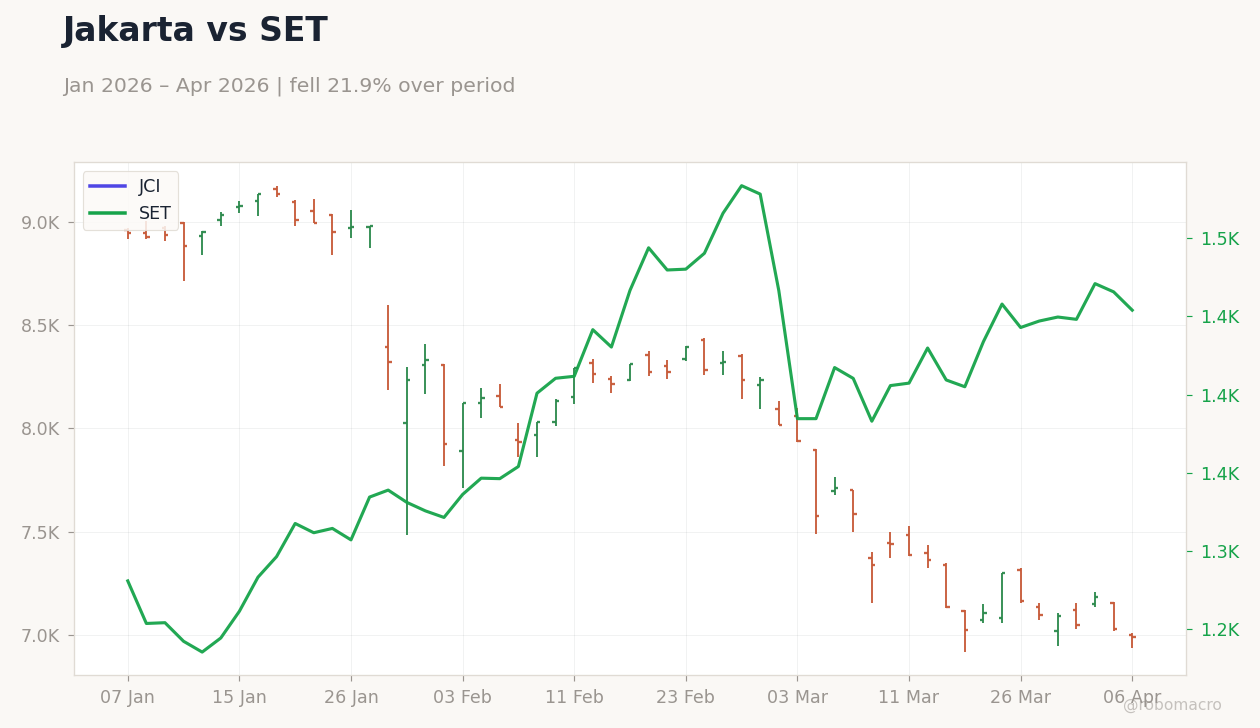
| JCI | 6,989.43 | -0.53% |
| SET | 1,454.00 | -0.80% |
| KLCI | 1,680.83 | -0.87% |
| PSEi | 5,948.33 | -0.84% |
| STI | 4,972.40 | +0.50% |
| USD/IDR | 17,087.00 | +0.58% |
| USD/THB | 32.40 | -0.89% |
| USD/MYR | 4.03 | -0.01% |
| USD/PHP | 60.20 | -0.02% |
| USD/SGD | 1.28 | -0.54% |
| Brent Crude | 105.47 | -3.92% |
| Gold | 4,733.30 | +1.64% |
| Bitcoin | 70,076.41 | +1.77% |
| Indonesia 10Y Govt Yield | - | - |
| Thailand 10Y Govt Yield | - | - |
Prior Economic Events
| Data | Prior | Cons | Actual |
|---|---|---|---|
| Inflation Rate Year-over-Year | 2.40 | 3.60 | 4.10 |
 Brent Crude Oil Prices | Type: market_hloc | Brent Crude: 103.5 (2026-04-07) | Range: 59.96–118.3 | Trend(6pt): 59.96,70.71,71.76,103.1,109.8,103.5
Today's Economic Events
| Data | Prior | Cons | Time |
|---|---|---|---|
| Headline Unemployment Rate | 5.80 | - | 17:00 |
- Philippines inflation rose to 4.1% YoY, beating consensus of 3.6% amid oil price pressures from Middle East tensions.
- Indonesian rupiah hit record lows at 17,087 versus USD, with Bank Indonesia intervening to prioritize stability.
- ASEAN stocks mostly fell, led by KLCI and PSEi declines, while STI gained on financial strength; Brent crude dropped sharply.
Yesterday's Recap
Philippines led regional news with inflation climbing to 4.1% YoY, exceeding the 3.6% consensus and prior 2.4%, fueled by elevated fuel and food prices from global oil disruptions. Indonesia's rupiah weakened 0.58% to 17,087 against the USD, reaching record lows due to Middle East conflicts, strong dollar, and energy risks, prompting Bank Indonesia to emphasize stability through market interventions. Equity markets were mostly down: Indonesia's JCI closed at 6,989.43 (-0.53%) amid commodity fluctuations, Thailand's SET at 1,454.00 (-0.80%) on oil-related tourism concerns, Malaysia's KLCI at 1,680.83 (-0.87%) from export pressures, and Philippines' PSEi at 5,948.33 (-0.84%) reflecting inflation worries.
Singapore's STI bucked the trend, rising 0.50% to 4,972.40 supported by financials. FX trends showed USD gains against most pairs: USD/THB fell 0.89% to 32.40 (THB strength), USD/MYR edged to 4.03 (-0.01%), USD/PHP to 60.20 (-0.02%), and USD/SGD to 1.28 (-0.54%). Indonesia operationalized cross-border QRIS payments with South Korea, boosting trade efficiency.
Malaysia's ringgit opened higher against majors, aiding stability.
The Day Ahead
Philippines headlines with headline unemployment rate release at 17:00 ET, following previous 5.8% and lacking consensus, which could underscore labor market strength despite inflation. Attention may turn to oil volatility impacts on energy importers like Thailand and Malaysia. Indonesia's rupiah could see reactions to ongoing Bank Indonesia interventions and QRIS payment rollout with South Korea.
Malaysia Airlines' push for Kuala Lumpur as a regional hub may highlight aviation competition with Singapore and Bangkok. No major events elsewhere, with focus on spillovers from Philippines inflation data and global energy risks.
Other Economic Notes
ASEAN economies navigate oil shocks, with Philippines projected as the region's second-fastest grower despite pressures, and Thailand's inflation nearing positive territory from higher costs. Indonesia's first-quarter budget deficit widened to $14 billion as spending outpaced revenue, while airfare tax cuts aim to offset fuel surcharge hikes. Cross-border initiatives advance, including Indonesia-South Korea QRIS payments for seamless transactions.
(cont...)