ASEAN Macro Daily(Beta Mode)
Rupiah Weakens Amid Growth Cuts
Market Snapshot
| Asset | Level | Change |
|---|---|---|
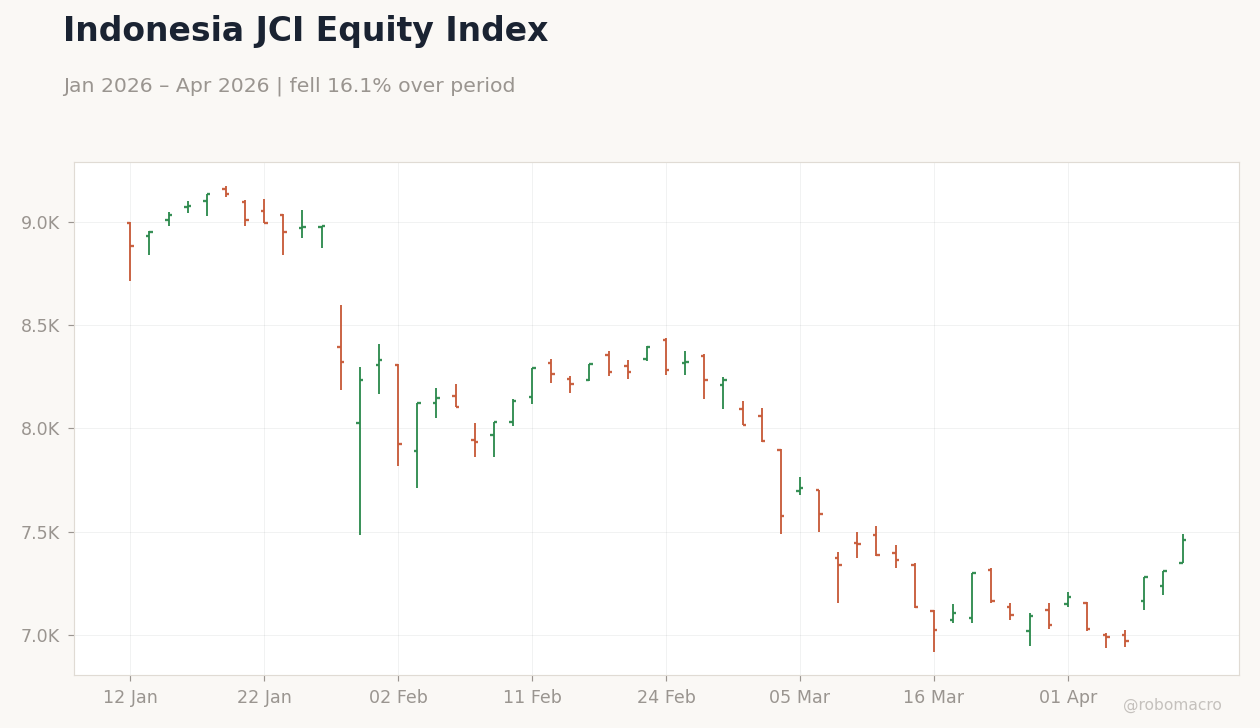
| JCI | 7,458.50 | +2.07% |
| SET | 1,506.84 | +1.15% |
| KLCI | 1,691.31 | +0.30% |
| PSEi | 6,098.21 | +0.14% |
| STI | 4,989.41 | +0.25% |
| USD/IDR | 17,090.00 | +0.18% |
| USD/THB | 31.98 | -0.28% |
| USD/MYR | 3.96 | -0.45% |
| USD/PHP | 59.97 | +0.53% |
| USD/SGD | 1.27 | +0.00% |
| Brent Crude | 95.20 | -0.75% |
| Gold | 4,761.90 | -0.63% |
| Bitcoin | 73,671.12 | +0.95% |
| Indonesia 10Y Govt Yield | - | - |
| Thailand 10Y Govt Yield | - | - |
Prior Economic Events
| Data | Prior | Cons | Actual |
|---|---|---|---|
| No events available | |||
 USD/IDR Currency Pair | Type: market_hloc | USD/IDR Rate: 1.709e+04 (2026-04-11) | Range: 1.667e+04–1.709e+04 | Trend(6pt): 1.683e+04,1.676e+04,1.682e+04,1.704e+04,1.706e+04,1.709e+04
Today's Economic Events
| Data | Prior | Cons | Time |
|---|---|---|---|
| GDP Growth Quarter-over-Quarter Advance Estimate | 2.10 | - | 20:00 |
| Inflation Rate Month-over-Month | 0.20 | - | 00:00 |
| Inflation Rate Year-over-Year | 1.40 | - | 00:00 |
- Indonesian rupiah slid to 17,090/USD, pressuring BI to tighten USD access as consumer confidence dipped and job availability declined.
- ASEAN equities rose modestly, led by Indonesia's JCI (+2.07%) on commodity strength, while Thailand's SET gained 1.15% despite economic warnings.
- Malaysia's growth outlook upgraded to 4.6% by ADB, contrasting World Bank's 4.7% cut for Indonesia amid oil shocks and wage stagnation.
Yesterday's Recap
ASEAN markets showed resilience yesterday with equities advancing across the board, driven by commodity gains in Indonesia where the JCI climbed 2.07% to 7,458.50 amid rupiah weakness to 17,090/USD (+0.18%). Thailand's SET rose 1.15% to 1,506.84, buoyed by potential investment reforms despite finance minister warnings of limited economic options and high diesel costs impacting fishing. Malaysia's KLCI edged up 0.30% to 1,691.31, supported by positive growth projections from the Asian Development Bank at 4.6% for 2026.
The Philippines' PSEi increased 0.14% to 6,098.21, though oil shock risks were highlighted as deepening economic vulnerabilities. Singapore's STI gained 0.25% to 4,989.41, with flat USD/SGD at 1.27 reflecting stable financial hub dynamics. Vietnam was not prominently featured in moves, but regional FX pressures saw USD/THB dip 0.28% to 31.98 and USD/MYR fall 0.45% to 3.96, contrasting USD/PHP's 0.53% rise to 59.97.
No major data releases occurred, but news focused on Indonesia's declining job index and rupiah impacts on households.
The Day Ahead
Upcoming ASEAN events include Singapore's advance GDP growth estimate for Q1, set for release on April 13 at 20:00 ET, with previous quarter-over-quarter at 2.1% and no consensus yet, potentially influencing MAS exchange rate policy. Malaysia's inflation data follows on April 17 at 00:00 ET, covering month-over-month (previous 0.2%) and year-over-year (previous 1.4%) figures, which could affect BNM's rate stance amid wage stagnation concerns. No immediate releases today or tomorrow, allowing markets to digest recent rupiah pressures and global oil dynamics.
Investors will watch for any BI interventions on USD/IDR, given ongoing currency weakness. Thailand may see focus on finance ministry statements regarding energy crisis reforms. Overall, the light calendar shifts attention to broader themes like FDI flows and commodity prices.
Other Economic Notes
Broader ASEAN themes highlight supply chain shifts, with Vietnam benefiting from electronics FDI amid US-China rerouting, while Indonesia faces commodity export volatility offset by nickel demand. (cont...)