ASEAN Macro Daily(Beta Mode)
ID GDP Beats, PH CPI Surges
Market Snapshot
| Asset | Level | Change |
|---|---|---|
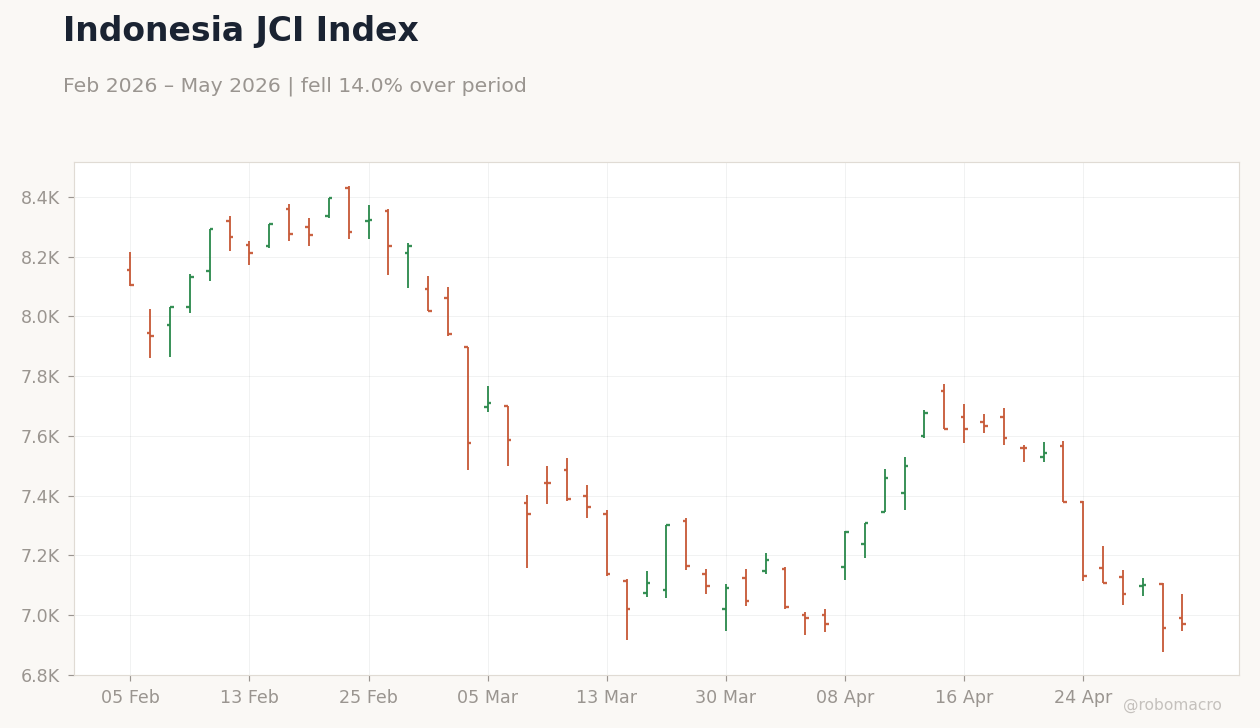
| JCI | 6,971.95 | +0.22% |
| SET | 1,493.69 | +0.13% |
| KLCI | 1,739.77 | +1.03% |
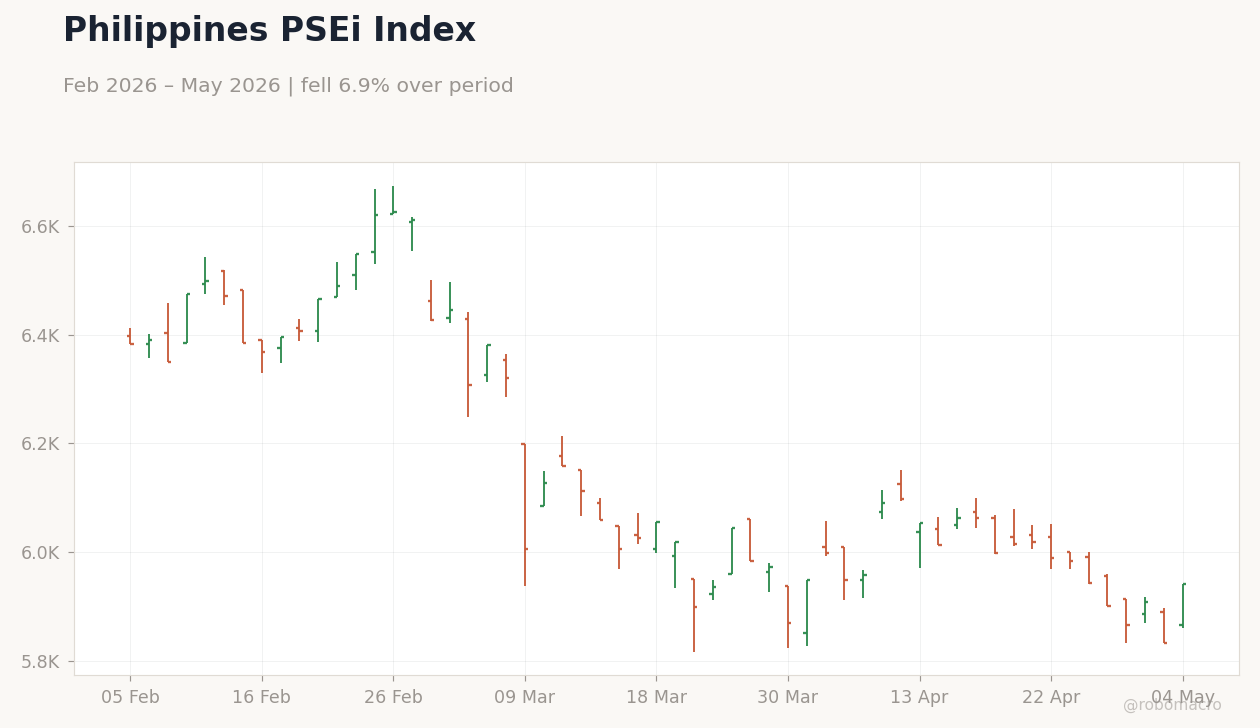
| PSEi | 5,942.16 | +1.86% |
| STI | 4,924.31 | +0.24% |
| USD/IDR | 17,420.00 | +0.76% |
| USD/THB | 32.53 | +0.15% |
| USD/MYR | 3.96 | -0.19% |
| USD/PHP | 61.37 | -0.45% |
| USD/SGD | 1.28 | +0.18% |
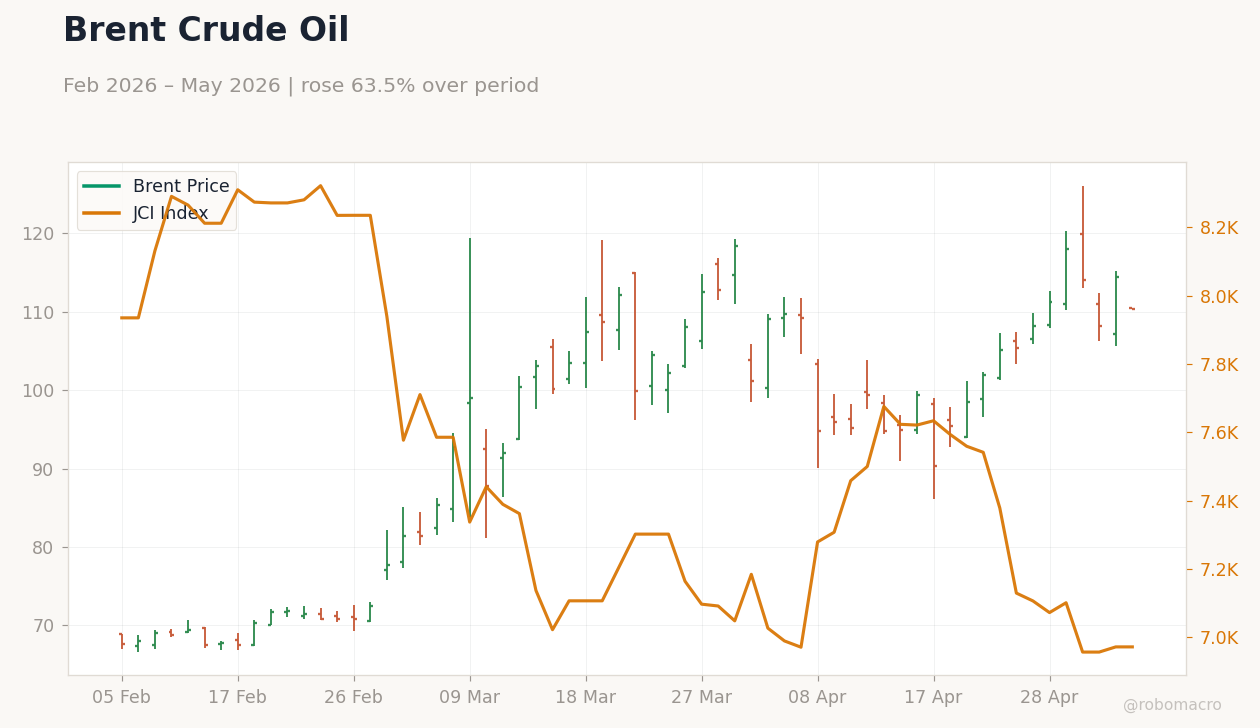
| Brent Crude | 110.50 | -3.44% |
| Gold | 4,567.80 | +1.07% |
| Bitcoin | 81,452.47 | +2.04% |
| Indonesia 10Y Govt Yield | - | - |
| Thailand 10Y Govt Yield | - | - |
Prior Economic Events
| Data | Prior | Cons | Actual |
|---|---|---|---|
| Inflation Rate Year-over-Year | 3.48 | - | 2.42 |
| Trade Balance | 1,280m | - | 3,320m |
| Inflation Rate Year-over-Year | 4.10 | 5.50 | 7.20 |
| GDP Growth Year-over-Year | 5.39 | 5.30 | 5.61 |
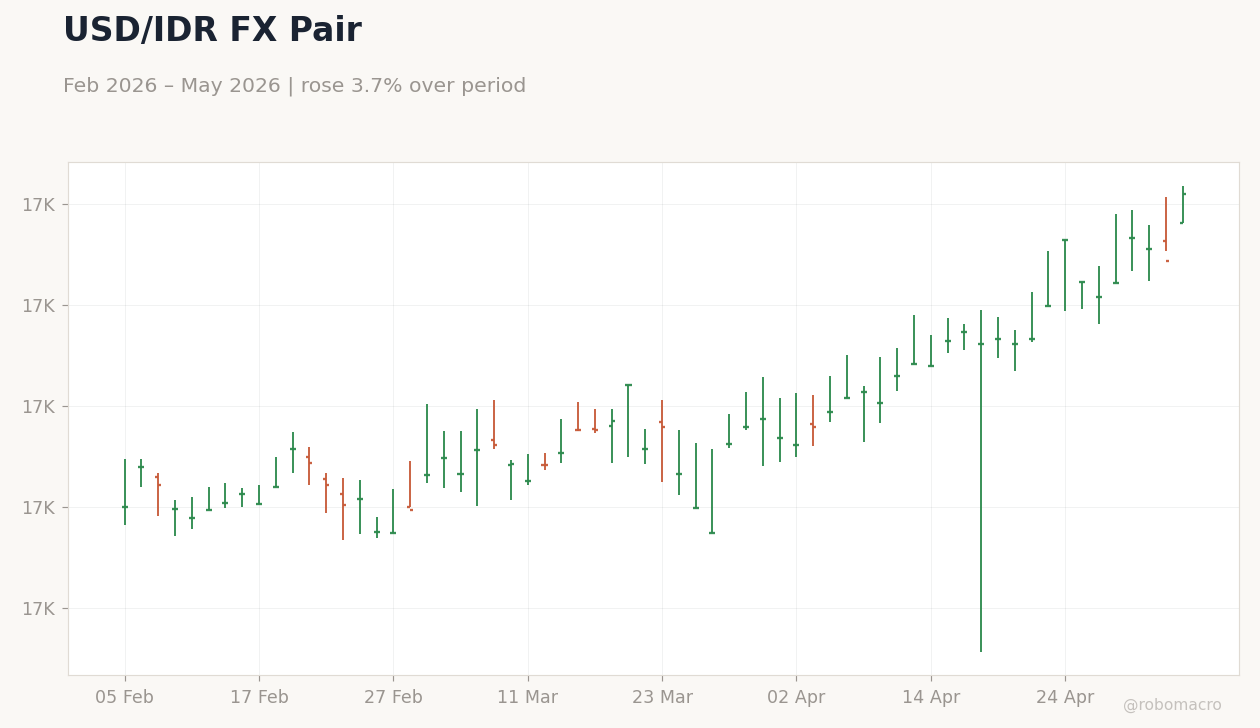 USD/IDR FX Pair | Type: market_hloc | USD/IDR Rate: 1.742e+04 (2026-05-05) | Range: 1.675e+04–1.742e+04 | Trend(5pt): 1.68e+04,1.675e+04,1.696e+04,1.708e+04,1.742e+04
Today's Economic Events
| Data | Prior | Cons | Time |
|---|---|---|---|
| Headline Unemployment Rate | 5.10 | - | 17:00 |
| GDP Growth Quarter-over-Quarter | 0.60 | - | 18:00 |
| GDP Growth Year-over-Year | 3 | 3.70 | 18:00 |
- Indonesia's Q1 GDP growth exceeded expectations at 5.61% YoY, while inflation eased to 2.42% YoY, supporting rupiah stabilization efforts amid BI interventions.
- Philippines inflation jumped to 7.2% YoY, far above consensus, pressuring BSP to maintain tight policy amid remittance-driven demand.
- ASEAN equities rose modestly, led by Philippines' PSEi up 1.86%, while rupiah weakened 0.76% versus USD on global risk aversion.
Yesterday's Recap
Indonesia dominated headlines with Q1 GDP growth accelerating to 5.61% YoY, beating consensus of 5.3% and previous 5.39%, driven by robust commodity exports and domestic consumption in the region's largest economy. Indonesian inflation cooled sharply to 2.42% YoY from 3.48%, aided by stable food prices, while the trade surplus widened to $3.32 billion from $1.28 billion, bolstered by nickel and palm oil shipments. In the Philippines, inflation surged to 7.2% YoY, exceeding consensus of 5.5% and prior 4.1%, fueled by rising food and energy costs in the remittance-dependent economy.
ASEAN equity markets closed higher overall, with Philippines' PSEi gaining 1.86% to 5,942.16 on bargain hunting, Malaysia's KLCI up 1.03% to 1,739.77 on palm oil strength, and Indonesia's JCI edging 0.22% to 6,971.95 amid GDP optimism. Thailand's SET rose 0.13% to 1,493.69, and Singapore's STI advanced 0.24% to 4,924.31, supported by financials. Currencies were mixed against a firmer USD, as USD/IDR rose 0.76% to 17,420 reflecting depreciation pressures, while USD/PHP fell 0.45% to 61.37 on inflation data digestion.
USD/THB increased 0.15% to 32.53, USD/MYR declined 0.19% to 3.96, and USD/SGD rose 0.18% to 1.28. Brent crude dropped 3.44% to $110.50, pressuring commodity exporters like Indonesia and Malaysia, while gold rose 1.07% to $4,567.80 and Bitcoin gained 2.04% to $81,452.47.
The Day Ahead
Philippines will release its headline unemployment rate today at 17:00 ET, with previous at 5.1%, offering insights into labor market resilience amid high inflation. Tomorrow brings Philippines Q1 GDP growth data at 18:00 ET, with YoY consensus at 3.7% versus prior 3%, and QoQ previous at 0.6%, potentially influencing BSP's rate path. No major releases are scheduled for Indonesia, Thailand, Malaysia, Singapore, or Vietnam today, allowing focus on global cues like Middle East tensions.
Investors will monitor any BI statements on rupiah defense following recent interventions. Regional markets may react to ongoing China stimulus talks, impacting export outlooks.
Other Economic Notes
Rupiah depreciation continues to align with emerging market trends, prompting Indonesia to leverage currency swaps with China and tighten dollar-buying rules to bolster reserves. (cont...)