ASEAN Macro Daily(Beta Mode)
Rupiah Hits Record Low as BI Tightens FX Rules
Market Snapshot
| Asset | Level | Change |
|---|---|---|
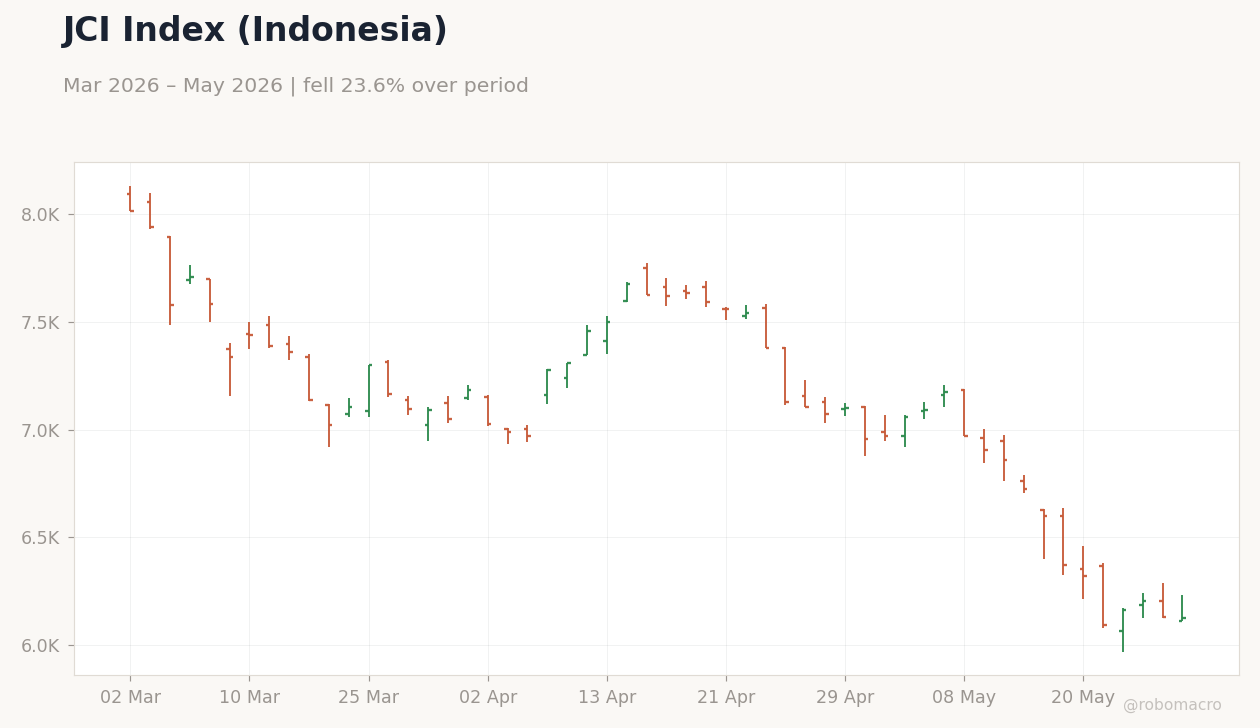
| JCI | 6,127.38 | -0.05% |
| SET | 1,568.37 | -0.04% |
| KLCI | 1,683.07 | -0.11% |
| PSEi | 5,768.76 | -1.56% |
| STI | 5,037.86 | +0.98% |
| USD/IDR | 17,878.00 | +0.21% |
| USD/THB | 32.43 | -0.34% |
| USD/MYR | 3.96 | -0.32% |
| USD/PHP | 61.48 | +1.25% |
| USD/SGD | 1.28 | +0.04% |
| Brent Crude | 91.12 | -2.76% |
| Gold | 4,593.00 | +2.08% |
| Bitcoin | 73,660.97 | -0.13% |
| Indonesia 10Y Govt Yield | - | - |
| Thailand 10Y Govt Yield | - | - |
Prior Economic Events
| Data | Prior | Cons | Actual |
|---|---|---|---|
| No events available | |||
 USD/IDR Spot Rate | Type: market_hloc | IDR per USD: 1.788e+04 (2026-05-31) | Range: 1.675e+04–1.788e+04 | Trend(6pt): 1.68e+04,1.687e+04,1.713e+04,1.73e+04,1.784e+04,1.788e+04
Today's Economic Events
| Data | Prior | Cons | Time |
|---|---|---|---|
| Trade Balance | 3,320m | - | 00:00 |
| Inflation Rate Year-over-Year | 2.42 | - | 00:00 |
| Inflation Rate Year-over-Year | 7.20 | - | 21:00 |
- Indonesia’s rupiah hits fresh lows at 17,878 per USD amid BI dollar purchase curbs and global uncertainty.
- Thailand posts record $7.6bn current account deficit in April, raising dual deficit risks and baht pressure.
- Regional equities mixed with PSEi down 1.56% while STI rises 0.98%; Brent crude falls 2.76% to $91.12.
Yesterday's Recap
Indonesia dominated ASEAN moves as the rupiah weakened to a record 17,878 per USD, up 0.21%, prompting Bank Indonesia to tighten dollar purchase rules and cite global uncertainty. Stocks and bonds tumbled with JCI closing at 6,127.38, down 0.05%. Thailand reported a record $7.6bn current account deficit in April, driven by slowing growth and rising imports, sparking debate over longer-term baht weakness.
Malaysia’s official reserve assets rose to US$129.73bn at end-April. The Philippines saw USD/PHP climb 1.25% to 61.48 while Singapore’s STI gained 0.98% to 5,037.86. Brent crude dropped 2.76% to $91.12 and gold rose 2.08% to $4,593.
Vietnam and Malaysia showed limited moves outside reserve and FDI updates.
The Day Ahead
Indonesia will release May trade balance and inflation data on June 2, with consensus pointing to inflation near 2.97%. Philippines inflation for May prints on June 4, following the prior 7.2% reading. No central bank meetings are scheduled across the six ASEAN economies today.
Thailand’s bond auction and corporate earnings remain the only other items on the calendar. Markets will watch USD strength and oil price swings for spillover effects on regional FX.
Other Economic Notes
Indonesia’s squeezed middle class faces higher import costs from the weak rupiah, shifting consumption patterns. Thailand’s tourism recovery continues to offset part of the current account deterioration but cannot fully mask slowing domestic demand. Malaysia’s rising reserves provide a buffer against ringgit pressure yet fail to reverse structural outflows.
Broader ASEAN supply-chain shifts from China remain supportive for Vietnam and Malaysia manufacturing FDI.
Global Macro News
Persistent USD strength continues to pressure ASEAN currencies, especially the rupiah and peso. Brent crude’s 2.76% decline eases imported inflation risks for oil-dependent importers like Thailand and Philippines. Gold’s 2.08% rally signals ongoing safe-haven demand amid global uncertainty.
<i>↓ p.2</i>