ASEAN Macro Daily(Beta Mode)
Rupiah Slumps to Record Low as Officials Move
Market Snapshot
| Asset | Level | Change |
|---|---|---|
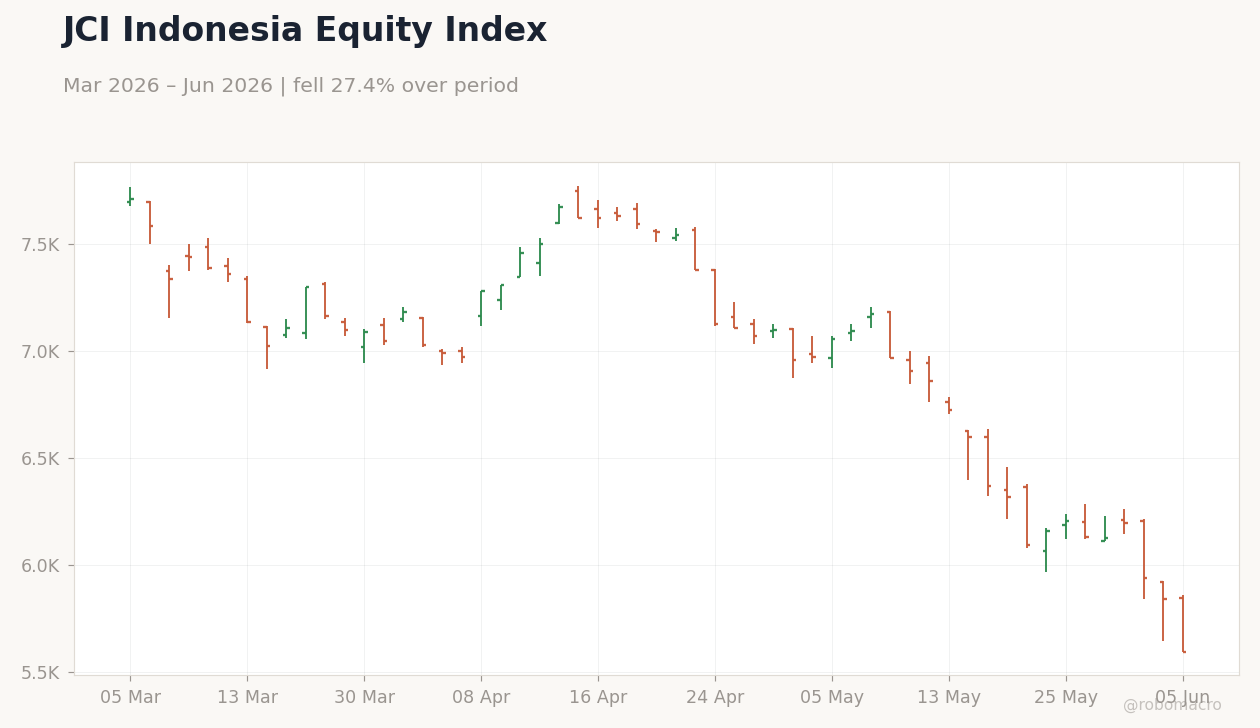
| JCI | 5,594.77 | -4.20% |
| SET | 1,582.60 | -0.76% |
| KLCI | 1,693.43 | +0.60% |
| PSEi | 5,938.38 | +0.45% |
| STI | 5,049.96 | -0.35% |
| USD/IDR | 18,035.00 | +0.44% |
| USD/THB | 32.79 | +0.51% |
| USD/MYR | 4.03 | +0.34% |
| USD/PHP | 61.72 | +0.60% |
| USD/SGD | 1.29 | +0.45% |
| Brent Crude | 93.09 | -2.04% |
| Gold | 4,365.30 | -2.47% |
| Bitcoin | 61,739.24 | +1.43% |
| Indonesia 10Y Govt Yield | - | - |
| Thailand 10Y Govt Yield | - | - |
Prior Economic Events
| Data | Prior | Cons | Actual |
|---|---|---|---|
| No events available | |||
 USD/IDR Exchange Rate | Type: market_hloc | USD per IDR: 1.804e+04 (2026-06-07) | Range: 1.675e+04–1.804e+04 | Trend(5pt): 1.686e+04,1.696e+04,1.713e+04,1.753e+04,1.804e+04
Today's Economic Events
| Data | Prior | Cons | Time |
|---|---|---|---|
| Headline Unemployment Rate | 5 | - | 21:00 |
- Indonesian rupiah weakens to record 18,035 versus USD amid capital outflow concerns, prompting coordinated BI-finance ministry measures to lift asset yields.
- Regional equities mixed with JCI falling 4.20% while KLCI and PSEi post modest gains; Brent crude drops 2.04% to 93.09.
- Philippines unemployment rate due tomorrow; Thailand inflation remains supply-driven, keeping BoT on hold.
Yesterday's Recap
Indonesian assets dominated moves as the rupiah slid to a fresh record low of 18,035 against the USD, up 0.44% on the day, driven by negative sentiment around policy shifts under the new administration. Officials from Bank Indonesia and the finance ministry agreed to boost yields on domestic assets to attract inflows and support the currency, while also pledging further stabilization steps including potential fund draws. JCI tumbled 4.20% to 5,594.77 on the broad risk-off tone.
Elsewhere, Thailand’s SET declined 0.76% to 1,582.60 and Singapore’s STI fell 0.35% to 5,049.96, while Malaysia’s KLCI rose 0.60% to 1,693.43 and the Philippines’ PSEi gained 0.45% to 5,938.38. USD/THB climbed 0.51% to 32.79 and USD/PHP rose 0.60% to 61.72. Gold fell 2.47% to 4,365.30 as Bitcoin advanced 1.43% to 61,739.24.
USD/MYR rose 0.34% to 4.03 and USD/SGD gained 0.45% to 1.29. Brent crude settled at 93.09 after a 2.04% decline.
The Day Ahead
Philippines will release its headline unemployment rate tomorrow evening, with the prior print at 5.0%. No other major data releases are scheduled across the six ASEAN economies. Markets will continue to monitor Indonesian authorities’ follow-through on rupiah-support measures announced yesterday.
Thailand’s supply-led inflation trajectory keeps focus on the BoT’s steady policy stance. Regional FX desks remain alert to any further IDR volatility after the record print.
Other Economic Notes
Indonesia’s commodity export base offers partial buffers, yet importer margins face acute pressure from sustained rupiah depreciation past 18,000. Supply-chain relocation momentum in Vietnam and Malaysia continues to support manufacturing FDI despite the regional risk-off mood. Singapore’s role as the financial hub amplifies transmission of USD strength into broader ASEAN funding costs.
Thailand’s tourism rebound provides an offset to soft domestic demand.
Global Macro News
Firmer US yields and persistent dollar strength weighed on EM currencies including ASEAN units. Bank of Canada signals point to a hold this week amid stagnant growth, limiting downside for commodity-linked ASEAN exports. <i>↓ p.2</i>