ASEAN Macro Daily(Beta Mode)
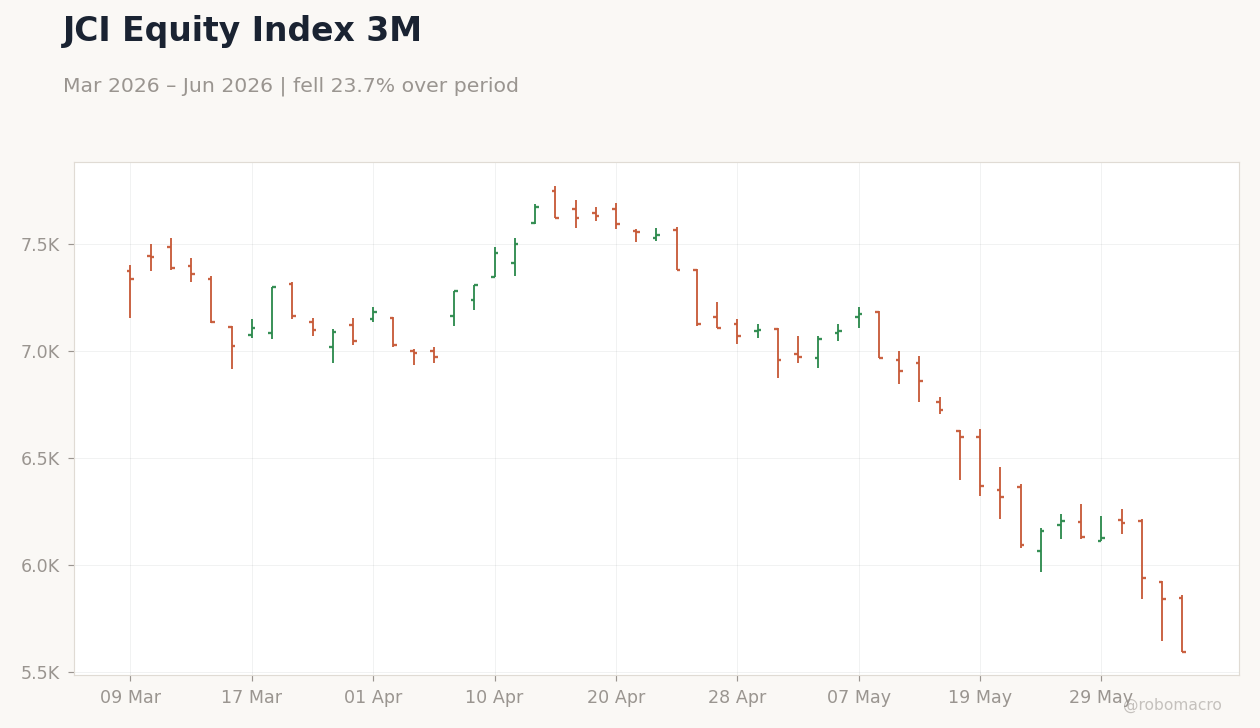
Rupiah Hits Record Low as JCI Falls 4.2%
Market Snapshot
| Asset | Level | Change |
|---|---|---|
| JCI | 5,594.77 | -4.20% |
| SET | 1,582.60 | -0.76% |
| KLCI | 1,693.43 | +0.60% |
| PSEi | 5,938.38 | +0.45% |
| STI | 5,049.96 | -0.35% |
| USD/IDR | 18,029.00 | +0.41% |
| USD/THB | 32.83 | -0.06% |
| USD/MYR | 4.05 | +0.87% |
| USD/PHP | 61.75 | +0.65% |
| USD/SGD | 1.29 | -0.18% |
| Brent Crude | 94.31 | +1.31% |
| Gold | 4,349.90 | +0.30% |
| Bitcoin | 63,421.36 | +0.29% |
| Indonesia 10Y Govt Yield | - | - |
| Thailand 10Y Govt Yield | - | - |
Prior Economic Events
| Data | Prior | Cons | Actual |
|---|---|---|---|
| No events available | |||
 USD/IDR 3M | Type: market_hloc | USD/IDR: 1.803e+04 (2026-06-08) | Range: 1.675e+04–1.803e+04 | Trend(6pt): 1.692e+04,1.698e+04,1.713e+04,1.75e+04,1.796e+04,1.803e+04
Today's Economic Events
| Data | Prior | Cons | Time |
|---|---|---|---|
| Headline Unemployment Rate | 5 | - | 17:00 |
- Indonesia's rupiah reaches record low of 18,029 per USD as forex reserves decline and capital outflows accelerate.
- JCI drops 4.2% while SET falls 0.76%; KLCI rises 0.60% and PSEi gains 0.45%.
- BI and finance ministry agree on measures to lift asset yields and stabilise the rupiah.
Yesterday's Recap
Indonesia dominated ASEAN moves as the rupiah fell to a historic low of 18,029 against the USD, driven by dwindling reserves and investor concerns over policy direction. JCI tumbled 4.2% to 5,594.77, reflecting broad selling pressure on Indonesian assets. Officials announced plans to boost yields on domestic instruments to attract inflows and support the currency.
Thailand saw milder weakness with SET declining 0.76% to 1,582.60 as markets priced steady BoT policy. Malaysia's KLCI advanced 0.60% to 1,693.43 while the ringgit weakened 0.87% to 4.05 per USD. Singapore's STI eased 0.35% and the Philippines' PSEi rose 0.45%, with USD/PHP climbing 0.65% to 61.75.
Brent crude rose 1.31% to 94.31, providing limited support to commodity-linked regional currencies.
The Day Ahead
The Philippines will release its headline unemployment rate at 17:00 ET, following the prior 5.0% print, with markets watching for signs of labour-market softening. No major data releases are scheduled for Indonesia, Thailand, Malaysia, Singapore or Vietnam. Traders will monitor BI's ongoing FX interventions and any further statements on rupiah stabilisation measures.
Regional equity flows may remain sensitive to USD strength and US data surprises.
Other Economic Notes
Indonesia's manufacturing sector faces margin pressure from the weaker rupiah, raising imported input costs for firms reliant on foreign components. Thailand's inflation remains supply-driven, limiting BoT room to ease policy despite subdued growth. Malaysia and the Philippines continue to see portfolio outflows as US yields stay elevated.
Vietnam maintains its position as a key beneficiary of supply-chain shifts from China, though FDI momentum has moderated. Singapore's financial centre shows resilience in trade-related services despite regional FX volatility.
Global Macro News
The ECB signalled it can tighten further even as euro-area growth slows, adding to global rate differentials. Bank of Canada is projected to hold rates amid sticky prices and uneven domestic demand. <i>↓ p.2</i>