ASEAN Macro Daily(Beta Mode)
Indonesian Stimulus, Thai Rate Hold in Focus
Market Snapshot
| Asset | Level | Change |
|---|---|---|
| JCI | 6,116.69 | -0.98% |
| SET | 1,572.50 | -0.79% |
| KLCI | 1,700.84 | -0.65% |
| PSEi | 6,135.35 | -0.30% |
| STI | 5,204.01 | +0.22% |
| USD/IDR | 17,862.00 | +0.42% |
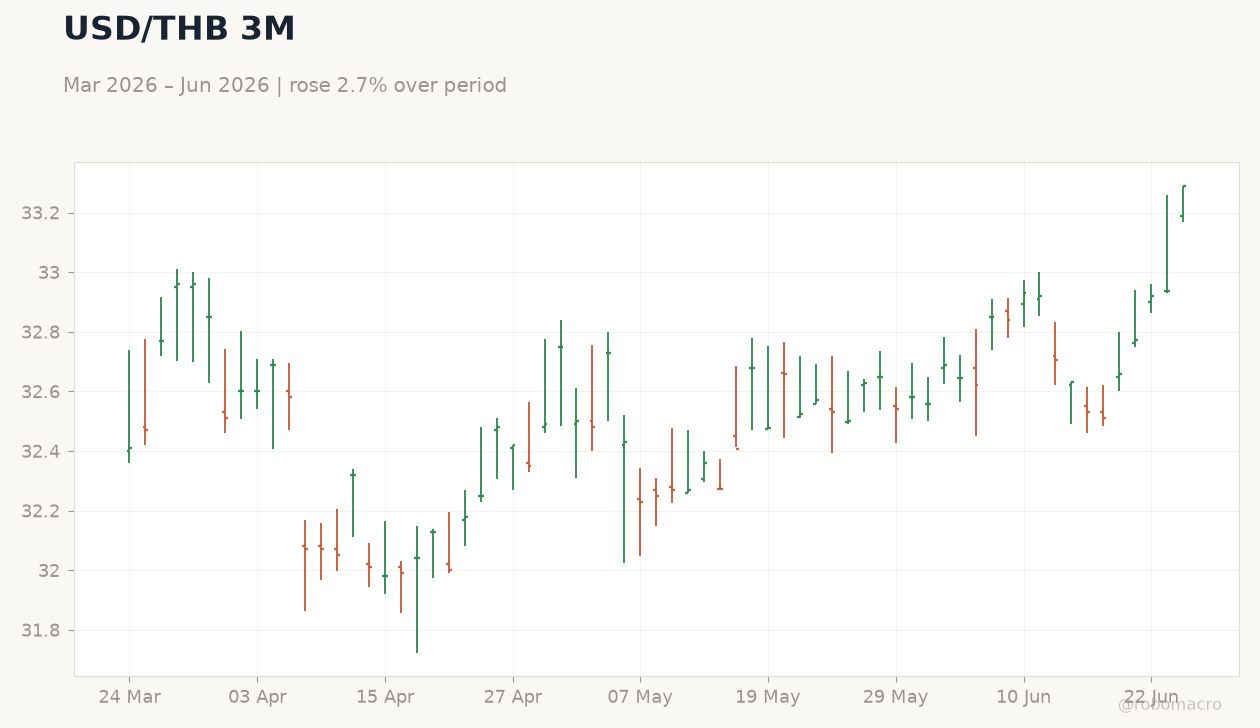
| USD/THB | 33.25 | +0.95% |
| USD/MYR | 4.15 | +0.27% |
| USD/PHP | 61.06 | +0.68% |
| USD/SGD | 1.30 | +0.23% |
| Brent Crude | 76.73 | -1.50% |
| Gold | 4,124.50 | -1.37% |
| Bitcoin | 62,499.01 | -2.27% |
| Indonesia 10Y Govt Yield | - | - |
| Thailand 10Y Govt Yield | - | - |
Prior Economic Events
| Data | Prior | Cons | Actual |
|---|---|---|---|
| No events available | |||
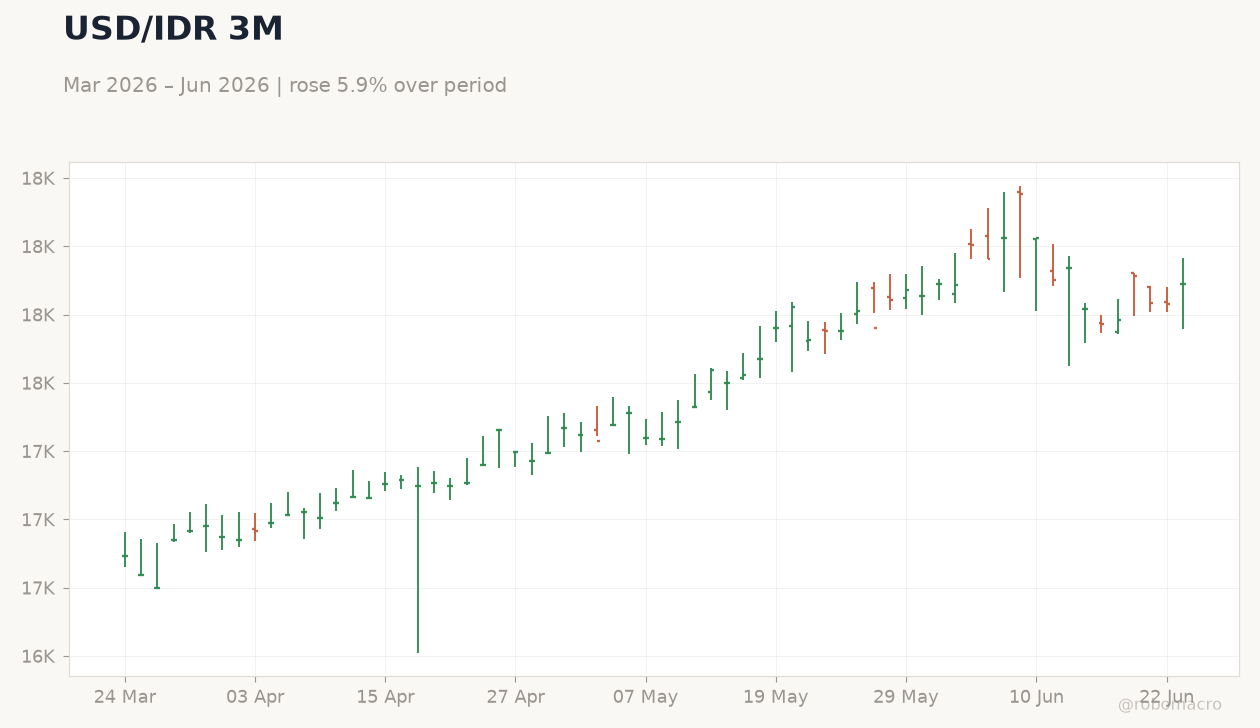 USD/IDR 3M | Type: market_hloc | USD per IDR: 1.786e+04 (2026-06-23) | Range: 1.675e+04–1.819e+04 | Trend(6pt): 1.687e+04,1.713e+04,1.73e+04,1.784e+04,1.779e+04,1.786e+04
Today's Economic Events
| Data | Prior | Cons | Time |
|---|---|---|---|
| Central Bank Interest Rate Decision | 1 | 1 | 23:00 |
| Wednesday (2026-06-24) | |||
| Central Bank Interest Rate Decision | 1 | 1 | 23:00 |
- Indonesia launches 26.34 trillion rupiah stimulus to offset external shocks and rupiah pressure.
- Thai baht weakens to one-year low ahead of BoT decision expected to hold at 1%.
- Regional equities fall with JCI down 0.98% and SET off 0.79%, while most ASEAN currencies weaken versus USD.
Yesterday's Recap
Indonesia announced a 26.34 trillion rupiah stimulus package to cushion external shocks and support the rupiah, yet the currency still closed weaker at 17,862 per USD after rising 0.42%. Markets reacted to MSCI review risks that could trigger further capital outflows from Indonesian assets. The JCI index fell 0.98% to 6,116.69 as investors priced in potential index adjustments.
In Thailand the baht dropped 0.95% to 33.25 per USD, reaching its weakest level in a year on expectations of a persistent US rate advantage. Household debt concerns surfaced after reports highlighted buy-now-pay-later usage for small purchases. Malaysian, Philippine and Singaporean currencies also posted modest losses against the dollar, while the STI edged 0.22% higher.
No major data releases occurred across the remaining ASEAN economies.
The Day Ahead
Thailand’s Monetary Policy Committee meets tonight with consensus pointing to an unchanged 1% policy rate. The decision will be watched for any signals on baht intervention or tolerance for further depreciation. Indonesia releases no high-impact data, though markets will monitor follow-through on the new stimulus measures.
Malaysia and the Philippines remain quiet on the calendar, leaving focus on external drivers such as US yields and oil prices. Singapore reports no scheduled releases, while Vietnam’s data flow stays light. Traders will also track Brent crude after its 1.5% decline, given Thailand’s energy import exposure.
Other Economic Notes
Persistent USD strength continues to pressure ASEAN currencies, with the Thai baht and Indonesian rupiah showing the largest daily moves. Supply-chain diversification away from China supports medium-term FDI inflows into Vietnam and Malaysia, yet short-term capital flow volatility dominates sentiment. Indonesia’s stimulus adds fiscal support but risks widening the current-account gap if commodity prices stay soft.
Regional equity valuations remain sensitive to MSCI index decisions that could reclassify Indonesian shares. Thailand’s elevated household debt level limits the scope for stronger domestic demand even if the baht stabilizes.