ASEAN Macro Daily(Beta Mode)
Indonesia Inflation Overshoots, Trade to Deficit
Market Snapshot
| Asset | Level | Change |
|---|---|---|
| JCI | 5,643.19 | -3.05% |
| SET | 1,542.34 | -1.04% |
| KLCI | 1,664.06 | -0.11% |
| PSEi | 6,072.24 | +0.02% |
| STI | 5,170.65 | -0.73% |
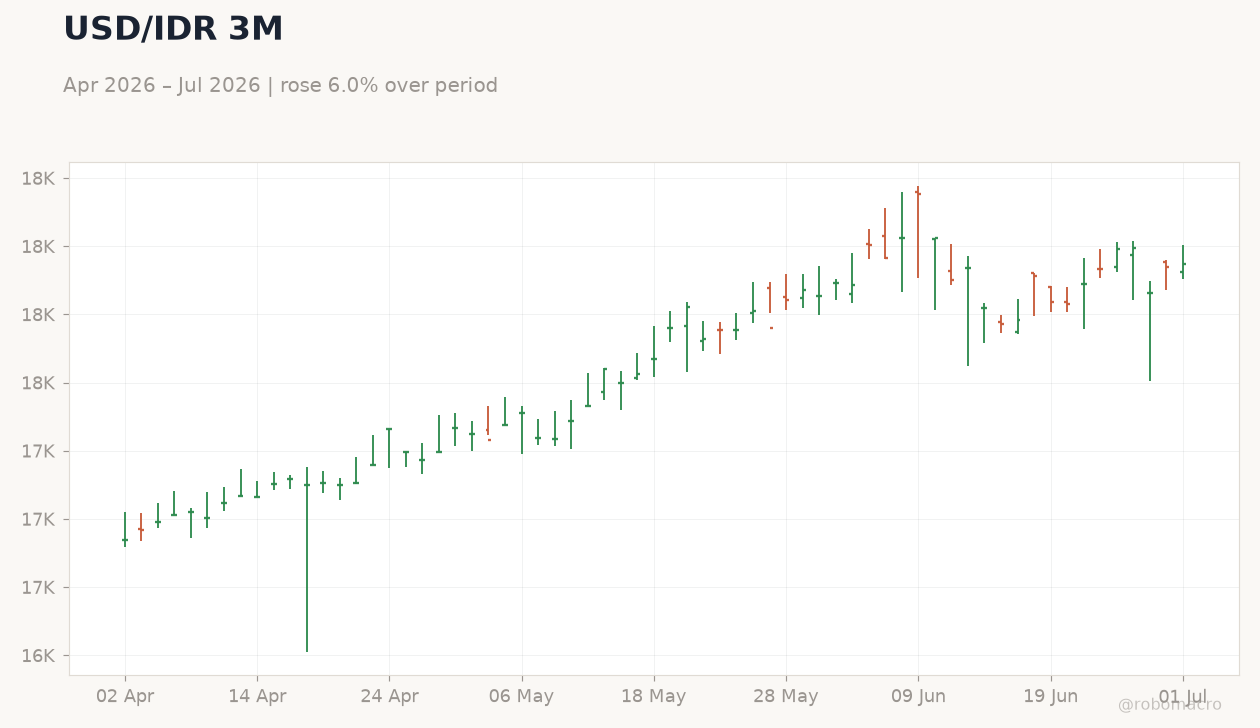
| USD/IDR | 17,935.00 | +0.06% |
| USD/THB | 33.31 | +0.15% |
| USD/MYR | 4.08 | +0.34% |
| USD/PHP | 61.31 | +0.46% |
| USD/SGD | 1.30 | +0.11% |
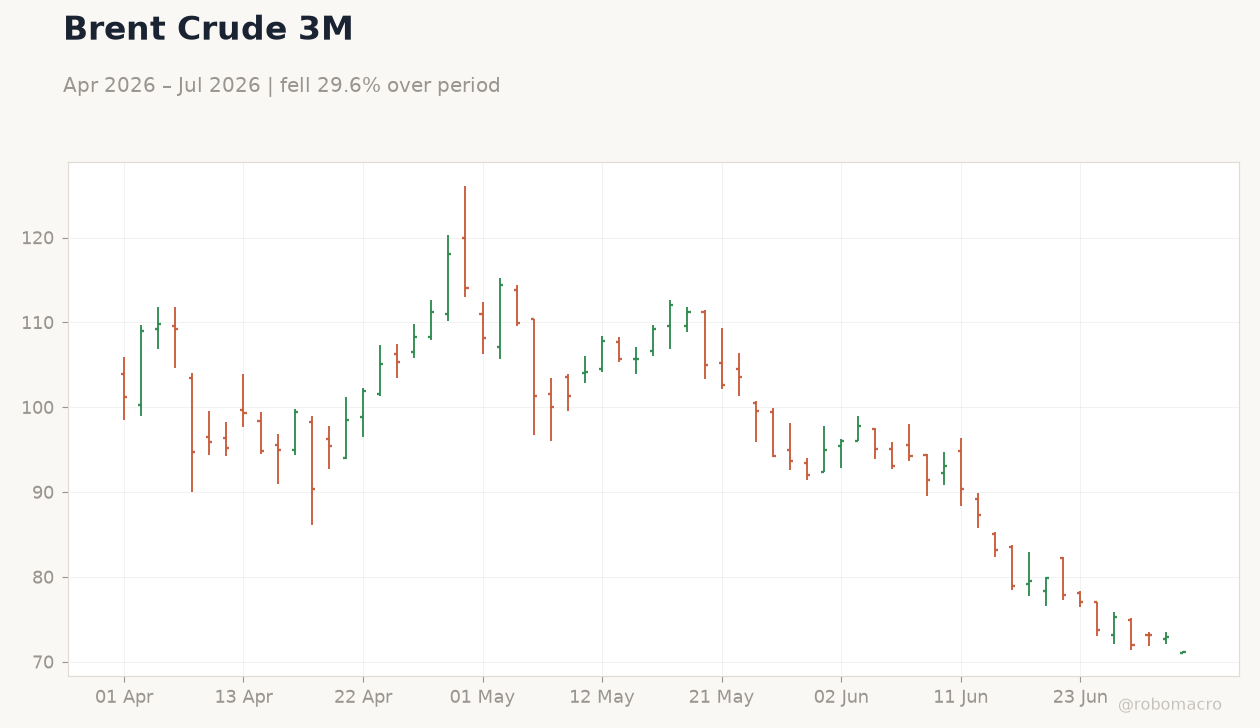
| Brent Crude | 71.18 | -2.39% |
| Gold | 4,056.00 | +0.82% |
| Bitcoin | 60,243.93 | +2.88% |
| Indonesia 10Y Govt Yield | - | - |
| Thailand 10Y Govt Yield | - | - |
Prior Economic Events
| Data | Prior | Cons | Actual |
|---|---|---|---|
| Inflation Rate Year-over-Year | 3.08 | 3.20 | 3.34 |
| Trade Balance | 90m | 1,200m | -1,610m |
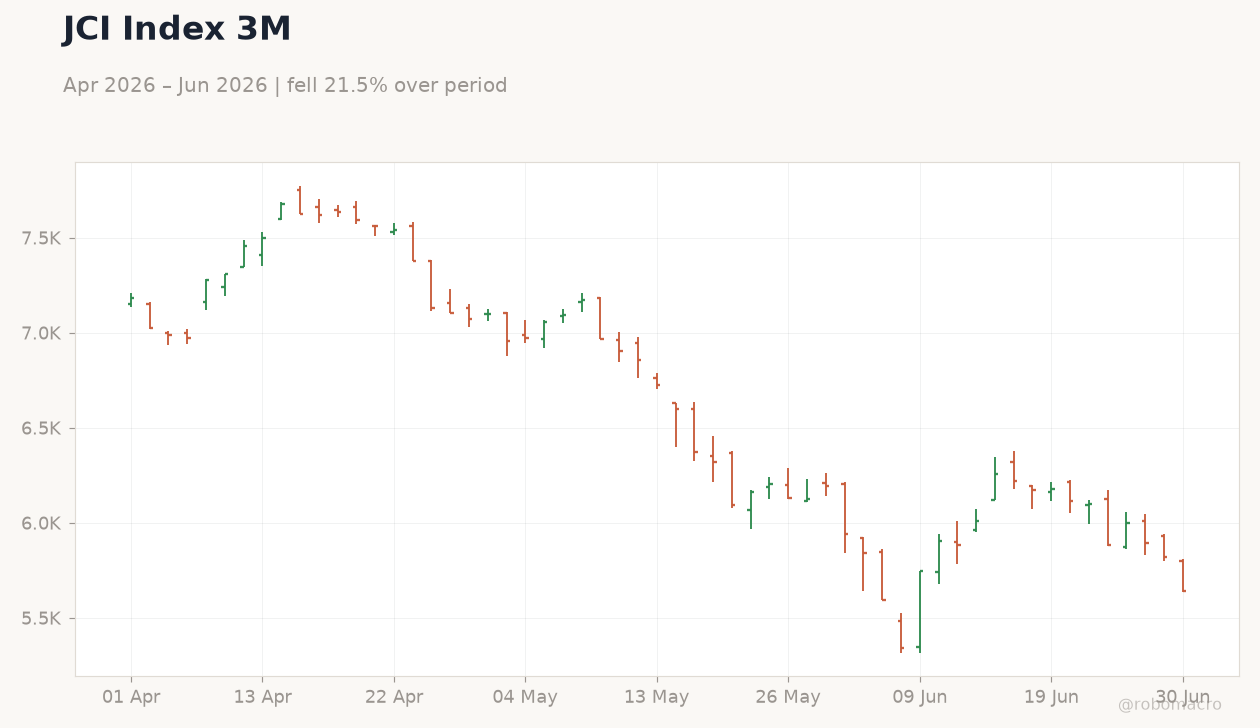 JCI Index 3M | Type: market_hloc | JCI Level: 5643 (2026-06-30) | Range: 5342–7676 | Trend(5pt): 7184,7542,6723,5747,5643
Today's Economic Events
| Data | Prior | Cons | Time |
|---|---|---|---|
| No events available | |||
- Indonesia June inflation rose to 3.34% y/y, above 3.2% consensus, while trade balance swung to a $1.61 bn deficit versus $1.2 bn expected.
- Regional equities fell, led by JCI (-3.05%) and SET (-1.04%), with USD/IDR edging 0.06% higher to 17,935 amid capital flow concerns.
- BI intensified short-term measures to cushion volatility, while Thailand flagged potential FX intervention as USD/THB tested 33.40.
Yesterday's Recap
Indonesia’s June inflation printed 3.34% y/y, exceeding consensus and marking a three-month high, while the trade balance deteriorated sharply to a $1.61 bn deficit against expectations of a $1.2 bn surplus. Equity markets closed lower across ASEAN, with Jakarta’s JCI dropping 3.05% to 5,643.19 and Bangkok’s SET falling 1.04% to 1,542.34; Kuala Lumpur’s KLCI eased 0.11% to 1,664.06 while Manila’s PSEi held flat at 6,072.24 and Singapore’s STI fell 0.73% to 5,170.65. Currencies weakened modestly, with USD/MYR rising 0.34% to 4.08 and USD/PHP up 0.46% to 61.31, though USD/IDR gained only 0.06% to 17,935.
Brent crude declined 2.39% to $71.18 per barrel while gold advanced 0.82% to $4,056. Bank Indonesia announced stepped-up short-term actions to shield the economy from external volatility, coinciding with reports of capital outflows pressuring Indonesian banks.
The Day Ahead
No major data releases are scheduled across ASEAN today or tomorrow. Markets will monitor ongoing rupiah pressure and BI’s response measures. Thailand’s baht faces resistance near 33.40 as the BoT signals intervention risks amid equity outflows.
Malaysia’s stablecoin testing by BNM and reserve levels may draw attention for ringgit stability signals. Regional investors will also track global risk sentiment and any updates on Indonesia’s five-point investment plan aimed at South Korean capital.
Other Economic Notes
Indonesia maintains its 8% growth target, relying on exports and investment inflows despite recent capital flight. Thailand’s current account deficit narrowed in May, supporting baht stability under steady conditions. Broader ASEAN economies continue to benefit from supply-chain shifts away from China, with Vietnam and Malaysia posting solid electronics export gains in recent months.
Global Macro News
Weakening commodity prices, notably Brent’s 2.39% drop, add downside pressure to Indonesia’s trade and fiscal accounts. Elevated gold prices reflect persistent safe-haven demand that could support further portfolio outflows from ASEAN. US-China trade rhetoric remains a key overhang for regional supply chains and FDI flows.
Bitcoin’s 2.88% gain signals risk-on appetite in crypto markets but has limited direct spillover to ASEAN currencies. <i>↓ p.2</i>