ASEAN Macro Daily(Beta Mode)
BI Steps Up Rupiah Defense After Volatility
Market Snapshot
| Asset | Level | Change |
|---|---|---|
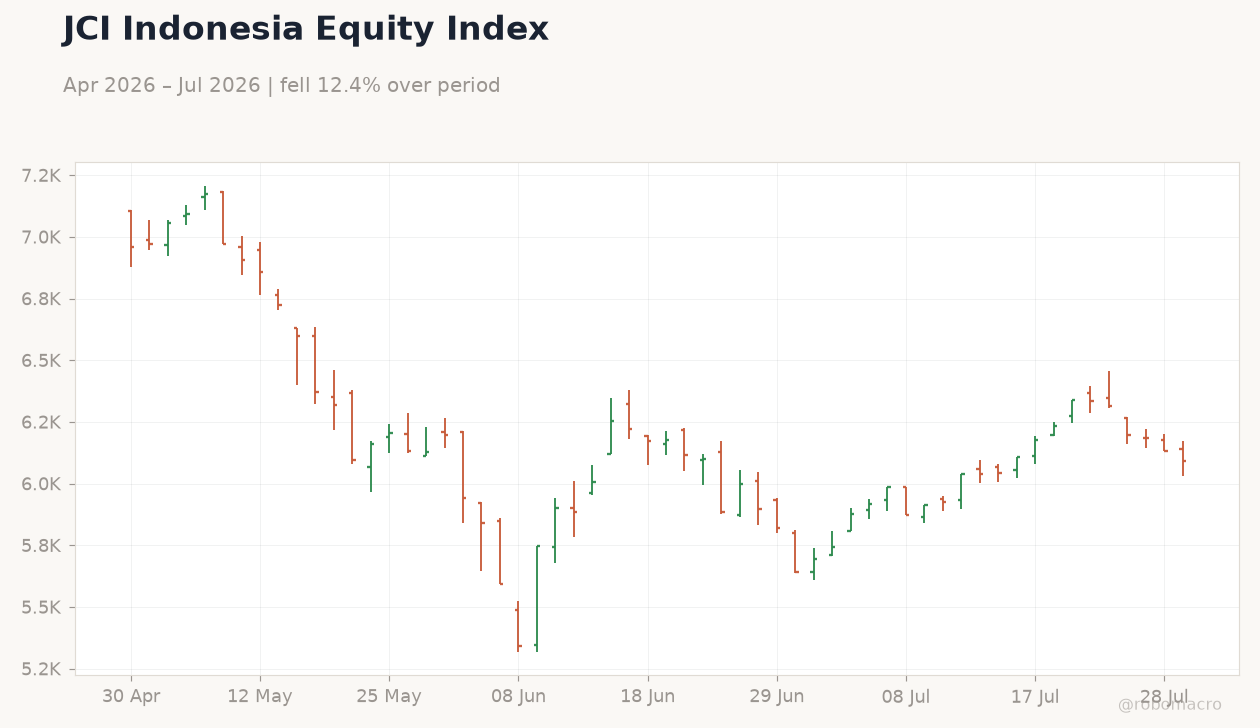
| JCI | 6,091.39 | -0.64% |
| KLCI | 1,715.56 | +0.18% |
| STI | 5,713.19 | +1.73% |
| USD/IDR | 18,073.00 | +0.11% |
| USD/THB | 33.37 | -0.54% |
| USD/MYR | 4.07 | -0.33% |
| USD/PHP | 61.52 | +0.16% |
| USD/SGD | 1.28 | -0.85% |
| Brent Crude | 89.45 | -1.42% |
| Gold | 4,166.20 | +3.26% |
| Bitcoin | 64,885.94 | +1.53% |
| Indonesia 10Y Govt Yield | - | - |
| Thailand 10Y Govt Yield | - | - |
Prior Economic Events
| Data | Prior | Cons | Actual |
|---|---|---|---|
| No events available | |||
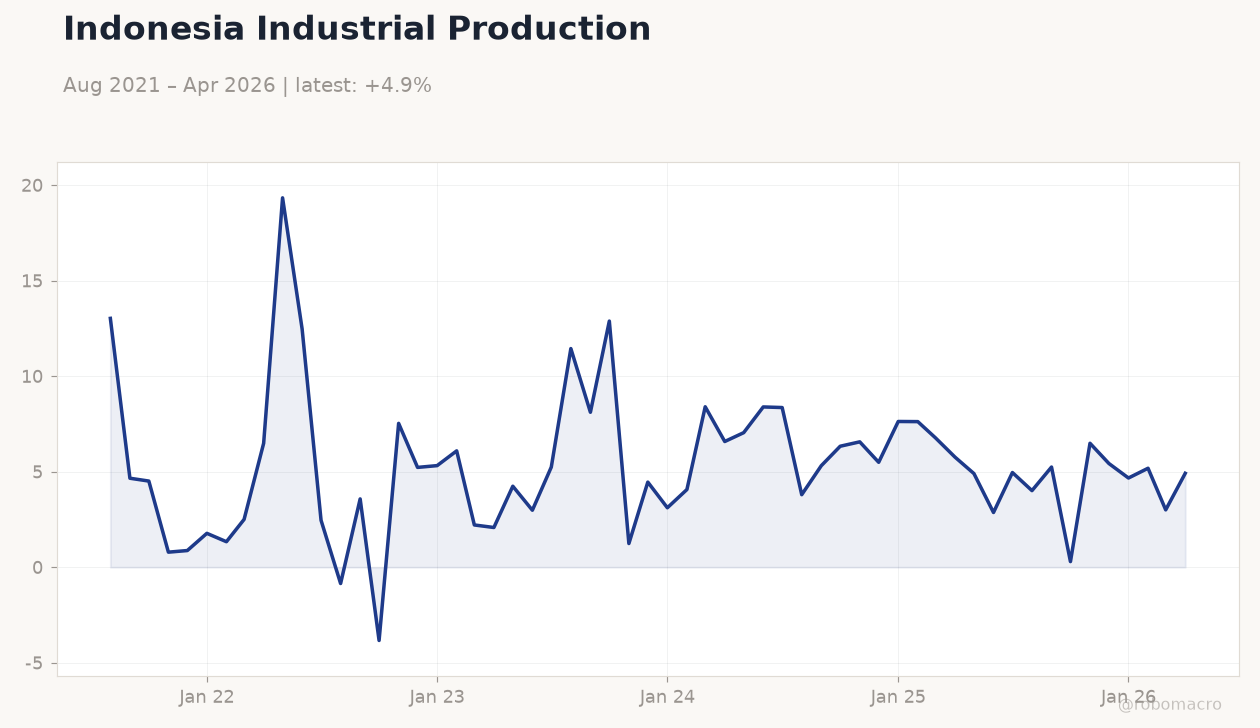 Indonesia Industrial Production | Type: macro_line | IP YoY %: 4.916 (2026-04-01) | Range: -3.835–19.33 | Trend(5pt): 13.02,-3.835,4.455,7.621,4.916
Today's Economic Events
| Data | Prior | Cons | Time |
|---|---|---|---|
| Trade Balance | -1,610m | - | 00:00 |
| Inflation Rate Year-over-Year | 3.34 | - | 00:00 |
| GDP Growth Year-over-Year | 5.61 | - | 00:00 |
- Bank Indonesia escalates rupiah stabilization via rates and monetary tools following governor resignation and market swings.
- Regional equities mixed: STI jumps 1.73% while JCI falls 0.64%; USD/IDR rises 0.11% to 18,073.
- Indonesia to release trade balance, inflation YoY and GDP growth data on 3-5 August.
Yesterday's Recap
Bank Indonesia reinforced its commitment to rupiah stability through intensified use of interest rates and other monetary instruments. The central bank’s actions followed market turbulence linked to the governor’s resignation and external pressures. Jakarta’s JCI fell 0.64% to close at 6,091.39 as investors digested the policy signals.
Singapore’s STI outperformed with a 1.73% gain to 5,713.19, supported by firmer regional sentiment. The Malaysian ringgit strengthened, with USD/MYR declining 0.33% to 4.07 after Bank Negara Malaysia delivered an upbeat assessment. Thailand’s baht also appreciated, as USD/THB dropped 0.54% to 33.37.
Brent crude eased 1.42% to 89.45 while gold rose 3.26% to 4,166.20, reflecting shifting risk appetite across ASEAN. KLCI edged up 0.18% to 1,715.56 and USD/SGD fell 0.85% to 1.28. Bitcoin gained 1.53% to 64,885.94 amid broader commodity moves.
The Day Ahead
Indonesia will publish its trade balance on 3 August, followed by inflation rate YoY and second-quarter GDP growth on 3–5 August. These releases will provide fresh insight into external demand and price pressures in Southeast Asia’s largest economy. No major data prints are scheduled for Thailand, Malaysia, the Philippines, Singapore or Vietnam over the next two sessions.
Market participants will monitor Bank Indonesia’s ongoing currency interventions and any follow-through comments from Bank Negara Malaysia. Regional equity and FX desks are expected to remain focused on rupiah movements and commodity price trends, with Brent at 89.45 and gold at 4,166.20 likely to influence sentiment.
Other Economic Notes
Commodity exporters across ASEAN benefited from elevated gold prices while facing softer energy markets. Supply-chain realignment continues to favor Vietnam and Malaysia as electronics and semiconductor shipments post steady gains. Indonesia’s palm-oil and nickel exports remain supported by Chinese and Indian demand despite currency headwinds.
Portfolio flows into Singapore and Malaysia have turned modestly positive on improved local macro outlooks. Capital-flow management measures in Indonesia highlight the region’s divergent policy responses to external shocks. USD/PHP rose 0.16% to 61.52 while USD/IDR held near 18,073 amid the interventions.