ASEAN Macro Daily(Beta Mode)
Indonesia Inflation Cools, Trade Gap Narrows
Market Snapshot
| Asset | Level | Change |
|---|---|---|
| JCI | 6,234.50 | -0.03% |
| KLCI | 1,725.73 | +0.05% |
| STI | 5,612.28 | -0.29% |
| USD/IDR | 18,032.00 | +0.01% |
| USD/THB | 33.22 | -0.36% |
| USD/MYR | 4.09 | +0.06% |
| USD/PHP | 60.97 | -0.46% |
| USD/SGD | 1.28 | +0.08% |
| Brent Crude | 78.69 | -6.06% |
| Gold | 4,134.20 | +2.49% |
| Bitcoin | 64,161.52 | +1.10% |
| Indonesia 10Y Govt Yield | - | - |
| Thailand 10Y Govt Yield | - | - |
Prior Economic Events
| Data | Prior | Cons | Actual |
|---|---|---|---|
| Inflation Rate Year-over-Year | 3.34 | 3.20 | 2.88 |
| Trade Balance | -1,610m | -790m | -450m |
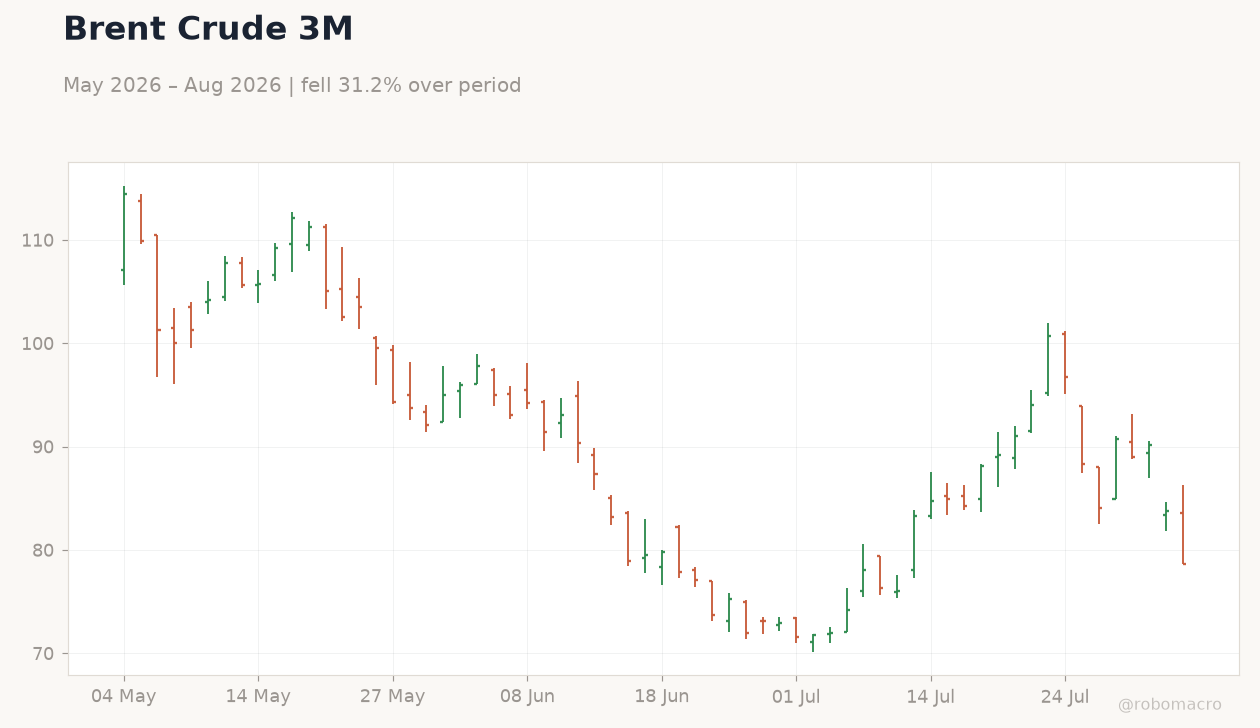 Brent Crude 3M | Type: market_hloc | USD per barrel: 78.69 (2026-08-04) | Range: 71.57–114.4 | Trend(5pt): 114.4,94.29,79.85,84.73,78.69
Today's Economic Events
| Data | Prior | Cons | Time |
|---|---|---|---|
| Inflation Rate Year-over-Year | 6.40 | 6.30 | 17:00 |
| GDP Growth Year-over-Year | 5.61 | 5.10 | 20:00 |
| Unemployment Rate | 4.80 | - | 17:00 |
| GDP Growth Quarter-over-Quarter | 0.90 | 0.90 | 18:00 |
| GDP Growth Year-over-Year | 2.80 | 2.80 | 18:00 |
- Indonesia July inflation fell to 2.88% y/y versus 3.2% consensus, while trade balance improved to -450 million USD.
- Regional equities closed mixed with JCI down 0.03% and STI off 0.29%; USD/IDR rose 0.01%.
- Brent crude dropped 6.06% while gold climbed 2.49% amid global risk-off flows.
Yesterday's Recap
Indonesia released cooler-than-expected July inflation at 2.88% y/y, undershooting the 3.2% consensus and prior 3.34% print, reflecting softer food prices. The same release showed the trade balance narrowing to -450 million USD from the -790 million USD consensus and prior -1.61 billion USD deficit. These prints point to contained price pressures and a narrower external gap in Southeast Asia’s largest economy.
Equity markets finished mixed on light volumes, with Indonesia’s JCI slipping 0.03% to 6,234.50 while Malaysia’s KLCI edged up 0.05% to 1,725.73. Singapore’s STI declined 0.29% to 5,612.28. Currency moves were modest, with USD/IDR rising 0.01% to 18,032 and USD/THB falling 0.36% to 33.22.
Brent crude’s 6.06% drop to 78.69 overshadowed gold’s 2.49% gain to 4,134.20. USD/MYR rose 0.06% to 4.09 while USD/PHP fell 0.46% to 60.97.
The Day Ahead
Philippines July inflation is due at 17:00 ET, with consensus pointing to a modest easing from 6.4%. Indonesia will release second-quarter GDP growth at 20:00 ET, expected at 5.1% y/y after 5.61% prior. Philippines unemployment data follows on 5 August and GDP prints on 6 August.
Vietnam’s State Bank may announce reserve levels later this week. No major policy meetings are scheduled across the six central banks in the immediate window. Markets will watch for any follow-through from Indonesia’s softer inflation on BI’s near-term stance.
Additional focus rests on whether Philippines data confirm the expected cooling path or reveal stickier services prices.
Other Economic Notes
Lower Indonesian inflation broadens the scope for steady policy amid still-elevated regional food costs. Trade data improvements support external balances in commodity-linked economies while electronics exporters in Vietnam and Malaysia track China demand signals. Remittance-dependent Philippines faces separate inflation and unemployment prints that could influence BSP timing.
Regional FX stability remains sensitive to US yields and commodity swings, with gold’s advance highlighting hedging demand. <i>↓ p.2</i>


