Argentina Macro Daily(Beta Mode)
MERVAL Slips as Peso Holds Steady
Market Snapshot
| Asset | Level | Change |
|---|---|---|
| MERVAL | 3,224,264.00 | -0.57% |
| USD/ARS | 1,426.50 | -0.05% |
| EUR/ARS | 1,658.66 | -0.12% |
| Gold | 4,491.30 | +0.05% |
| Brent Crude | 98.02 | +2.10% |
| Soybean | 1,171.50 | +0.54% |
| Bitcoin | 67,001.01 | +0.45% |
| Argentina 10Y | - | - |
Prior Economic Events
| Data | Prior | Cons | Actual |
|---|---|---|---|
| No events available | |||
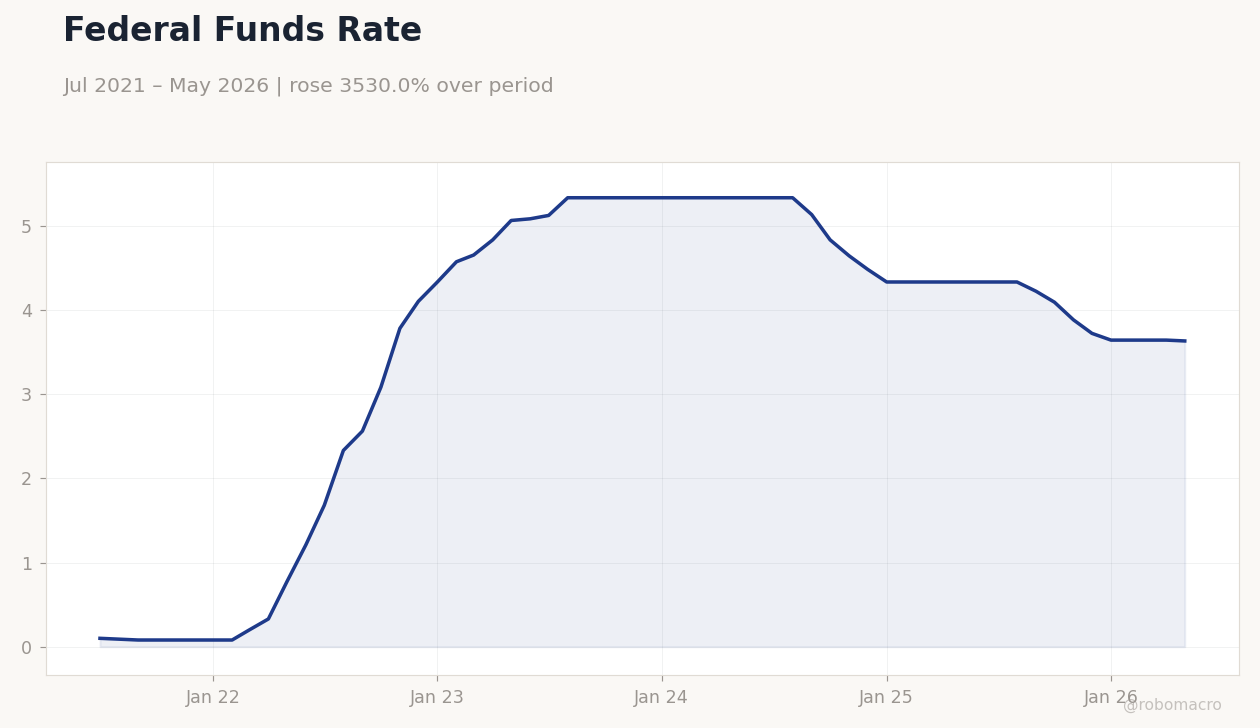 Federal Funds Rate | Type: macro_line | Percent: 3.63 (2026-05-01) | Range: 0.08–5.33 | Trend(6pt): 0.1,2.56,5.33,4.33,3.64,3.63
Today's Economic Events
| Data | Prior | Cons | Time |
|---|---|---|---|
| No events available | |||
- MERVAL fell 0.57% to 3,224,264 on light volumes.
- USD/ARS eased 0.05% to 1,426.50, signaling stability.
- Soybean futures rose 0.54%, supporting export outlook.
Yesterday's Recap
Equity markets closed lower with the MERVAL declining 0.57% to 3,224,264 amid subdued trading. The official USD/ARS rate slipped 0.05% to 1,426.50 while the EUR/ARS fell 0.12% to 1,658.66. Brent crude gained 2.10% to $98.02 per barrel and soybean prices advanced 0.54% to $1,171.50, providing modest support for energy and agricultural names.
No major data releases occurred on the day. Gold edged up 0.05% and Bitcoin rose 0.45%, reflecting mixed global risk sentiment. The Argentina 10Y bond showed no price change.
The Day Ahead
No economic releases are scheduled for June 3. The BCRA will publish weekly monetary aggregates and reserve data at 3 p.m. local time.
Treasury plans to auction Lecaps and dual-currency bonds totaling around $800 million. Market participants will monitor global commodity prices and any updates on IMF Article IV talks. Focus remains on fiscal consolidation signals ahead of the revised 2026 budget submission.
Other Economic Notes
The government targets a 1.8% of GDP primary surplus in the updated budget due by mid-June. May trade surplus widened on strong soybean meal exports, aiding reserve accumulation that reached $27.8 billion. Union rejection of the 38% wage guideline raises risks of transport and health sector strikes.
YPF reported a 14% y/y increase in upstream capex, supported by higher domestic gas prices.
Global Macro News
Euro zone business activity contracted in May while inflation pressures intensified, weighing on external demand for Argentine exports. Thailand’s central bank projects 2% growth and 3% inflation for 2026, illustrating divergent EM policy paths that could affect capital flows to Argentina. South Korea faces simultaneous rises in inflation, exchange rate stress and mortgage rates, highlighting global tightening spillovers.
The Danish krone hit a record low versus the euro, testing peg credibility and underscoring currency volatility risks for EM currencies. IMF and Bundesbank warnings on political threats to central bank independence carry relevance for Argentina’s policy credibility. <i>↓ p.2</i>


