Brazil Macro Daily(Beta Mode)
Retail Sales Miss, Confidence Drops
Market Snapshot
| Asset | Level | Change |
|---|---|---|
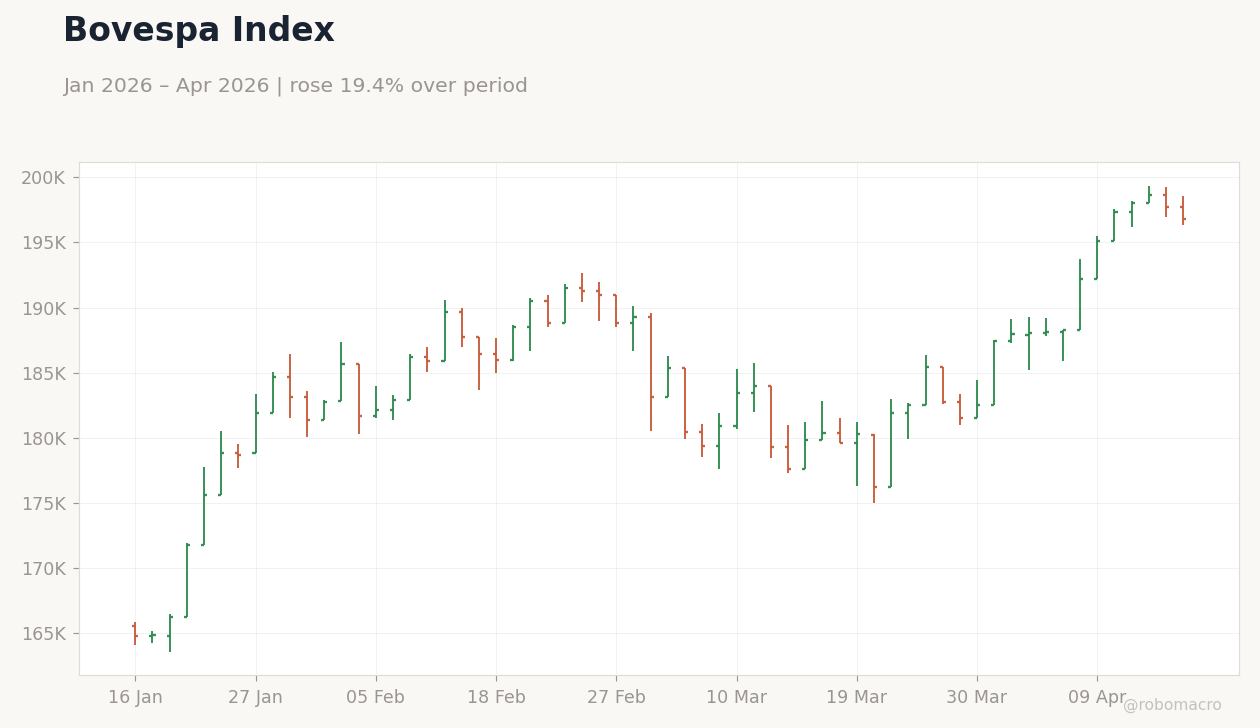
| Bovespa | 196,819.00 | -0.46% |
| USD/BRL | 4.99 | +0.03% |
| EUR/BRL | 5.87 | -0.41% |
| Vale | 17.43 | -1.08% |
| Petrobras | 21.50 | +4.67% |
| WTI Crude | 89.14 | -5.86% |
| Gold | 4,816.20 | +0.64% |
| Bitcoin | 75,734.99 | +0.78% |
| Brazil Short-term Rate | 14.90% | -0.67% |
| Brazil Long-term Rate | - | - |
Prior Economic Events
| Data | Prior | Cons | Actual |
|---|---|---|---|
| Retail Sales Month-over-Month | 0.40 | 1 | 0.60 |
| Business Confidence Index | 46.60 | - | 45.20 |
 Brazil Industrial Production YoY | Type: macro_line | YoY % Change: 2.039 (2026-02-01) | Range: -6.408–24.4 | Trend(6pt): 24.4,1.812,1.483,2.437,0.577,2.039
Today's Economic Events
| Data | Prior | Cons | Time |
|---|---|---|---|
| No events available | |||
- Retail sales rose 0.6% MoM, missing consensus of 1% but above previous 0.4%, signaling resilient consumer spending amid high rates.
- Business confidence fell to 45.2 from 46.6, reflecting pessimism in services and manufacturing despite activity topping forecasts.
- Markets mixed: Bovespa down 0.46%, Petrobras up 4.67% on oil dynamics, USD/BRL stable at 4.99.
Yesterday's Recap
Brazil's retail sales increased 0.6% month-over-month, missing the consensus estimate of 1% but improving on the prior 0.4%, driven by household consumption that underpins GDP growth despite debt burdens blunting income gains. The business confidence index dropped to 45.2 from 46.6, indicating weakening sentiment in key sectors like rail transport, which stabilized below pre-pandemic levels. Bovespa index fell 0.46% to 196,819, weighed by Vale's 1.08% decline to 17.43 amid commodity volatility, while Petrobras surged 4.67% to 21.50 on oil price dynamics.
USD/BRL edged up 0.03% to 4.99, reflecting minor real weakness, and EUR/BRL dipped 0.41% to 5.87. Brazil's short-term rate eased 0.67% to 14.90%, aligning with the Selic benchmark, as markets digested resilient economic activity weathering high borrowing costs. WTI crude plunged 5.86% to 89.14, pressuring export revenues, but gold rose 0.64% to 4,816.20, offering some hedge for commodity-dependent equities.
Bitcoin climbed 0.78% to 75,734.99.
The Day Ahead
No major Brazilian data releases are scheduled for today, shifting focus to global cues that could influence USD/BRL and Bovespa flows. Investors will monitor U.S. economic indicators for spillover effects on emerging market sentiment, particularly if they signal shifts in Fed policy impacting capital inflows.
Tomorrow also lacks key events, potentially leading to subdued trading volumes unless fiscal news emerges. Attention remains on broader themes like tourism recovery in cities such as Rio de Janeiro and São Paulo, which could bolster service sector activity. Markets may consolidate around recent gains in Petrobras amid oil price dynamics.
Other Economic Notes
Household consumption continues to drive Brazil's GDP growth this year, supported by income gains, though rising debt burdens are tempering the impact and raising sustainability concerns. Fiscal policy is shifting from tax-led adjustments, with targets for a 0.5% surplus excluding large off-book spending, as the IMF projects gross debt reaching 106.5% of GDP by 2031. (cont...)