Brazil Macro Daily(Beta Mode)
Economists Lift Brazil Rate Forecasts
Market Snapshot
| Asset | Level | Change |
|---|---|---|
| Bovespa | 168,600.69 | -0.25% |
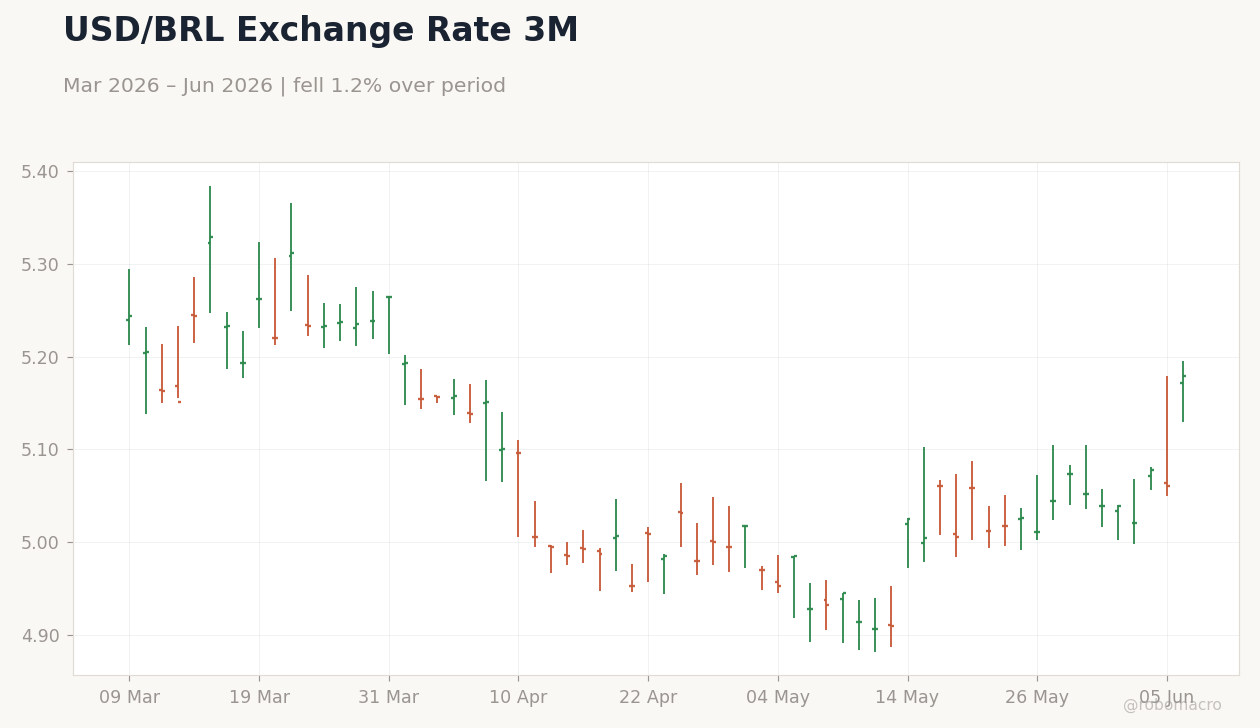
| USD/BRL | 5.18 | +2.41% |
| EUR/BRL | 5.98 | +1.92% |
| Vale | 15.23 | -3.42% |
| Petrobras | 17.75 | -1.72% |
| WTI Crude | 91.31 | +0.85% |
| Gold | 4,345.20 | +0.19% |
| Bitcoin | 63,853.44 | +0.97% |
| Brazil Short-term Rate | 14.75% | -1.01% |
| Brazil Long-term Rate | - | - |
Prior Economic Events
| Data | Prior | Cons | Actual |
|---|---|---|---|
| No events available | |||
 Brazil Short-term Policy Rate | Type: macro_line | Policy Rate %: 14.75 (2026-04-01) | Range: 4.25–15 | Trend(6pt): 4.25,13.75,12.27,12.31,14.9,14.75
Today's Economic Events
| Data | Prior | Cons | Time |
|---|---|---|---|
| Friday (2026-06-12) | |||
| Inflation Rate Month-over-Month | 0.67 | - | 04:00 |
| Inflation Rate Year-over-Year | 4.39 | - | 04:00 |
| Business Confidence Index | 47.20 | - | 05:40 |
- Economists raised 2026-2027 Selic forecasts after hot growth data kept inflation pressures elevated.
- Bovespa fell 0.25% to 168,600.69 while USD/BRL jumped 2.41% to 5.18 on risk aversion.
- May inflation prints due 12 June will test whether the 14.75% Selic path needs further upward revision.
Yesterday's Recap
Markets closed lower after the long weekend with Bovespa dropping 0.25% amid profit-taking in Vale and Petrobras. USD/BRL surged 2.41% to 5.18 as investors priced higher-for-longer rates and political noise around impeachment proceedings. No economic releases occurred on 7 June, leaving the focus on the prior week’s strong activity indicators that prompted analysts to lift rate projections.
Brazil short-term rates held at 14.75%, down 1.01% in yield terms, while long-term benchmarks showed limited movement. Commodity exporters faced mixed signals as iron-ore and oil prices provided only modest support. Fiscal rhetoric from Minister Haddad remained anchored to the 0.5% primary-deficit target, containing immediate sovereign-spread widening.
The Day Ahead
Attention turns to Friday’s May inflation release at 04:00 ET, covering both month-over-month and year-over-year readings. The Business Confidence Index at 05:40 ET will provide an early read on June sentiment. Markets currently embed expectations for steady policy at the next COPOM meeting given the 14.75% Selic level.
A hotter-than-expected IPCA print could accelerate further upward revisions to year-end rate forecasts. No BCB speakers are scheduled before the data.
Other Economic Notes
A new R$5bn loan program targets delivery riders, adding a modest fiscal impulse while the economy runs above potential. U.S. share of Brazilian exports has fallen to its lowest level since 1997, underscoring diversification toward China and regional partners.
US terrorist designations on Brazilian gangs raise compliance costs for local firms and could weigh on cross-border financing. Real-estate funds offering CDI-plus spreads attract inflows as the high Selic environment persists.
Global Macro News
Argentina’s visa-free policy for 90 countries, including Brazil, may boost regional tourism and services exports later this year. India’s currency-support measures highlight emerging-market capital-flow volatility that could spill into BRL positioning. <i>↓ p.2</i>