| Asset | Level | Change |
|---|---|---|
| S&P/TSX | 31,960.70 | +0.23% |
| USD/CAD | 1.39 | +0.48% |
| EUR/CAD | 1.60 | +0.10% |
| WTI Crude | 101.06 | +1.43% |
| Natural Gas | 2.92 | -5.53% |
| Gold | 4,574.30 | +1.83% |
| Brent Crude | 107.49 | -4.51% |
| Bitcoin | 67,617.90 | +2.52% |
| Canada 2Y Govt Yield | 2.25% | +0.00% |
| Canada 10Y Govt Yield | 3.29% | -3.35% |
| Data | Prior | Cons | Actual |
|---|---|---|---|
| No events available | |||
Canada 10Y Govt Yield | Type: macro_line | 10Y Yield %: 3.288 (2026-02-01) | Range: 1.192–4.062 | Trend(6pt): 1.516,3.315,3.654,3.186,3.423,3.288 | Short-term Rate %: 2.25 (2026-02-01) | Range: 0.1603–5.026 | Trend(6pt): 0.1603,1.429,4.994,4.138,2.251,2.25
| Data | Prior | Cons | Time |
|---|---|---|---|
| Tuesday (2026-03-31) | |||
| GDP Month-over-Month | 0.20 | 0 | 04:30 |
| GDP Month-over-Month Prel | 0 | - | 04:30 |
| Wednesday (2026-04-01) | |||
| S&P Global Manufacturing PMI Index | 51 | - | 05:30 |
| BoC Summary of Deliberations | - | - | 09:30 |
| Thursday (2026-04-02) | |||
| Trade Balance | -3,650m | -1,900m | 04:30 |
Canadian markets displayed mixed results on March 29, with the S&P/TSX Composite advancing 0.23% to 31,960.70, buoyed by commodity-related gains amid geopolitical tensions. USD/CAD increased 0.48% to 1.39, indicating CAD depreciation as the U.S. dollar strengthened on inflation projections and Middle East instability.
The 10-year Government of Canada yield declined 3.35% to 3.29%, reflecting safe-haven demand despite oil-driven inflation concerns, while the 2-year yield held steady at 2.25%. WTI Crude rose 1.43% to 101.06, supported by supply disruption risks from the Iran war, though Brent Crude fell 4.51% to 107.49 on inventory dynamics. Natural Gas dropped 5.53% to 2.92, pressured by builds, and Gold climbed 1.83% to 4,574.30 as a risk hedge.
EUR/CAD edged up 0.10% to 1.60, but CAD faced broad weakness from energy volatility. Bitcoin gained 2.52% to 67,617.90, diverging from traditional assets. No significant economic data was released, but markets responded to news of the U.S.-Iran conflict entering its fifth week, with Houthi attacks escalating and oil prices climbing overall, influencing Canadian energy sector expectations.
TSX performance was supported by financials, offsetting minor energy lags.
March 31 features GDP month-over-month at 4:30 ET, with consensus at 0% after a previous 0.2%, alongside a preliminary reading following 0.0% prior, offering clues on early-year growth amid high oil prices. On April 1, S&P Global Manufacturing PMI is due at 5:30 ET, building on 51.0 previous, gauging sector health under cost pressures. The BoC Summary of Deliberations follows at 9:30 ET, detailing recent policy insights.
April 2 brings Trade Balance at 4:30 ET, forecasted at -1.9 billion versus -3.65 billion prior, potentially showing export gains from elevated crude values. These events could drive CAD and yield movements, with focus on inflation and trade implications from global tensions.
Subscribe to Canada Macro Daily and get each new issue delivered to your inbox.
Already a member? Visit robomacro.com to log in and manage subscriptions, or use Forgot Password to set a password.
Canada Short-term Rates | Type: macro_line | Short-term Rate %: 2.25 (2026-02-01) | Range: 0.1603–5.026 | Trend(6pt): 0.1603,1.429,4.994,4.138,2.251,2.25
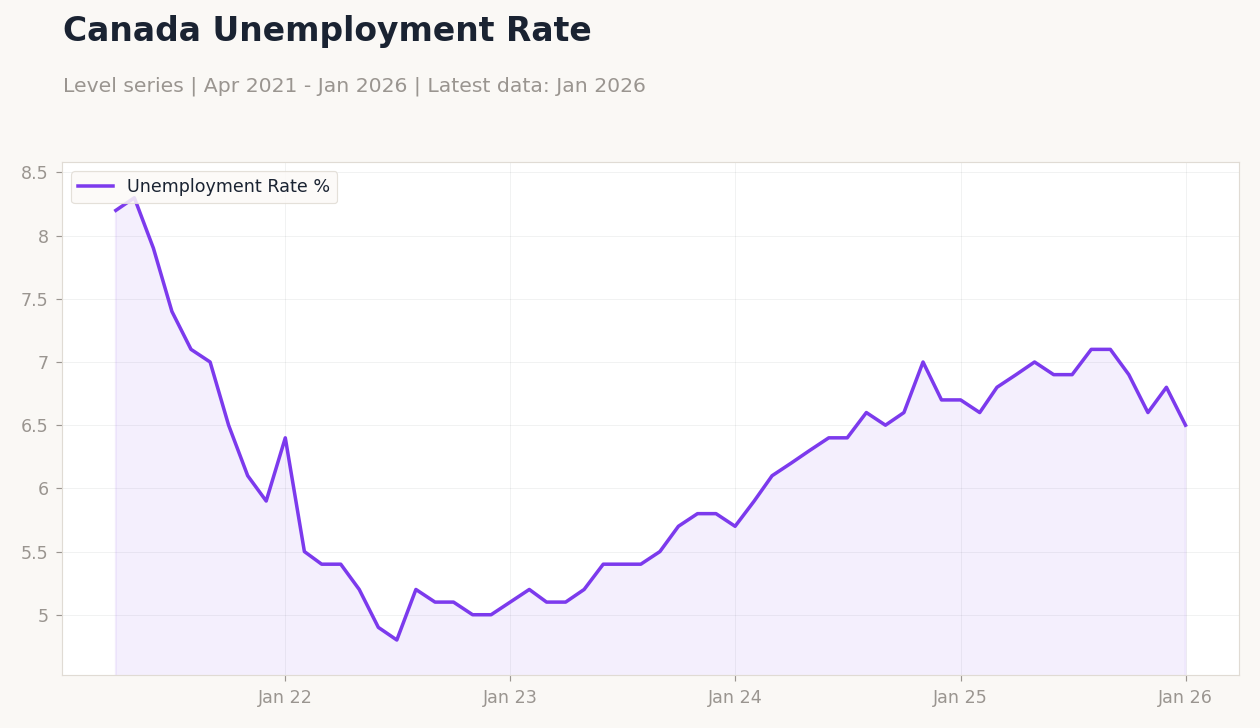
Canada Unemployment Rate | Type: macro_line | Unemployment Rate %: 6.5 (2026-01-01) | Range: 4.8–8.3 | Trend(6pt): 8.2,4.9,5.4,6.6,6.8,6.5
Canada Exports Value | Type: macro_line | Exports USD: -3.114 (2025-12-01) | Range: -16.08–68.65 | Trend(5pt): 68.65,24.07,-6.557,-0.6915,-3.114
WTI Crude Oil Prices | Type: market_hloc | WTI USD/bbl: 101.5 (2026-03-30) | Range: 55.99–101.5 | Trend(6pt): 57.95,59.36,62.84,90.9,99.64,101.5
Canadian economy grapples with oil price surges from the Iran war, as economists predict rising inflation and unemployment, per Financial Post analysis. The BoC policy rate stands at 2.25% as of February 2026, with CPI at 2.32% YoY through March 2025. Housing starts and construction slow under higher borrowing costs, while USMCA strains intensify with potential U.S.
tariffs on Canadian EVs, threatening manufacturing. Alberta oil sands production remains robust, but pipeline delays add risks. Broader themes include vulnerability to global commodity shifts, with war effects likely elevating import costs and pressuring consumer spending.
Oil prices advanced as the U.S.-Iran war reached its fifth week, with Brent poised for a record monthly rise amid Houthi missile strikes on Israel and new conflict fronts, benefiting Canadian exporters but heightening global supply fears. U.S. inflation is forecast to top G7 levels in 2026 due to tariffs and war fallout, impacting cross-border trade and CAD strength.
China's teapot refineries face margin squeezes from high crude, potentially reducing demand for Canadian oil. Worldwide responses to fuel price hikes include rations and free transport in some nations, signaling growth headwinds that could curb Canadian exports. Roubini warns of U.S.
escalation in Iran over retreat, while IMF aid to Pakistan highlights emerging market strains amid instability. These dynamics underscore commodity market volatility, with ripple effects on Canadian tourism, aviation, and overall economic stability.
The Bank of Canada held its policy rate at 2.25% in February, monitoring inflation at 2.32% YoY as of March 2025. Recent guidance stresses caution on persistent pressures from shelter, food, and now energy amid Middle East tensions. The forthcoming Summary of Deliberations will outline council views on quantitative tightening, expected to continue gradually for CAD support.
Markets view BoC tone as hawkish, diminishing near-term cut prospects with oil shocks risking imported inflation. Prior reports noted balanced risks, but war escalation may lead to tighter language. This approach aims to maintain 2% inflation anchoring, influencing yields and TSX sentiment, though recent yield dips suggest bets on easing if growth weakens.