| Asset | Level | Change |
|---|---|---|
| BIST 100 | 12,702.00 | -0.71% |
| iShares Poland | 35.66 | +0.82% |
| EUR/PLN | 4.25 | -1.03% |
| EUR/HUF | 387.15 | -1.92% |
| EUR/CZK | 24.35 | -0.27% |
| USD/TRY | 44.07 | -0.03% |
| Brent Crude | 93.53 | +0.91% |
| Gold | 5,177.90 | +0.62% |
| Bitcoin | 70,226.96 | +6.45% |
| Poland 10Y Govt Yield | 5.10% | -2.11% |
| Hungary 10Y Govt Yield | 6.67% | -3.19% |
| Data | Prior | Cons | Actual |
|---|---|---|---|
| No events available | |||
Poland 10Y Yield vs NBP Context | Type: macro_line | Poland 10Y Yield: 5.1 (2026-01-01) | Range: 1.55–7.82 | Trend(6pt): 1.55,7.14,5.59,5.6,5.21,5.1 | Poland Interbank Rate: 3.93 (2026-01-01) | Range: 0.21–7.51 | Trend(6pt): 0.21,7.05,6.69,5.85,4.06,3.93
| Data | Prior | Cons | Time |
|---|---|---|---|
| Industrial Production Year-over-Year | -2.10 | - | 23:00 |
| TCMB Interest Rate Decision | 37 | 37 | 03:00 |
| Inflation Rate Month-over-Month | 0.60 | 0.60 | 01:00 |
| Inflation Rate Year-over-Year | 2.20 | - | 01:00 |
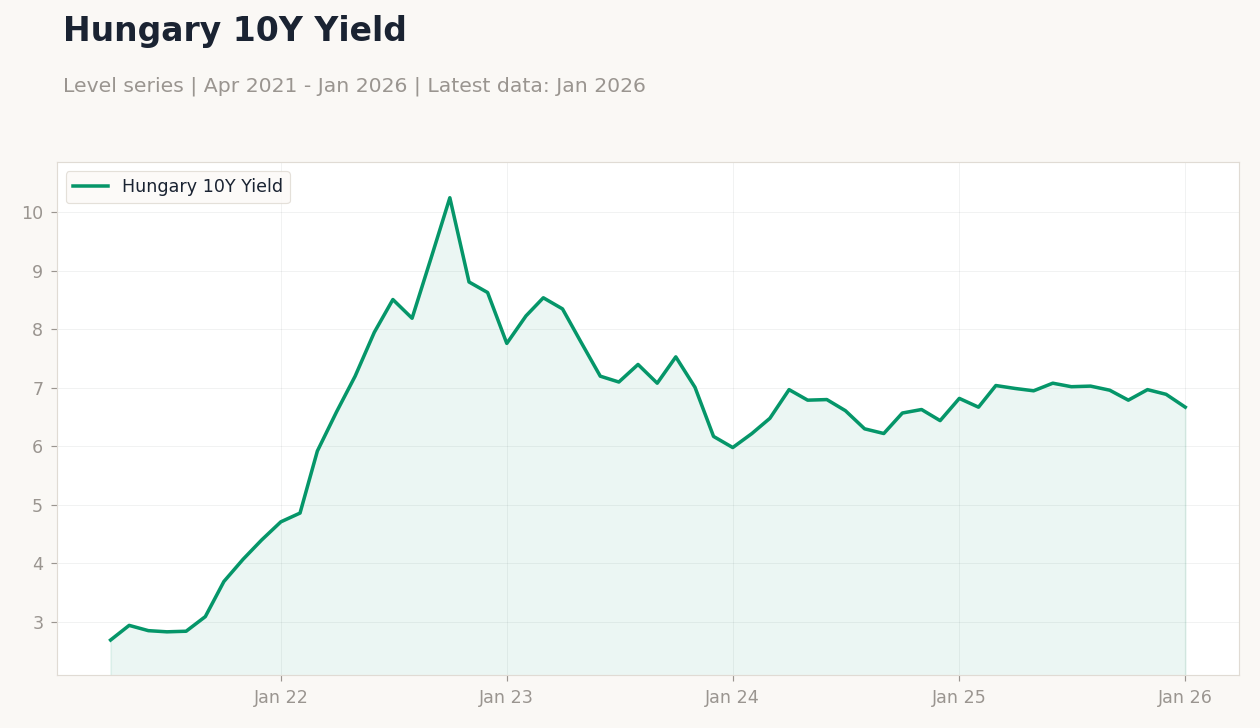
Emerging European markets displayed resilience yesterday amid global geopolitical uncertainties, with currencies appreciating against the euro as investors sought regional safe havens. In Poland, the largest CEE economy, the iShares Poland ETF rose 0.82% to 35.66, supported by a 1.03% decline in EUR/PLN to 4.25, indicating PLN strength, while the 10Y government yield dropped 2.11% to 5.10%, signaling a bond rally. Hungary saw EUR/HUF fall 1.92% to 387.15, bolstering the forint, alongside a 3.19% decrease in the 10Y yield to 6.67%, though the BUX index was not directly reported; this reflects fiscal caution amid EU fund negotiations.
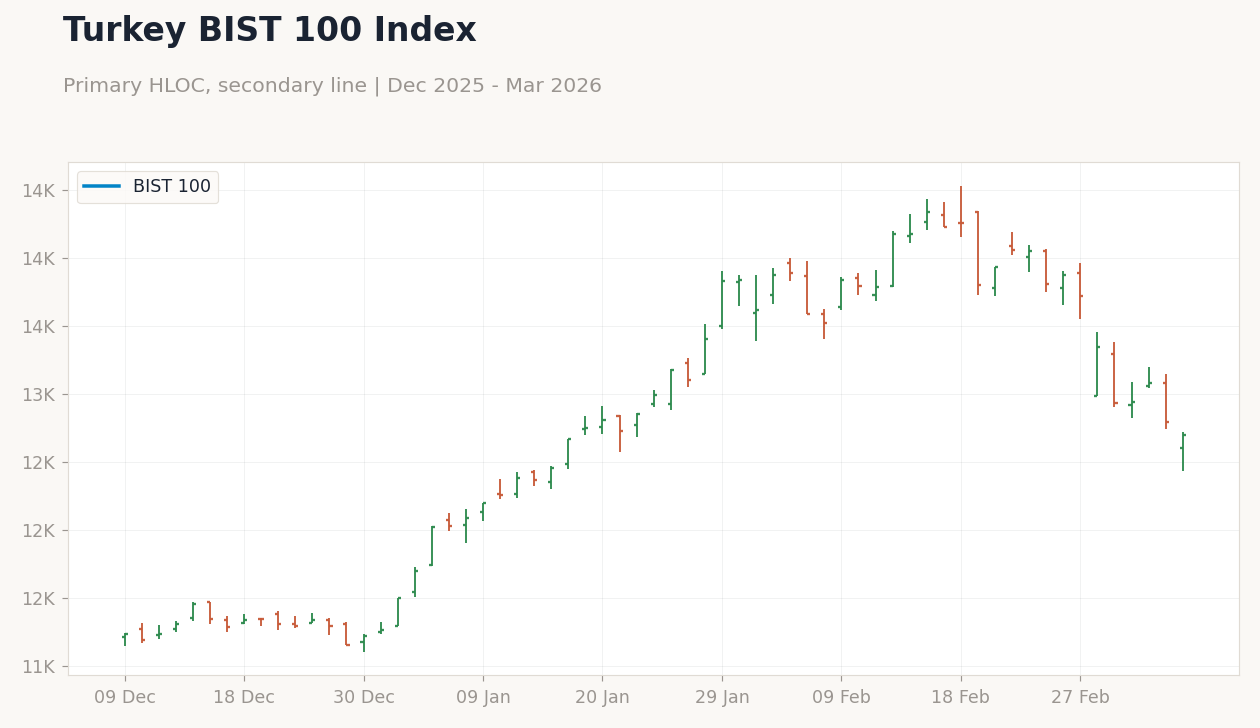
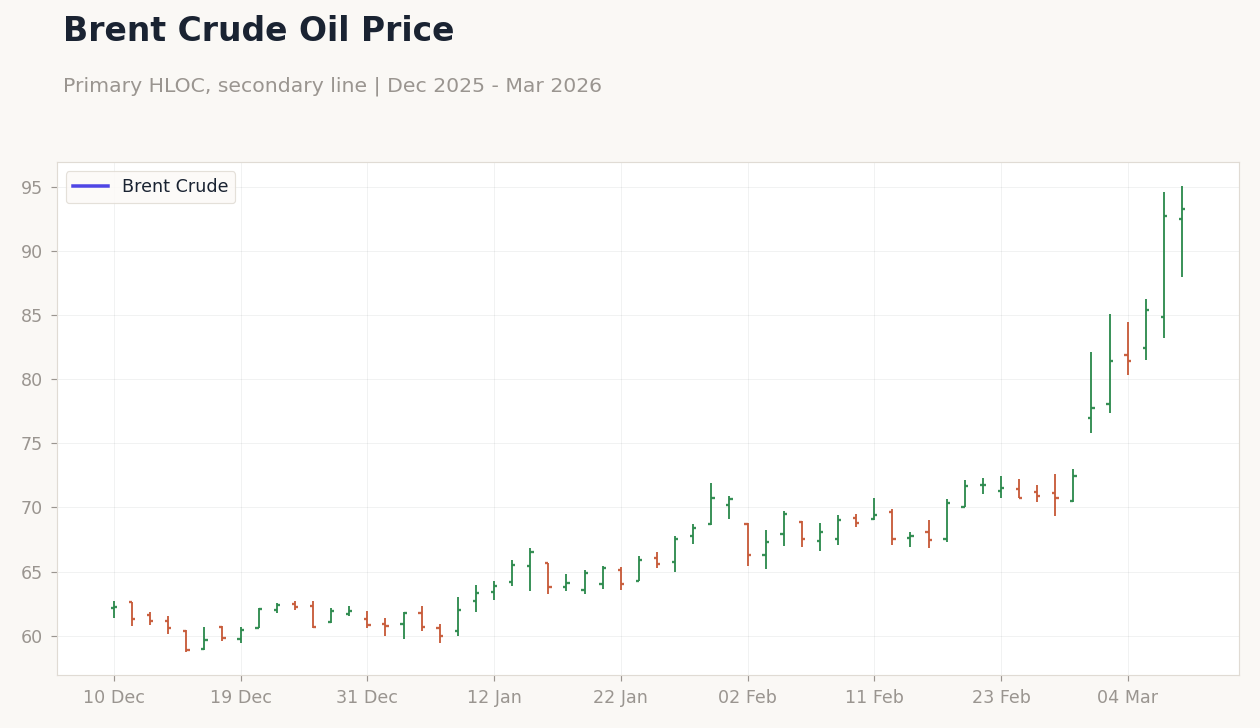
The Czech Republic experienced a modest 0.27% drop in EUR/CZK to 24.35, with no major equity moves noted, underscoring its closer alignment to eurozone stability. Turkey, operating under distinct high-inflation dynamics, had its BIST 100 index decline 0.71% to 12,702.00, with USD/TRY edging down 0.03% to 44.07, as markets awaited industrial data; Romania was relatively quiet, with no standout moves in available proxies. Overall, these shifts highlight shared vulnerabilities to energy prices, as Brent crude rose 0.91% to 93.53, exacerbating import costs for gas-dependent PL, CZ, HU, and RO.
Today's calendar features Turkey's industrial production year-over-year release at 23:00 ET, with the previous figure at -2.1% and no consensus available, potentially signaling ongoing manufacturing weakness amid high inflation. Looking further, Turkey's TCMB interest rate decision is slated for March 12 at 03:00 ET, expected to hold at 37% based on consensus, though persistent price pressures could prompt surprises. Poland's inflation data arrives on March 13 at 01:00 ET, including month-over-month at a consensus of 0.6% (previous 0.6%) and year-over-year with no consensus (previous 2.2%), which may influence NBP's policy outlook.
No immediate events are noted for Czech Republic, Hungary, or Romania, allowing focus on these Turkish and Polish indicators. Markets will monitor these for insights into regional disinflation progress and euro convergence. Broader attention may turn to any ECB-related spillovers affecting CNB and MNB decisions.
Subscribe to Emerging Europe Macro Daily and get each new issue delivered to your inbox.
Already a member? Visit robomacro.com to log in and manage subscriptions, or use Forgot Password to set a password.
Hungary 10Y Yield | Type: macro_line | Hungary 10Y Yield: 6.67 (2026-01-01) | Range: 2.69–10.25 | Trend(6pt): 2.69,7.95,7.4,6.57,6.89,6.67
EUR/PLN vs EUR/HUF | Type: market_hloc | EUR/PLN: 4.251 (2026-03-10) | Range: 4.197–4.296 | Trend(6pt): 4.226,4.212,4.197,4.21,4.273,4.251 | EUR/HUF: 387.1 (2026-03-10) | Range: 373.9–394.7 | Trend(6pt): 383,383.1,381.5,378.6,386.5,387.1
Turkey BIST 100 Index | Type: market_hloc | BIST 100: 1.27e+04 (2026-03-09) | Range: 1.115e+04–1.434e+04 | Trend(6pt): 1.124e+04,1.126e+04,1.285e+04,1.418e+04,1.308e+04,1.27e+04
Brent Crude Oil Price | Type: market_hloc | Brent Crude: 93.29 (2026-03-10) | Range: 58.92–93.29 | Trend(5pt): 62.21,60.75,65.59,67.42,93.29
Broader economic themes in Emerging Europe emphasize energy security risks, with PL, CZ, HU, and RO's heavy reliance on imported gas exposing them to Russian supply disruptions and Brent price spikes above $90. Turkey's structural inflation, far exceeding peers, complicates its EU trade ties despite its outlier status, while EU fund flows remain critical for convergence in PL and HU amid fiscal reforms. Geopolitical tensions, including border rewilding in PL near Russia, underscore the need for resilient infrastructure investments across the region.
Global macro developments are increasingly impacting Emerging Europe, particularly through energy and security channels, as Iran's conflict drives oil prices and inflationary risks. US stock markets closed higher despite initial volatility from Iran-driven oil surges above $100, later settling at $85, which could ease pressure on CEE importers but heightens uncertainty for TR's energy-dependent economy. European leaders, including Macron and von der Leyen, are pushing for a more interest-driven EU foreign policy, vowing support for Cyprus post-drone strikes, signaling potential military aid that bolsters security for EU members like PL, CZ, HU, and RO.
Sanctions on Russia are under scrutiny, with calls to maintain them to choke its economy, directly affecting Emerging Europe's trade and gas dependencies; investigators attribute parcel fires in PL and elsewhere to Russia, escalating regional tensions. Trump's claims on the US-Israel-Iran war as 'very complete' influenced market sentiment, while EU environment chief's advocacy for rewilding borders, as in PL and Finland, aims to deter invasions, enhancing stability for CEE currencies. The ECB's deposit rate stands at 2.00%, providing a benchmark for CNB and MNB convergence, amid eurozone unemployment at 6.70%.
France's preparations against far-right risks and Axel Springer's media moves highlight broader EU institutional resilience, indirectly supporting Emerging Europe's accession dynamics.
Central banks in Emerging Europe are navigating divergent paths amid global inflation and geopolitical risks, with Poland's NBP facing doubts over resuming rate cuts due to Iran-related inflationary spillovers, potentially delaying easing from current levels. The Czech National Bank (CNB) remains responsive to ECB signals, given its euro adoption ambitions, and may hold rates steady to maintain inflation targeting credibility, especially with EUR/CZK stability. Hungary's MNB, also closely tied to ECB moves, contends with forint volatility and fiscal pressures, focusing on FX interventions to support convergence criteria despite policy divergences from TR.
Romania's BNR prioritizes eurozone alignment, monitoring inflation and EU funds without recent interventions, contrasting with Turkey's CBRT, which operates under political constraints and holds rates at elevated levels to combat hyperinflation. (cont...)
Across the five, CNB and MNB show the strongest ECB convergence, while CBRT's unique challenges highlight regional policy splits; NBP and BNR emphasize credibility amid low inflation, unlike CBRT's high-inflation fight. Upcoming decisions, like CBRT's on March 12, could widen these gaps if holds persist.