Emerging Europe Macro Daily(Beta Mode)
Turkey IP Improves, BIST Rallies
Market Snapshot
| Asset | Level | Change |
|---|---|---|
| BIST 100 | 13,175.70 | +3.73% |
| iShares Poland | 35.68 | +0.06% |
| EUR/PLN | 4.26 | +0.38% |
| EUR/HUF | 383.73 | -0.86% |
| EUR/CZK | 24.38 | +0.16% |
| USD/TRY | 44.07 | -0.02% |
| Brent Crude | 84.50 | -3.76% |
| Gold | 5,213.50 | -0.31% |
| Bitcoin | 70,025.16 | +2.37% |
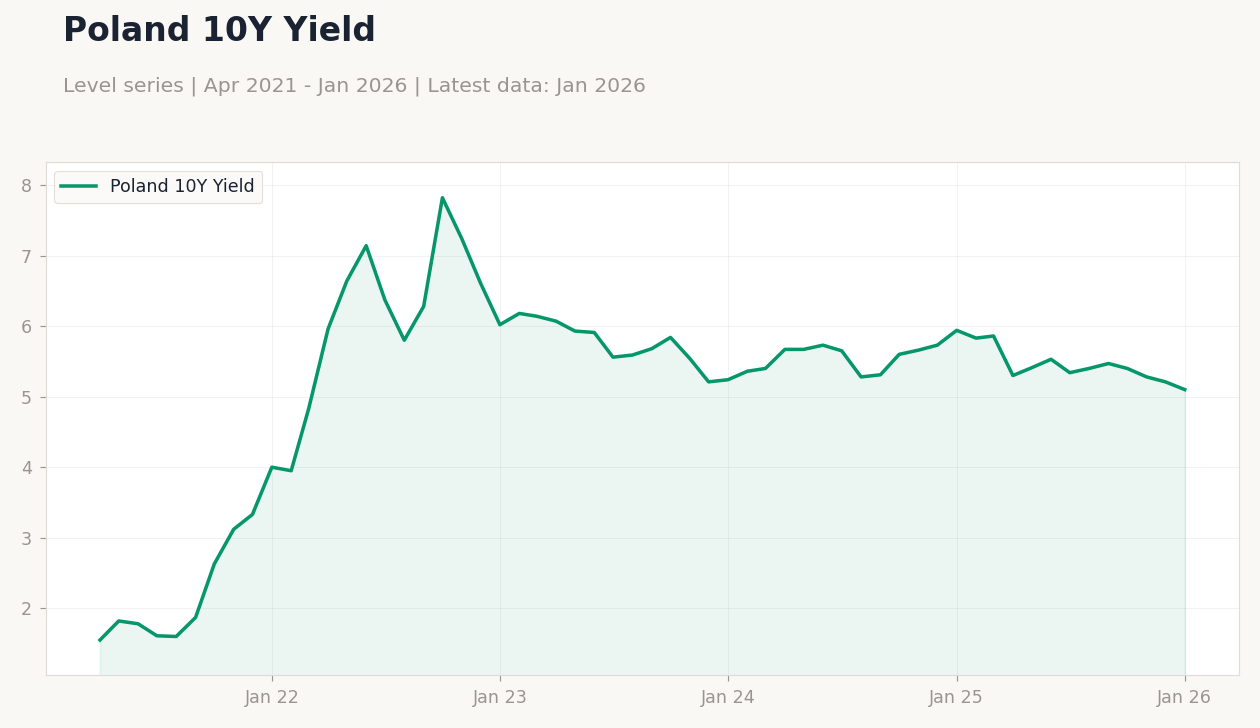
| Poland 10Y Govt Yield | 5.10% | -2.11% |
| Hungary 10Y Govt Yield | 6.67% | -3.19% |
Prior Economic Events
| Data | Prior | Cons | Actual |
|---|---|---|---|
| Industrial Production Year-over-Year | -2.10 | - | -1.80 |
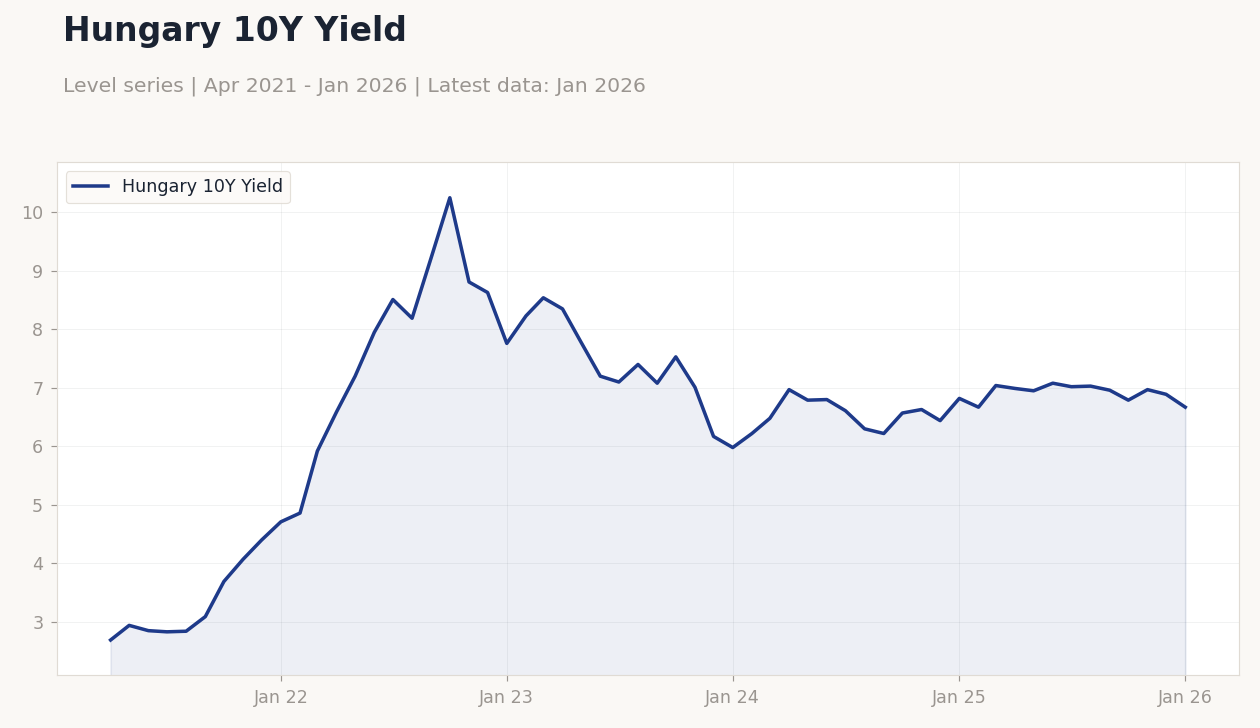 Hungary 10Y Yield | Type: macro_line | Hungary 10Y Yield: 6.67 (2026-01-01) | Range: 2.69–10.25 | Trend(6pt): 2.69,7.95,7.4,6.57,6.89,6.67
Today's Economic Events
| Data | Prior | Cons | Time |
|---|---|---|---|
| TCMB Interest Rate Decision | 37 | 37 | 03:00 |
| Inflation Rate Month-over-Month | 0.60 | 0.60 | 01:00 |
| Inflation Rate Year-over-Year | 2.20 | - | 01:00 |
- Turkey's industrial production rose to -1.8% YoY in February, up from -2.1% prior, signaling modest manufacturing recovery amid tight monetary policy.
- Regional equities and currencies mixed: BIST 100 jumped 3.73%, forint gained vs euro, while zloty and koruna weakened slightly.
- Bond yields declined in Poland and Hungary, Brent crude fell 3.76% on Iran crisis fears, gold dipped 0.31%, Bitcoin rose 2.37%.
Yesterday's Recap
Turkey led yesterday's data releases with February industrial production at -1.8% YoY, improving from January's -2.1%, indicating gradual stabilization in output despite elevated inflation and CBRT's restrictive measures. The BIST 100 advanced 3.73% to 13,175.70, supported by lira steadiness, as USD/TRY edged down 0.02% to 44.07. Poland's iShares ETF rose 0.06% to 35.68, but EUR/PLN climbed 0.38% to 4.26, reflecting mild zloty softening in volatile CEE FX markets.
Hungary's forint firmed, with EUR/HUF dropping 0.86% to 383.73, contributing to a 3.19% decline in 10Y yields to 6.67%. The Czech koruna weakened modestly, as EUR/CZK rose 0.16% to 24.38. Poland's 10Y yields fell 2.11% to 5.10%, signaling reduced risk perceptions.
Romania saw no major data, staying secondary to regional trends. These developments highlighted Turkey's unique high-inflation context against CEE's eurozone linkages.
The Day Ahead
Focus shifts to Turkey's TCMB interest rate decision on March 12, expected to maintain the 37% rate amid ongoing inflation challenges, with guidance on potential future adjustments key for markets. Poland's February inflation data, including MoM at consensus 0.6% after January's 0.6% and YoY figures, is due on March 13, offering clues on NBP policy amid Iran-related risks. These releases may drive FX volatility, especially USD/TRY, given Turkey's exposure to global sentiment.
Czech Republic, Hungary, and Romania have no significant events, leaving room for spillover from ECB or energy market shifts. Traders should watch energy assets for Iran crisis impacts.
Other Economic Notes
Emerging Europe's reliance on imported energy heightens risks from the Iran crisis, prompting Poland and Hungary to seek diversified supplies to reduce dependence on Russian gas. EU funds aid convergence in Czech Republic and Romania, but Hungary's rule-of-law disputes with Brussels risk delaying allocations. Turkey's separate challenges, including persistent inflation and geopolitical tensions, underscore policy differences from CEE counterparts aligned with eurozone norms.