| Asset | Level | Change |
|---|---|---|
| BIST 100 | 12,956.72 | -1.04% |
| iShares Poland | 35.08 | +1.74% |
| EUR/PLN | 4.27 | +0.13% |
| EUR/HUF | 390.50 | -0.22% |
| EUR/CZK | 24.42 | +0.05% |
| USD/TRY | 44.18 | -0.00% |
| Brent Crude | 103.01 | -0.13% |
| Gold | 5,041.90 | -0.21% |
| Bitcoin | 74,328.62 | +2.11% |
| Poland 10Y Govt Yield | 4.99% | -2.16% |
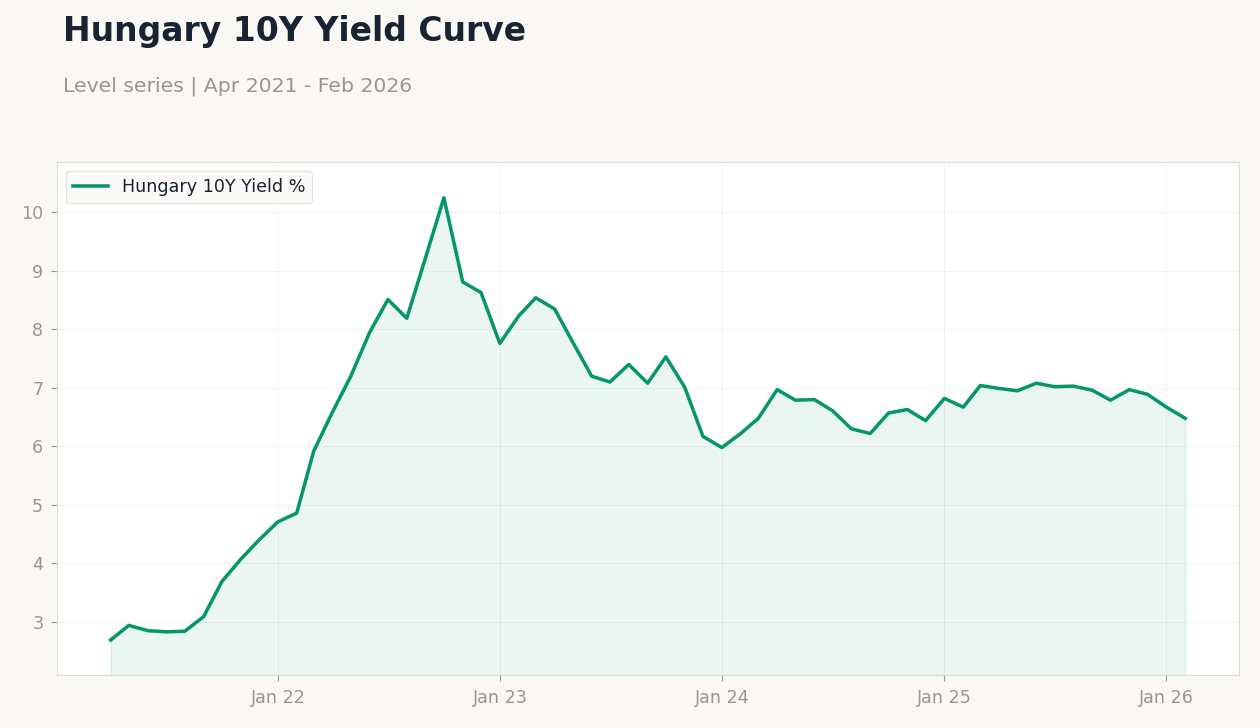
| Hungary 10Y Govt Yield | 6.48% | -2.85% |
| Data | Prior | Cons | Actual |
|---|---|---|---|
| No events available | |||
Poland 10Y vs Hungary 10Y | Type: macro_line | Poland 10Y: 4.99 (2026-02-01) | Range: 1.55–7.82 | Trend(6pt): 1.55,7.14,5.59,5.6,5.21,4.99 | Hungary 10Y: 6.48 (2026-02-01) | Range: 2.69–10.25 | Trend(6pt): 2.69,7.95,7.4,6.57,6.89,6.48
| Data | Prior | Cons | Time |
|---|---|---|---|
| No events available | |||
Emerging European markets displayed mixed results on March 16, with Turkey's BIST 100 index falling 1.04% to 12,956.72, amid persistent concerns over lira stability even as USD/TRY remained unchanged at 44.18. Poland's iShares Poland ETF advanced 1.74% to 35.08, driven by headlines celebrating the nation's rise to the 20th largest global economy, evolving from communist-era rationing to a $1 trillion powerhouse via EU integration. The zloty saw slight softening, with EUR/PLN increasing 0.13% to 4.27, while Poland's 10-year government bond yield declined 2.16% to 4.99%, indicating stronger investor trust in its growth trajectory.
Hungary's forint firmed modestly, with EUR/HUF dropping 0.22% to 390.50, and its 10-year yield fell 2.85% to 6.48%, against a backdrop of EU disputes over Russian fertilizer tariffs. The Czech koruna experienced minimal fluctuation, with EUR/CZK up 0.05% to 24.42, as the region navigated energy market volatility, including Brent crude slipping 0.13% to 103.01. Gold edged down 0.21% to 5,041.90, maintaining safe-haven appeal, while Bitcoin climbed 2.11% to 74,328.62, providing diversification amid currency pressures.
Turkey stood out with its distinct challenges, including elevated inflation risks, contrasting the EU-aligned stability in Poland, Hungary, and Czech Republic.
March 17 offers a subdued calendar for Emerging Europe, featuring no significant data releases or events in Poland, Czech Republic, Hungary, Romania, or Turkey. Market participants will watch for ripple effects from global developments, especially US indicators that might sway ECB-influenced policies in Central and Eastern Europe. Geopolitical updates, such as Hungary's advocacy to lift EU tariffs on Russian and Belarusian fertilizers, could impact regional agriculture and input costs.
In Turkey, ongoing lira monitoring persists due to central bank limitations, though no official statements are anticipated. Potential EU funding inflows may bolster Poland and Hungary, reinforced by recent economic convergence stories. With few domestic drivers, external factors like Middle East conflicts could intensify focus on energy security and import dependencies.
Subscribe to Emerging Europe Macro Daily and get each new issue delivered to your inbox.
Already a member? Visit robomacro.com to log in and manage subscriptions, or use Forgot Password to set a password.
Hungary 10Y Yield Curve | Type: macro_line | Hungary 10Y Yield %: 6.48 (2026-02-01) | Range: 2.69–10.25 | Trend(6pt): 2.69,7.95,7.4,6.57,6.89,6.48
Poland ETF Performance | Type: market_hloc | iShares Poland ETF: 35.08 (2026-03-16) | Range: 34.27–38.76 | Trend(5pt): 34.27,36.2,37.66,37.95,35.08
Turkey BIST 100 Index | Type: market_hloc | BIST 100: 1.296e+04 (2026-03-16) | Range: 1.115e+04–1.434e+04 | Trend(6pt): 1.135e+04,1.209e+04,1.383e+04,1.38e+04,1.329e+04,1.296e+04
EUR/PLN Currency Pair | Type: market_hloc | EUR/PLN: 4.271 (2026-03-17) | Range: 4.197–4.296 | Trend(6pt): 4.211,4.211,4.204,4.222,4.266,4.271
Poland's ascent to the 20th largest economy highlights effective post-communist reforms, shifting from sugar rationing to robust EU-driven growth and trade. This achievement stands in contrast to Hungary's issues, including political tensions with large rallies ahead of elections and disputes over the Przyjaźń pipeline, where Hungary accused Poland's foreign minister of misinformation. Turkey contends with high inflation and geopolitical strains, diverging from the EU convergence paths of peers.
Across the region, common risks from Russian energy reliance endure, amplified by global events like Middle East conflicts affecting oil prices and supply chains.
International developments are influencing Emerging Europe's landscape, with FXStreet emphasizing how global events are reshaping Poland's economy during its milestone rise. AP News and MSN detailed Poland's journey from post-communist struggles to a top-20 economy, while Newser and Devdiscourse highlighted its transformation into a European powerhouse. Former Fed officials warned of US economic risks via TheStreet, potentially curbing demand for CEE exports in sectors like Polish and Czech manufacturing.
Ghana's central bank governor, per Ghana News Agency, cautioned on Middle East conflicts threatening emerging economies through energy disruptions, a concern for Hungary and Romania's gas dependencies. TimesLIVE reported the UK economy stalling pre-Iran war energy shocks, echoing vulnerabilities for Turkey's oil-linked markets. Arab News covered Saudi Arabia's pivot to an art economy for diversification, which could model strategies for Turkey amid Brent fluctuations.
Politico noted Hungary's call to end EU tariffs on Russian and Belarusian fertilizers to lower farmer costs, challenging sanctions and possibly aiding Polish and Romanian agriculture. Vanguard Nigeria highlighted labor warnings on platform economy revenue losses, and Daily Star BD addressed Bangladesh's rejection of US cement overcapacity claims, underscoring trade frictions impacting Emerging Europe's balances. These elements foster risk aversion, with gold and Bitcoin movements supporting CEE asset resilience.
Emerging Europe central banks held steady amid varying inflation trajectories, with Poland's NBP maintaining rates to aid zloty stability and eurozone alignment, shadowing the ECB's deposit rate at 2.00%. The Czech CNB stressed inflation targeting without recent actions, observing koruna levels at EUR/CZK 24.42. Hungary's MNB prioritized forint protection, with EUR/HUF at 390.50 showing efforts against fiscal volatility, though EU funding delays persist.
Romania's BNR emphasized FX steadiness and euro criteria, facing energy risks like peers. Turkey's CBRT navigates political hurdles, refraining from sharp rate adjustments despite persistent inflation, differing from ECB-responsive strategies in the region. (cont...)
Convergence in inflation control marks EU members, while Turkey's approach underscores regional differences. Eurozone unemployment at 6.70% serves as a reference for CEE labor dynamics, enhancing convergence attractiveness for Poland and Czech Republic.
