Emerging Europe Macro Daily(Beta Mode)
MNB Holds, Turkey Sentiment Slips
Market Snapshot
| Asset | Level | Change |
|---|---|---|
| BIST 100 | 12,930.16 | -1.81% |
| iShares Poland | 34.61 | -2.01% |
| EUR/PLN | 4.27 | +0.27% |
| EUR/HUF | 389.47 | +0.60% |
| EUR/CZK | 24.43 | +0.01% |
| USD/TRY | 44.33 | -0.01% |
| Brent Crude | 99.24 | -5.02% |
| Gold | 4,568.00 | +3.83% |
| Bitcoin | 71,168.88 | +0.36% |
| Poland 10Y Govt Yield | 4.99% | -2.16% |
| Hungary 10Y Govt Yield | 6.48% | -2.85% |
Prior Economic Events
| Data | Prior | Cons | Actual |
|---|---|---|---|
| Consumer Confidence Index | 85.70 | - | 85 |
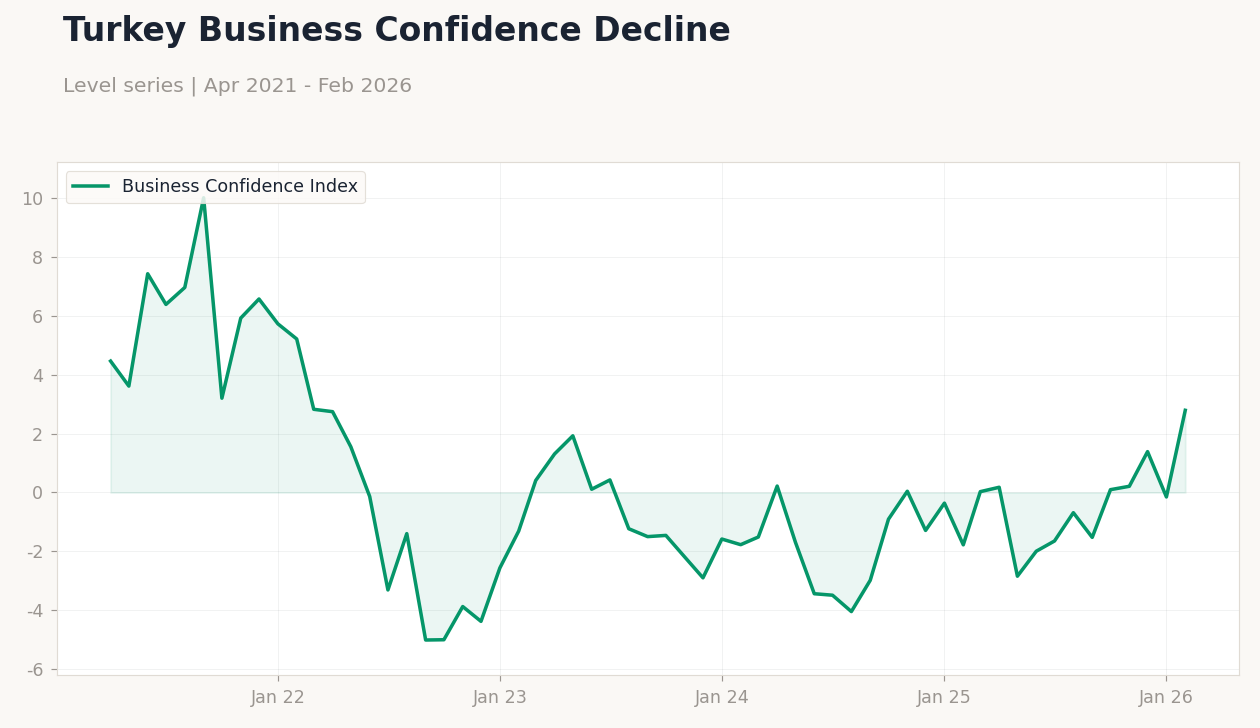
| Business Confidence Index | 104.10 | - | 101 |
| Headline Unemployment Rate | 6 | 6.10 | 6.10 |
 Hungary 10Y Yield vs Policy | Type: macro_line | 10Y Government Yield (%): 6.48 (2026-02-01) | Range: 2.69–10.25 | Trend(6pt): 2.69,7.95,7.4,6.57,6.89,6.48
Today's Economic Events
| Data | Prior | Cons | Time |
|---|---|---|---|
| No events available | |||
- Hungary's MNB held rates at 6.25% amid geopolitical risks, lowering its growth outlook due to the Iran war.
- Turkey's consumer and business confidence indices declined, signaling weakening sentiment amid global uncertainties.
- Poland's unemployment rate met consensus at 6.1%, while markets saw declines in equities and a rally in bonds.
Yesterday's Recap
Emerging Europe markets reflected global risk aversion, with Turkey's BIST 100 dropping 1.81% to 12,930.16 amid falling confidence indicators. Poland's headline unemployment rate came in at 6.1% as expected, underscoring labor market resilience in the region's largest CEE economy despite broader slowdown fears. Turkey reported a dip in consumer confidence to 85 from 85.7 and business confidence to 101.00 from 104.1, highlighting domestic pressures from high inflation and external shocks.
Hungarian assets showed mixed performance, with the EUR/HUF rising 0.60% to 389.47 following the MNB's rate hold, while the 10Y government yield fell 2.85% to 6.48%. Poland's iShares ETF declined 2.01% to 34.61, and the EUR/PLN appreciated 0.27% to 4.27, supported by news of Poland achieving 20th global economy status. Czech and Romanian data were absent, but the EUR/CZK held nearly flat at 24.43 with a 0.01% gain, amid stable regional FX dynamics.
The Day Ahead
With no major data releases scheduled for today in Emerging Europe, markets will likely focus on global cues, including any escalations in the Iran war that could impact energy prices and risk sentiment. Attention may turn to Hungary's ongoing MNB policy implications, as the central bank's revised growth outlook could influence forint volatility. Poland's defense sector developments, such as potential British arms contracts, might provide supportive news flow for investor confidence.
Broader EU fund absorption in CEE countries remains a watchpoint, potentially aiding fiscal stability. Tomorrow also lacks key events, setting up a quiet period ahead of any late-week global macro updates.
Other Economic Notes
Poland's ascent to the 20th largest global economy highlights its robust growth trajectory, driven by strong EU trade linkages and industrial output, though it faces challenges from energy dependencies. The Polish government's push for a digital tax on large firms could generate billions in revenue, aiding fiscal consolidation toward EU deficit targets. Hungary's forint strengthened significantly on de-escalation hopes, with the EUR/HUF returning near the middle of its war-driven corridor.
(cont...)