Emerging Europe Macro Daily(Beta Mode)
Poland Jobless Steady, Turkey Confidence Dips
Market Snapshot
| Asset | Level | Change |
|---|---|---|
| BIST 100 | 12,963.87 | +0.26% |
| iShares Poland | 35.49 | +2.54% |
| EUR/PLN | 4.28 | +0.16% |
| EUR/HUF | 387.23 | -0.51% |
| EUR/CZK | 24.45 | +0.13% |
| USD/TRY | 44.34 | +0.00% |
| Brent Crude | 98.76 | -3.38% |
| Gold | 4,514.50 | -0.78% |
| Bitcoin | 70,537.09 | +0.03% |
| Poland 10Y Govt Yield | 4.99% | -2.16% |
| Hungary 10Y Govt Yield | 6.48% | -2.85% |
Prior Economic Events
| Data | Prior | Cons | Actual |
|---|---|---|---|
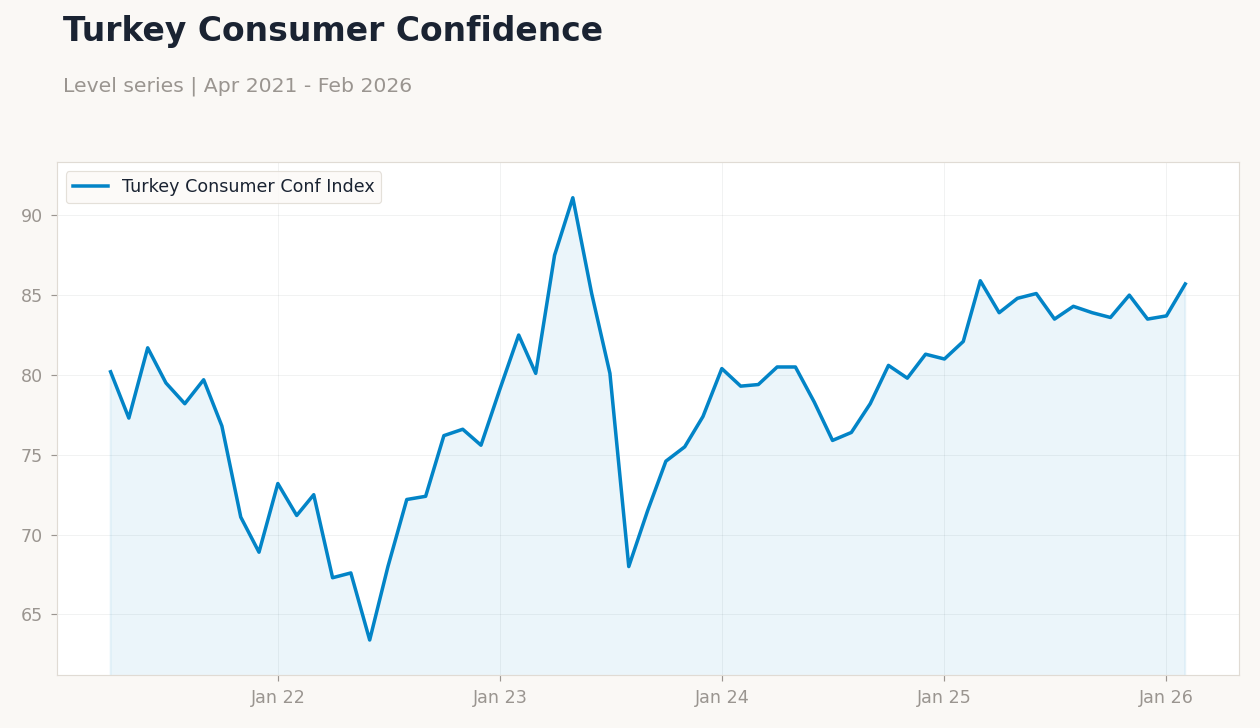
| Consumer Confidence Index | 85.70 | - | 85 |
| Business Confidence Index | 104.10 | - | 101 |
| Headline Unemployment Rate | 6 | 6.10 | 6.10 |
 Turkey Business Confidence | Type: macro_line | Turkey Business Conf Index: 2.796 (2026-02-01) | Range: -5.017–10.03 | Trend(6pt): 4.47,-0.1346,-1.232,-0.9081,1.39,2.796
Today's Economic Events
| Data | Prior | Cons | Time |
|---|---|---|---|
| No events available | |||
- Poland's unemployment rate met expectations at 6.1%, signaling labor market stability amid strong growth, while Turkish consumer and business confidence indices declined, underscoring economic strains.
- Regional markets mixed: iShares Poland up +2.54%, EUR/HUF down -0.51% on forint strength, BIST 100 +0.26% despite sentiment weakness.
- Iran war escalates global energy risks, pressuring Emerging Europe, though Poland's rise to 20th largest economy spotlights regional resilience.
Yesterday's Recap
Poland's headline unemployment rate met consensus at 6.1%, up from the previous 6.0%, reflecting a resilient labor market in Central Europe's largest economy despite geopolitical headwinds. In Turkey, consumer confidence fell to 85 from 85.7, and business confidence dropped to 101.00 from 104.1, highlighting inflation and tension impacts. iShares Poland climbed 2.54% to 35.49, supported by news of Poland achieving 20th largest global economy status.
The Hungarian forint strengthened, with EUR/HUF falling 0.51% to 387.23, amid reports of easing war pressures. Turkey's BIST 100 rose 0.26% to 12,963.87, while USD/TRY remained flat at 44.34, indicating tentative stability. EUR/CZK increased 0.13% to 24.45, and EUR/PLN rose 0.16% to 4.28, showing mild FX fluctuations.
Bond yields eased, with Poland's 10Y yield down 2.16% to 4.99% and Hungary's 10Y yield falling 2.85% to 6.48%, suggesting safe-haven demand.
The Day Ahead
No key data releases are scheduled for Emerging Europe today, so focus shifts to global developments, including Iran war updates that could drive energy price volatility and strain import-reliant nations like Poland and Hungary. Traders may watch EU progress on Hungary's frozen funds amid rule-of-law issues. In Turkey, lira monitoring intensifies after confidence declines, with potential central bank interventions if volatility rises.
Czech and Romanian markets could trade quietly, but ECB commentary might affect local policy outlooks. Geopolitical risks and commodity moves will dominate regional sentiment.
Other Economic Notes
Poland's status as the 20th largest global economy reflects robust EU integration and growth drivers, though energy vulnerabilities persist. Hungary contends with fiscal strains from the Iran war, including higher energy costs and threats to halt gas supplies to Ukraine, heightening tensions. Regional inflation diverges, with Turkey's elevated levels contrasting Central Europe's cooling trends.
Romania advances toward euro adoption, supported by structural reforms.