| Asset | Level | Change |
|---|---|---|
| BIST 100 | 14,058.50 | -0.11% |
| iShares Poland | 39.85 | +1.43% |
| EUR/PLN | 4.24 | -0.27% |
| EUR/HUF | 362.78 | -0.95% |
| EUR/CZK | 24.36 | +0.01% |
| USD/TRY | 44.71 | +0.03% |
| Brent Crude | 98.53 | -0.84% |
| Gold | 4,783.90 | +0.88% |
| Bitcoin | 74,319.79 | +5.04% |
| Poland 10Y Govt Yield | 4.99% | -2.16% |
| Hungary 10Y Govt Yield | 6.48% | -2.85% |
| Data | Prior | Cons | Actual |
|---|---|---|---|
| No events available | |||
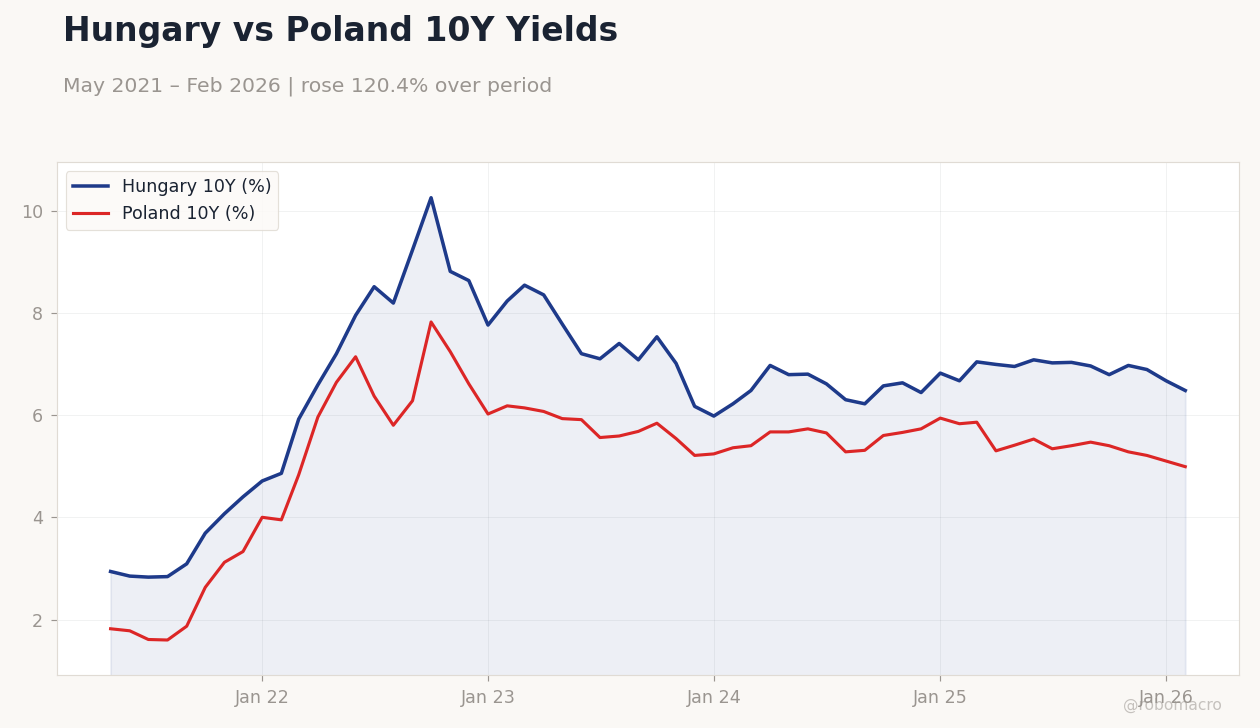
Hungary vs Poland 10Y Yields | Type: macro_line | Hungary 10Y (%): 6.48 (2026-02-01) | Range: 2.83–10.25 | Trend(6pt): 2.94,8.51,7.08,6.63,6.67,6.48 | Poland 10Y (%): 4.99 (2026-02-01) | Range: 1.6–7.82 | Trend(6pt): 1.82,6.37,5.68,5.66,5.1,4.99
| Data | Prior | Cons | Time |
|---|---|---|---|
| Business Confidence Index | 101 | - | 03:00 |
Emerging European markets displayed resilience amid global volatility, with Hungary's forint strengthening sharply as EUR/HUF fell 0.95% to 362.78 following Orban's defeat, signaling optimism for policy changes and EU fund inflows. Poland's iShares ETF rose 1.43% to 39.85, bolstered by news of expanded defense cooperation with South Korea and potential ESA center plans, while Poland's 10Y government yield dropped 2.16% to 4.99%, indicating safe-haven demand in the largest CEE economy. Turkey's BIST 100 index slipped 0.11% to 14,058.50, weighed by a slight 0.03% rise in USD/TRY to 44.71 amid persistent inflation worries, though no key data emerged.
In the Czech Republic, import and export prices declined in February due to crown appreciation, with EUR/CZK edging up 0.01% to 24.36, highlighting vulnerabilities to energy and commodity swings. Hungarian 10Y yields fell 2.85% to 6.48%, consistent with the forint's surge and lower political risk premiums. Broader regional assets gained support from gold's 0.88% advance to 4,783.90, countering Brent crude's 0.84% decline to 98.53.
Bitcoin climbed 5.04% to 74,319.79, adding to mixed equity moves. Overall, Hungary's political developments overshadowed Turkey's macro pressures.
No major data releases are scheduled for today or tomorrow across Emerging Europe, providing space to assess Hungary's election fallout and EU ties. Turkey's Business Confidence Index is due on April 21 at 03:00 ET, with medium impact; previous reading was 101, consensus unavailable, but a drop could reflect weakening sentiment from inflation and geopolitics. IMF and World Bank spring meetings continue in Washington through April 18, discussing war impacts, with Turkey's Finance Minister Mehmet Şimşek attending, potentially shaping regional funding.
Poland's ESA center decision, slated by end-May, remains key for investments. Markets will watch forint movements as Péter Magyar details his agenda, alongside any ECB hints influencing CNB and MNB policies.
Subscribe to Emerging Europe Macro Daily and get each new issue delivered to your inbox.
Already a member? Visit robomacro.com to log in and manage subscriptions, or use Forgot Password to set a password.
Czech 10Y Government Yield | Type: macro_line | Czech 10Y (%): 4.371 (2026-02-01) | Range: 1.673–5.518 | Trend(6pt): 1.742,4.402,4.494,4.104,4.46,4.371
EUR/HUF vs EUR/PLN Rates | Type: market_hloc | EUR/HUF: 362.9 (2026-04-14) | Range: 362.9–394.7 | Trend(5pt): 386,379.4,374.8,392.5,362.9 | EUR/PLN: 4.244 (2026-04-14) | Range: 4.197–4.296 | Trend(5pt): 4.211,4.213,4.222,4.271,4.244
Brent Crude Futures | Type: market_hloc | Brent Price: 98.56 (2026-04-14) | Range: 63.76–118.3 | Trend(6pt): 66.52,67.55,72.48,112.2,99.36,98.56
iShares Poland ETF | Type: market_hloc | EPOL Price: 39.85 (2026-04-13) | Range: 34.48–39.85 | Trend(5pt): 36.03,37.37,38.13,34.48,39.85
Poland is moving beyond its low-cost economy label, with rising wages and standards challenging inflation control and euro convergence, as noted in recent reports. Hungary's shift under Péter Magyar may speed EU fund releases, previously stalled by rule-of-law issues, aiding infrastructure and defense. Czech import/export prices dropped due to a stronger crown, easing costs for energy and commodities like electricity and oil products.
Global markets faced US-Iran conflict tensions, lifting safe-haven gold 0.88% while Brent crude fell 0.84% on supply fears, affecting Emerging Europe's importers like Poland and Hungary. US inflation increased from energy prices, termed a 'tax' on consumers, possibly delaying Fed rate cuts and pressuring currencies such as the TRY. The ECB deposit rate stands at 2.00%, guiding CNB and MNB, with Eurozone unemployment at 6.70% indicating stable labor conditions contrasting Turkey's volatility.
ECB transferred crypto oversight to ESMA amid rate cut hopes, potentially boosting digital finance trust in Poland. Nigeria's naira ranked as Africa's second-best performer despite US-Iran strife, echoing Hungary's forint resilience. IMF meetings address war's economic effects, relevant for Emerging Europe's trade.
UAE and Uzbekistan explored new economy partnerships, while Indonesia saw moderate US-Iran war impacts. South Korea and Poland agreed to enhance defense ties during Seoul talks.
The National Bank of Poland maintains caution on rates amid cooling inflation, bolstering zloty as EUR/PLN dropped 0.27%, stressing fiscal discipline near EU deficit caps. Czech National Bank gains from crown strength, tracking ECB at 2.00% deposit rate, monitoring import price falls for deflation risks without interventions. Hungary's National Bank may gain policy flexibility post-Orban, with forint gains easing FX needs; it follows ECB but focuses on inflation credibility during transitions.
Romania's National Bank prioritizes euro convergence, aided by stable unemployment, though lagging CNB and MNB in ECB alignment due to reform pace. Turkey's Central Bank contends with political limits and high inflation, potentially requiring tightening, differing from EU peers' convergence focus. Divergences persist, with CNB and MNB closer to ECB, while CBRT's approaches mark Turkey as an outlier; Hungary's changes could improve MNB credibility via EU funds.
