Eurozone Macro Daily(Beta Mode)
ECB Holds Steady Amid Oil Volatility
Market Snapshot
| Asset | Level | Change |
|---|---|---|
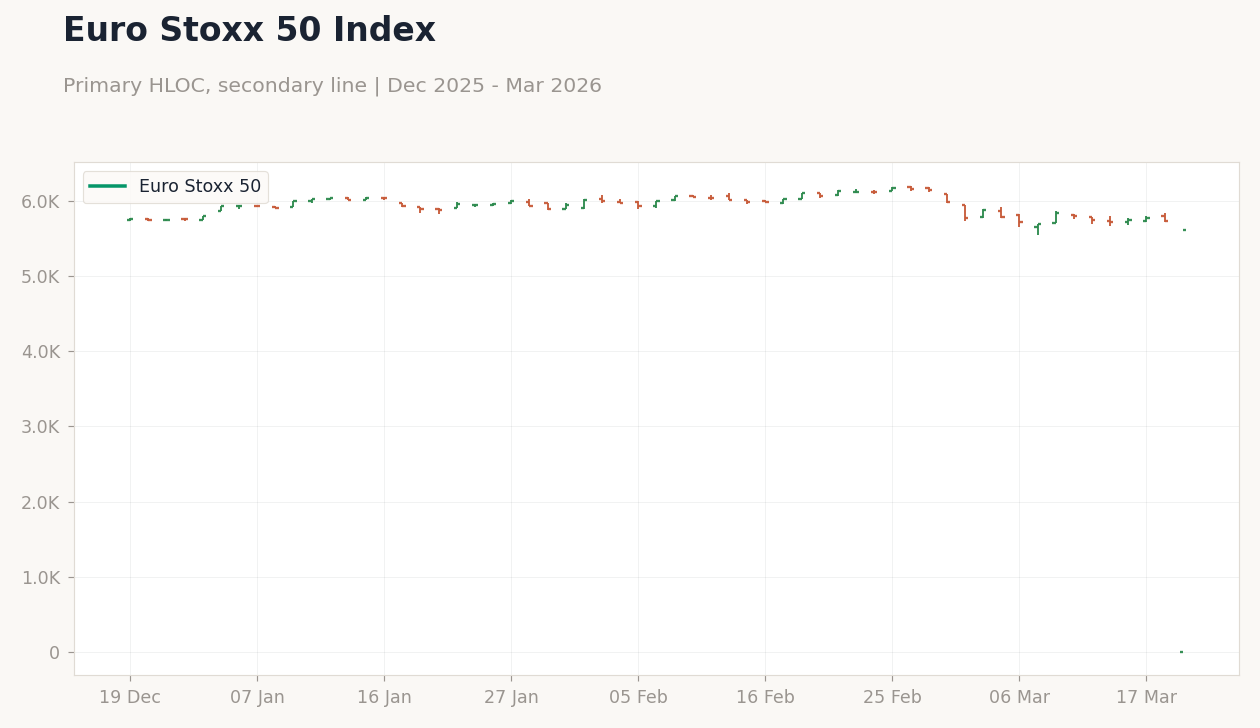
| Euro Stoxx 50 | 5,613.83 | -2.14% |
| DAX | 23,502.25 | -0.96% |
| CAC 40 | 7,807.87 | -2.03% |
| EUR/USD | 1.16 | +0.83% |
| EUR/GBP | 0.86 | +0.05% |
| EUR/JPY | 183.02 | -0.08% |
| Gold | 4,718.80 | +2.57% |
| Brent Crude | 102.66 | -5.51% |
| Bitcoin | 70,777.64 | -0.66% |
| German 2Y Bund | - | - |
| German 10Y Bund | 2.81% | -0.27% |
Prior Economic Events
| Data | Prior | Cons | Actual |
|---|---|---|---|
| ZEW Economic Sentiment Index | 58.30 | 39 | -0.50 |
| Headline Unemployment Rate | 4 | - | 4.10 |
 Brent Crude Oil | Type: market_hloc | Brent Crude: 102.8 (2026-03-20) | Range: 59.96–108.7 | Trend(5pt): 62.07,66.52,67.55,72.48,102.8
Today's Economic Events
| Data | Prior | Cons | Time |
|---|---|---|---|
| Producer Price Index Year-over-Year | -3 | -2.70 | 23:00 |
| Trade Balance | 6,037m | 5,650m | 01:00 |
- ECB keeps deposit rate at 2.00%, warns on energy aid amid Mideast risks and persistent inflation.
- Stocks slide with Euro Stoxx 50 down 2.14%, CAC 40 off 2.03%, as ECB signals caution on cuts.
- German ZEW sentiment drops sharply to -0.5, reflecting pessimism from global tensions.
Yesterday's Recap
European markets declined amid geopolitical tensions in the Middle East and ECB policy signals. The Euro Stoxx 50 index fell 2.14% to 5,613.83, while Germany's DAX dropped 0.96% to 23,502.25. France's CAC 40 decreased 2.03% to 7,807.87, influenced by concerns over prolonged high rates and oil price swings.
The euro gained against the dollar, with EUR/USD up 0.83% to 1.16, EUR/GBP rising 0.05% to 0.86, and EUR/JPY slipping 0.08% to 183.02. German 10-year Bund yields fell 0.27% to 2.81%, indicating some safe-haven demand despite equity losses. Germany's ZEW Economic Sentiment Index for March fell to -0.5, well below the consensus of 39 and previous 58.3, underscoring recession fears from energy disruptions.
The Netherlands' headline unemployment rate rose to 4.1% from 4.0%, suggesting mild labor market softening but remaining low historically. Brent crude dropped 5.51% to 102.66, driven by volatile supply concerns. These factors highlighted Eurozone exposure to external shocks, pressuring risk assets.
The Day Ahead
Focus turns to Germany's February producer price index at 23:00 ET, with consensus for a -2.7% year-over-year change from -3.0% prior, which may indicate softening input costs. Italy's January trade balance follows at 01:00 ET, expected at €5.65 billion versus €6.037 billion previous, potentially showing export strength despite trade frictions. No key ECB events or speakers are slated, allowing markets to process the recent rate decision.
Broader sentiment could be swayed by Mideast developments, with escalations likely boosting volatility in energy-linked areas. These data points may affect ECB easing expectations, currently tempered by inflation pressures.
Other Economic Notes
Eurozone faces ongoing inflation threats from Mideast conflicts affecting energy supplies, leading to ECB restraint on policy easing. Key economies like Germany and France encounter growth challenges, with projections noting downside risks from geopolitical factors. Labor markets show resilience overall, though the uptick in Dutch unemployment hints at vulnerabilities if energy costs rise.
(cont...)