Eurozone Macro Daily(Beta Mode)
German Orders Miss, DAX Slides as IP Holds
Market Snapshot
| Asset | Level | Change |
|---|---|---|
| Euro Stoxx 50 | 6,062.29 | +0.00% |
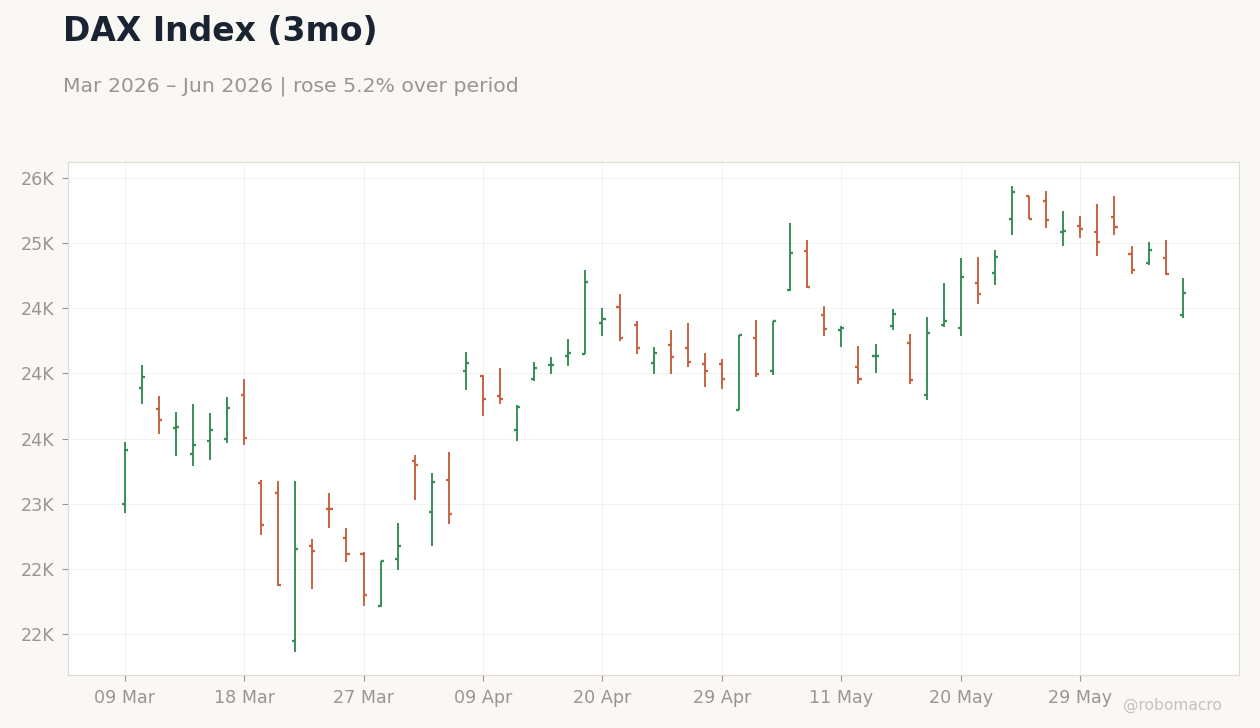
| DAX | 24,759.05 | -0.75% |
| CAC 40 | 8,199.29 | -0.23% |
| EUR/USD | 1.16 | +0.28% |
| EUR/GBP | 0.86 | -0.02% |
| EUR/JPY | 184.90 | +0.09% |
| Gold | 4,368.30 | +0.75% |
| Brent Crude | 93.23 | -1.08% |
| Bitcoin | 63,403.42 | +0.26% |
| German 2Y Bund | - | - |
| German 10Y Bund | 3.00% | +2.97% |
Prior Economic Events
| Data | Prior | Cons | Actual |
|---|---|---|---|
| Factory Orders Month-over-Month | 4.50 | -1.20 | -3.80 |
| Trade Balance | 14,300m | 15,000m | 14,500m |
| Exports Month-over-Month | 0.50 | - | 0.90 |
| Industrial Production Month-over-Month | -0.70 | 0.40 | 0.40 |
 German 10Y Bund Yield | Type: macro_line | Yield %: 2.996 (2026-04-01) | Range: -0.5386–2.996 | Trend(6pt): -0.4514,1.795,2.601,2.484,2.91,2.996
Today's Economic Events
| Data | Prior | Cons | Time |
|---|---|---|---|
| Industrial Production Month-over-Month | 0.70 | 0 | 00:00 |
| Wednesday (2026-06-10) | |||
| Industrial Production Month-over-Month | 0.70 | 0 | 00:00 |
- German factory orders plunged 3.8% m/m, well below the -1.2% consensus, while industrial production matched the 0.4% forecast.
- DAX fell 0.75% to 24,759.05 and CAC 40 declined 0.23%, with Euro Stoxx 50 unchanged at 6,062.29.
- German 10-year Bund yield rose to 3.00% as markets priced higher ECB terminal rates amid Mideast-driven inflation risks.
Yesterday's Recap
German factory orders contracted 3.8% month-over-month, missing consensus by a wide margin and highlighting persistent weakness in the manufacturing sector. Industrial production rose 0.4% as expected, while exports increased 0.9% and the trade balance printed at 14.5 billion euros. The DAX dropped 0.75% to 24,759.05 and the CAC 40 eased 0.23% to 8,199.29, with Euro Stoxx 50 closing flat.
EUR/USD advanced 0.28% to 1.16 while the German 10-year Bund yield climbed 2.97% to 3.00%. Negative eurozone investor sentiment eased slightly but Germany continued to weigh on the aggregate reading. Brent crude fell 1.08% to 93.23 amid shifting supply signals.
The Day Ahead
Italian industrial production is scheduled for release and is expected to show zero month-over-month growth after the prior 0.7% gain. Markets will watch the print for clues on euro-area manufacturing momentum outside Germany. No major ECB speakers are listed.
French final CPI and any follow-up German trade revisions could also feature. Investors will assess whether the Italian data reinforces or challenges the recent hawkish repricing in OIS curves. Equity futures point to a cautious open ahead of the Italian numbers.
Other Economic Notes
Eurozone unemployment stands at 6.70%, providing a stable labor backdrop that supports the ECB’s data-dependent stance. France and Germany abandoned their joint next-generation fighter jet project, removing a potential 100 billion euro defense stimulus. Investor surveys show sentiment improving modestly outside Germany, where industrial weakness persists.
Broader euro-area resilience data continue to underpin expectations for steady policy rates near current levels.
Global Macro News
Middle East tensions are pushing energy prices higher and lifting eurozone inflation expectations, prompting markets to price an ECB rate hike. Negative global views of Israel have risen sharply, adding geopolitical uncertainty that could sustain safe-haven flows into Bunds. France and Germany’s decision to scrap the fighter-jet program removes a major European defense-spending catalyst.
<i>↓ p.2</i>