| Asset | Level | Change |
|---|---|---|
| Saudi Aramco | 26.66 | -1.48% |
| MSCI Saudi | 37.72 | -0.37% |
| MSCI UAE | 18.07 | -2.85% |
| DFM General | 5,697.71 | +4.15% |
| MSCI Qatar | 18.21 | -2.52% |
| MSCI Kuwait | 36.11 | -1.60% |
| Brent Crude | 98.45 | -5.78% |
| WTI Crude | 91.61 | -0.80% |
| Gold | 4,511.90 | +2.56% |
| USD/SAR | 3.75 | +0.04% |
| USD/AED | 3.67 | +0.01% |
| USD/KWD | 0.31 | +0.00% |
| Bitcoin | 70,867.08 | +0.50% |
| Data | Prior | Cons | Actual |
|---|---|---|---|
| No events available | |||
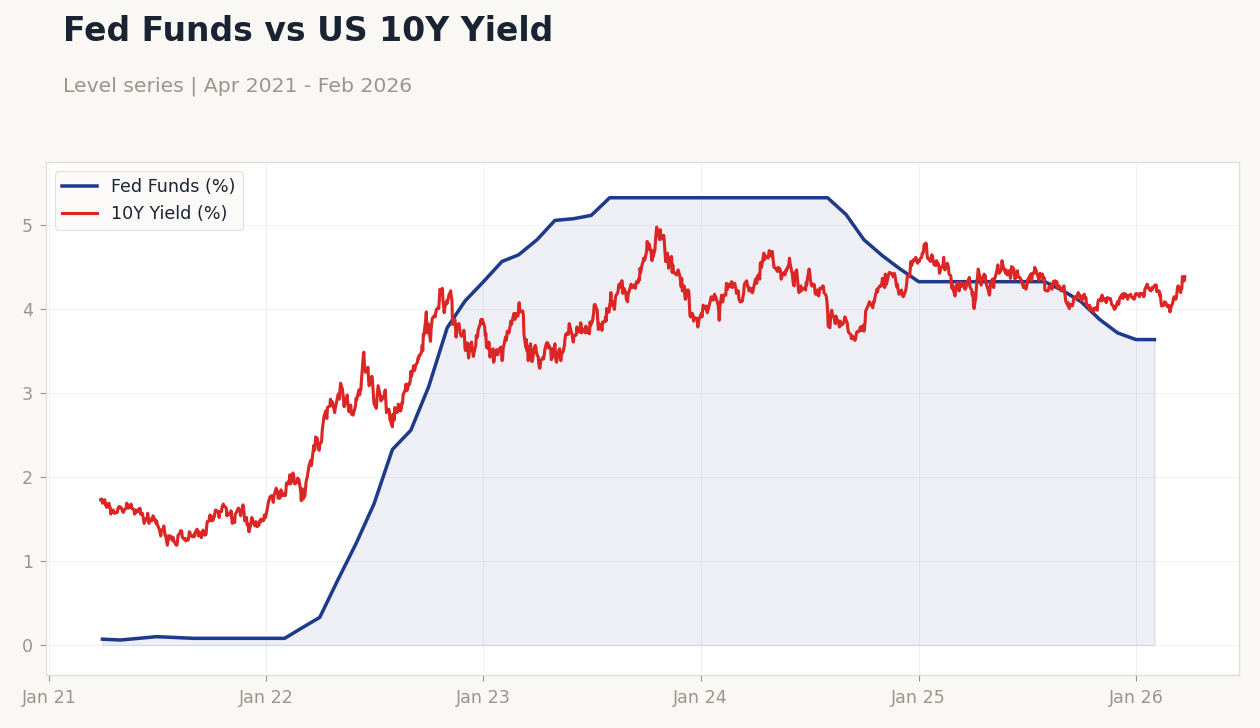
Fed Funds vs US 10Y Yield | Type: macro_line | Fed Funds (%): 3.64 (2026-02-01) | Range: 0.06–5.33 | Trend(6pt): 0.07,1.21,5.33,4.83,3.72,3.64 | 10Y Yield (%): 4.39 (2026-03-24) | Range: 1.19–4.98 | Trend(5pt): 1.73,3.09,4.35,4.5,4.39
| Data | Prior | Cons | Time |
|---|---|---|---|
| No events available | |||
Saudi Arabia's defense ministry reported intercepting 35 drones overnight and additional drones plus a ballistic missile in the eastern region, attributed to potential Houthi or Iranian proxies, with no damage to oil infrastructure but highlighting ongoing security threats. This follows multiple similar incidents, including more drone interceptions east of the country. The World Economic Forum postponed its Jeddah summit due to regional conflict, impacting global investment sentiment toward the GCC.
Reports suggest Saudi Arabia may be nearing involvement in the Iran conflict, escalating tensions, though the kingdom denies favoring prolonged war. UAE markets displayed divergence: the DFM General index jumped +4.15% to 5,697.71, buoyed by real estate and consumer optimism, contrasting with MSCI UAE's -2.85% drop to 18.07. Saudi Aramco fell -1.48% to 26.66, aligning with energy sector pressures as Brent crude plunged -5.78% to 98.45 and WTI dipped -0.80% to 91.61.
MSCI Saudi eased -0.37% to 37.72, MSCI Qatar declined -2.52% to 18.21, and MSCI Kuwait slipped -1.60% to 36.11, reflecting caution over geopolitical risks. Heavy rains struck UAE's Sharjah, Dubai, and Abu Dhabi, prompting police to lower speed limits and implement safety measures, potentially disrupting short-term economic activity. Qatar lifted remote work rules for private sector employees, signaling a return to office-based operations.
No macroeconomic data releases occurred across the GCC, keeping attention on security developments and commodity volatility.
No scheduled economic data releases or events in the GCC calendar, directing focus to potential updates on Saudi security measures post-interceptions, which could influence oil risk premiums and sovereign spreads. Monitoring for any escalation in Iran tensions, including threats to seize Bahrain and UAE coastlines or strike regional water infrastructure, remains key for Strait of Hormuz stability and energy flows. UAE may issue further guidance on rain-related disruptions, affecting transportation in major emirates.
Qatar could provide details on implementing the remote work policy shift, aiding non-oil sector productivity. Globally, oil market dynamics and any US Fed signals will be watched, given GCC currency pegs to the USD.
Subscribe to GCC Macro Daily and get each new issue delivered to your inbox.
Already a member? Visit robomacro.com to log in and manage subscriptions, or use Forgot Password to set a password.
Brent vs WTI Oil Prices | Type: macro_line | Brent ($/bbl): 103.8 (2026-03-23) | Range: 59.93–133.2 | Trend(5pt): 64.06,122.2,97.1,72.12,103.8 | WTI ($/bbl): 89.33 (2026-03-23) | Range: 55.44–123.6 | Trend(5pt): 61.49,105.8,91.16,70.8,89.33
Brent Crude HLOC | Type: market_hloc | Brent Crude: 98.71 (2026-03-25) | Range: 59.96–112.2 | Trend(5pt): 60.64,64.92,68.8,81.4,98.71
Gold Price HLOC | Type: market_hloc | Gold: 4506 (2026-03-25) | Range: 4314–5318 | Trend(5pt): 4529,4760,5004,5120,4506
DFM General Index Chart | Type: market_hloc | DFM General: 5698 (2026-03-25) | Range: 5289–6774 | Trend(6pt): 6137,6344,6675,6676,5383,5698
Saudi Arabia is expanding economic ties to Africa under Vision 2030, seeking non-oil investment opportunities to bolster diversification amid volatile energy prices. UAE's adaptive business stories, such as a Dubai jewelry designer's success during crises, underscore resilience in sectors like retail and entrepreneurship. Iranian warnings of potential strikes on Middle East water infrastructure pose risks to GCC countries including Qatar, Bahrain, Saudi Arabia, UAE, Kuwait, and Oman, threatening tourism, hospitality, and broader non-oil economies.
Postponed events like Asian Champions League ties, now moved to Saudi Arabia, highlight how conflicts disrupt regional activities.
Oil markets weakened sharply, with Brent crude down -5.78% to 98.45 amid supply abundance and demand concerns tied to Middle East tensions, pressuring GCC fiscal revenues heavily dependent on energy exports. WTI followed with a -0.80% decline to 91.61. Gold climbed +2.56% to 4,511.90, serving as a safe-haven amid geopolitical uncertainty that could widen GCC credit default swap premiums.
Bitcoin rose +0.50% to 70,867.08, providing diversification for some regional investors beyond oil assets. Currency pairs remained stable: USD/SAR at 3.75 (+0.04%), USD/AED at 3.67 (+0.01%), and USD/KWD at 0.31 (+0.00%). Germany's push for gas companies to diversify beyond US LNG underscores shifting energy alliances, potentially boosting Qatar's LNG role if regional supplies face disruptions.
The World Economic Forum's postponement of its Saudi summit due to conflict illustrates how instability hampers GCC investment inflows. Qatar's minor changes to the QIA board and a cyclone threat to Australian LNG operations add to global energy supply watchpoints, indirectly supporting GCC exporters.
GCC central banks upheld stable policies, aligning with USD pegs amid minimal volatility. Saudi Arabia's SAMA maintained the SAR at 3.75 (+0.04%), while the UAE's CBUAE held the AED at 3.67 (+0.01%), both tracking US Fed actions to curb inflation without policy divergence. Qatar's QCB and Bahrain's CBB preserved their pegs, supported by sufficient FX reserves to buffer against Iran-related risks, with slight upticks in interbank rates like SAIBOR and EIBOR reflecting added premiums.
Kuwait's CBK managed its basket-pegged dinar at 0.31 USD (+0.00%), offering modest flexibility versus pure USD links, yet still coordinated with Fed moves for liquidity stability. Oman's CBO emphasized reserve strength amid oil dips, requiring no interventions as pegs stayed firm. No policy meetings took place, but central banks remain vigilant on reserves to address potential disruptions from regional tensions.
Rate alignment with the Fed constrains independent GCC monetary tools, though Kuwait's approach provides a slight cushion.
