| Asset | Level | Change |
|---|---|---|
| Saudi Aramco | 27.00 | +0.52% |
| MSCI Saudi | 37.91 | -1.30% |
| MSCI UAE | 17.80 | -0.84% |
| DFM General | 5,510.99 | -0.12% |
| MSCI Qatar | 18.16 | -0.98% |
| MSCI Kuwait | 35.58 | -0.66% |
| Brent Crude | 108.11 | -3.96% |
| WTI Crude | 101.74 | +2.11% |
| Gold | 4,520.80 | +0.64% |
| USD/SAR | 3.75 | +0.12% |
| USD/AED | 3.67 | +0.01% |
| USD/KWD | 0.31 | -0.04% |
| Bitcoin | 67,035.66 | +1.08% |
| Data | Prior | Cons | Actual |
|---|---|---|---|
| No events available | |||
Brent vs WTI Crude Prices | Type: macro_line | Brent ($/bbl): 103.8 (2026-03-23) | Range: 59.93–133.2 | Trend(6pt): 63.52,120.8,97.1,73.19,118.4,103.8 | WTI ($/bbl): 89.33 (2026-03-23) | Range: 55.44–123.6 | Trend(6pt): 59.19,109.1,91.16,70.31,96.11,89.33
| Data | Prior | Cons | Time |
|---|---|---|---|
| No events available | |||
GCC markets posted mostly negative closes on March 28 amid sharp oil price declines and escalating Middle East tensions. In Saudi Arabia, the MSCI Saudi index dropped 1.30% to 37.91, pressured by energy sector concerns despite Saudi Aramco edging up 0.52% to 27.00, as Iranian attacks on regional assets heightened uncertainty. UAE benchmarks weakened modestly, with the MSCI UAE index down 0.84% to 17.80 and the DFM General index slipping 0.12% to 5,510.99, amid reports of airport disruptions and damage to an aluminum smelter from missile strikes.
Qatar's MSCI Qatar index fell 0.98% to 18.16, influenced by oil volatility despite positive defense cooperation news with Ukraine. Kuwait saw the MSCI Kuwait index decline 0.66% to 35.58, with stable but watchful currency dynamics. No significant economic data was released across the GCC, but FX rates remained steady, with USD/SAR rising 0.12% to 3.75, USD/AED up 0.01% to 3.67, and USD/KWD down 0.04% to 0.31.
Brent crude settled at 108.11 after a 3.96% drop, contrasting WTI's 2.11% gain to 101.74, underscoring divergent supply pressures. Gold advanced 0.64% to 4,520.80 as a safe haven, while Bitcoin rose 1.08% to 67,035.66. The session highlighted hydrocarbon dependency, with conflicts amplifying fiscal risks for oil-reliant economies like Saudi Arabia and the UAE.
March 29 brings no scheduled economic releases for the GCC, shifting focus to equity sessions in Riyadh, Dubai, Doha, and Kuwait amid ongoing monitoring of Middle East conflicts. Traders will watch for Strait of Hormuz updates, as any disruptions could spike oil volatility and impact sovereign CDS spreads. Saudi and UAE markets may react to infrastructure damage reports, including airport operations and aluminum production setbacks, potentially influencing energy and real estate sectors.
Qatar could see sentiment boosted by defense ties with Ukraine, following Zelenskyy's regional visits, while Kuwait monitors its currency basket for stability. Oman and Bahrain, with limited news, are likely to follow broader GCC trends in FX and interbank rates. Low trading volumes are expected unless new geopolitical developments emerge, with Brent futures serving as a primary indicator for regional economic health.
(cont...)
Subscribe to GCC Macro Daily and get each new issue delivered to your inbox.
Already a member? Visit robomacro.com to log in and manage subscriptions, or use Forgot Password to set a password.
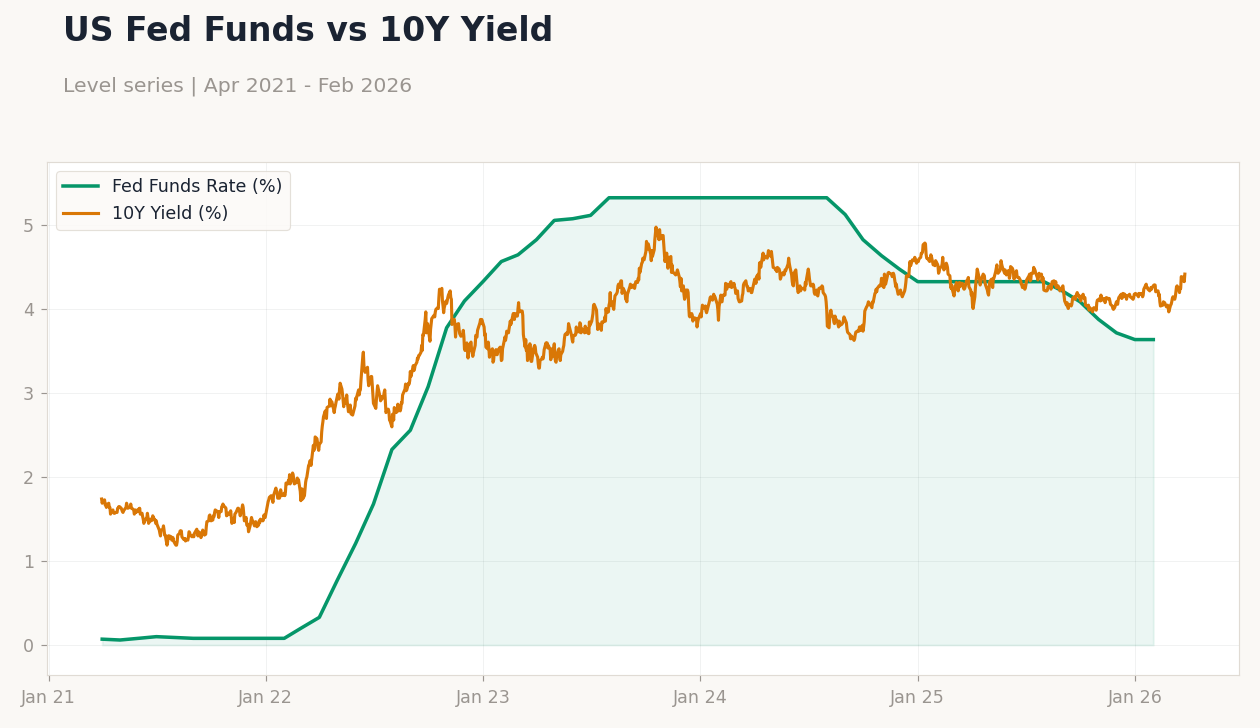
US Fed Funds vs 10Y Yield | Type: macro_line | Fed Funds Rate (%): 3.64 (2026-02-01) | Range: 0.06–5.33 | Trend(6pt): 0.07,1.21,5.33,4.83,3.72,3.64 | 10Y Yield (%): 4.42 (2026-03-26) | Range: 1.19–4.98 | Trend(6pt): 1.74,3.2,4.44,4.52,4.39,4.42
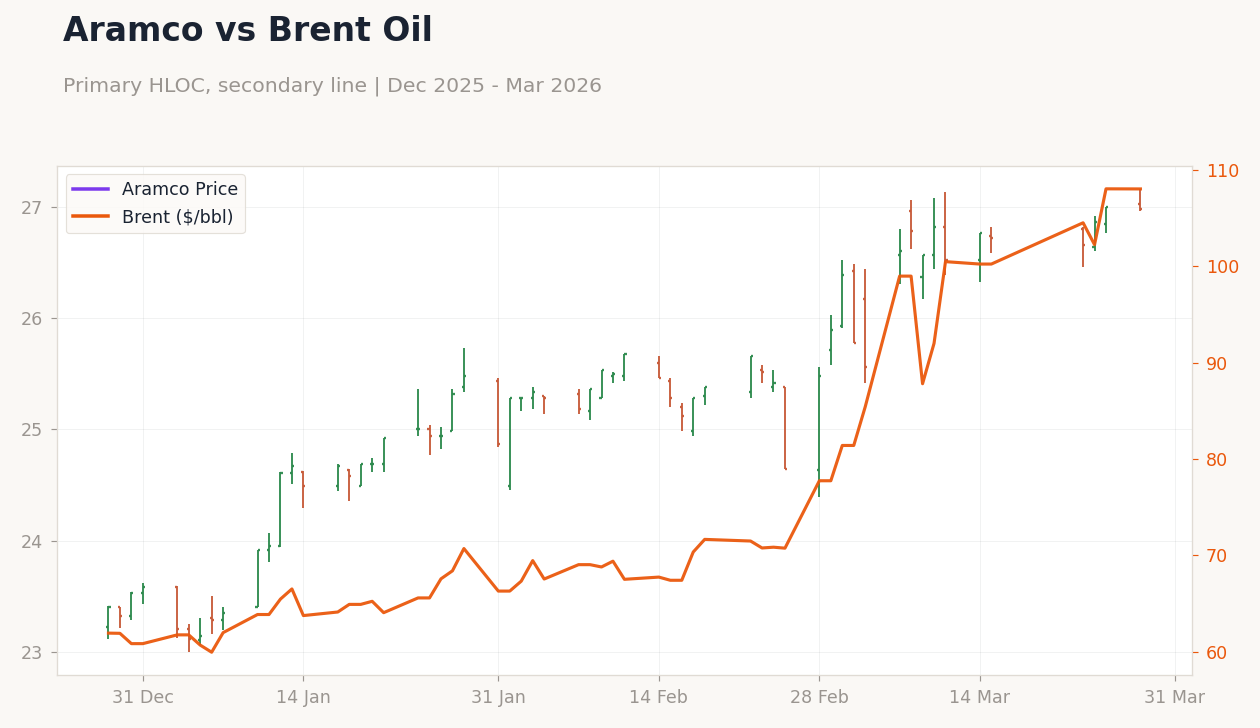
Aramco vs Brent Oil | Type: market_hloc | Aramco Price: 26.98 (2026-03-29) | Range: 23.12–27 | Trend(6pt): 23.4,24.67,25.28,24.65,26.86,26.98 | Brent ($/bbl): 108 (2026-03-29) | Range: 59.96–112.6 | Trend(6pt): 61.94,65.24,69.4,85.41,108,108
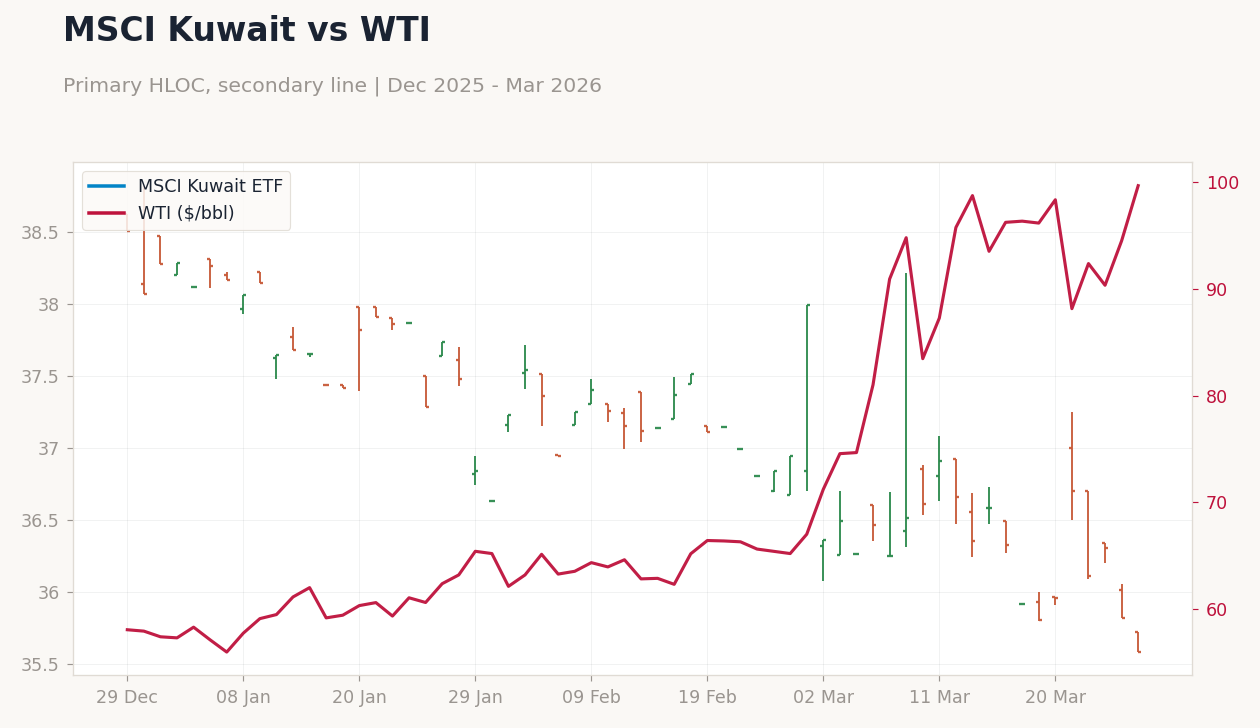
MSCI Kuwait vs WTI | Type: market_hloc | MSCI Kuwait ETF: 35.58 (2026-03-27) | Range: 35.58–38.51 | Trend(6pt): 38.51,37.91,37.15,36.47,35.82,35.58 | WTI ($/bbl): 101.7 (2026-03-29) | Range: 55.99–101.7 | Trend(6pt): 58.08,60.62,64.63,81.01,94.48,101.7
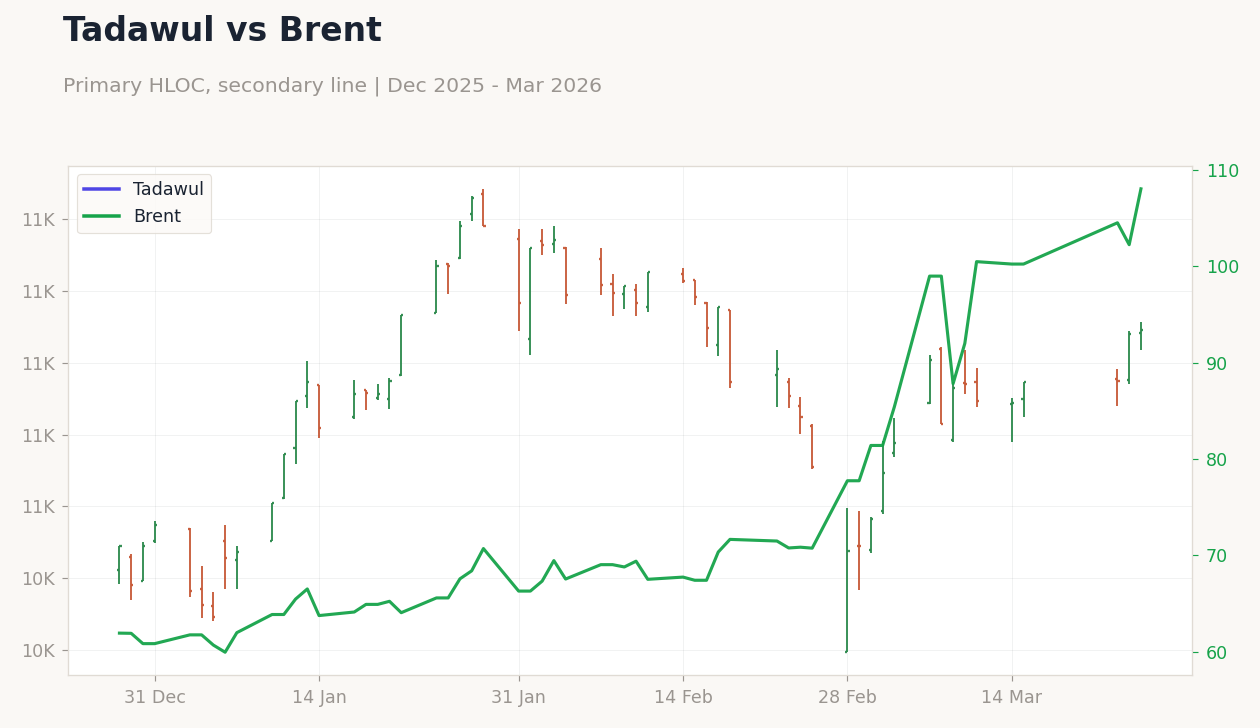
Tadawul vs Brent | Type: market_hloc | Tadawul: 1.109e+04 (2026-03-26) | Range: 1.029e+04–1.146e+04 | Trend(6pt): 1.049e+04,1.091e+04,1.119e+04,1.071e+04,1.108e+04,1.109e+04 | Brent: 108 (2026-03-29) | Range: 59.96–112.6 | Trend(6pt): 61.94,65.24,69.4,85.41,108,108
Overall, the day emphasizes vigilance on Red Sea security and global energy flows.
GCC economies continue pushing non-oil diversification, with Saudi Arabia advancing Vision 2030 initiatives like green hydrogen despite war disruptions. UAE retailers are innovating supply chains, using land routes from Europe to bypass maritime blockades and ensure food availability. Fiscal pressures from volatile oil prices are prompting Oman and Bahrain to ramp up renewable investments as a hedge against hydrocarbon reliance.
Broader themes include adapting to inflation risks from Strait of Hormuz tensions, with plastics and fuel costs rising globally, affecting export revenues.
The Middle East conflict dominates global macro, with Iran's Strait of Hormuz threats fueling inflation fears in plastics and fuels, straining GCC oil exports. China's teapot refineries face margin squeezes from high crude prices, potentially curbing demand for GCC barrels and pressuring Brent. Ukraine signed a drone expertise deal with Saudi Arabia and bolstered ties with Qatar, UAE, and Jordan via Zelenskyy's visits, signaling new defense alliances amid regional attacks.
Houthi rebels claimed missile strikes on Israel and entered the fray with attacks on Saudi bases, injuring at least 15 U.S. personnel in Iranian-linked incidents. Pakistan is set to host U.S.-Iran talks involving Saudi Arabia, Turkey, and Egypt, amid Trump considerations for ground troops, heightening uncertainty.
Yemen's Houthis escalated by targeting Israel, while UAE's main aluminum smelter sustained significant damage from attacks, disrupting production. Abu Dhabi's Zayed International Airport operates at reduced capacity due to ongoing threats, with warnings for Dubai hubs. Retailers in the UAE are sourcing goods via alternative routes, like overland from London, to mitigate shortages.
The war, now a month old, is fostering long-term demand destruction, inflation, and recession risks, as noted at energy forums. Renewables are gaining appeal, though GCC transitions vary by economic structure and trade ties. Gold climbed 0.64% to 4,520.80 on safe-haven demand, while Bitcoin gained 1.08% to 67,035.66, largely detached from GCC fundamentals.
These dynamics expose GCC vulnerabilities to energy shocks and U.S. policy shifts.
GCC central banks upheld USD peg alignments with no rate adjustments, prioritizing stability amid oil volatility and geopolitical risks. Saudi Arabia's SAMA and UAE's CBUAE kept interbank rates unchanged, with SAIBOR and EIBOR steady, supported by robust FX reserves to defend pegs against Hormuz uncertainties. Qatar's QCB emphasized reserve strength from LNG income, coordinating with global signals to manage liquidity in an inflationary environment.
Kuwait's CBK noted a minor 0.04% dip in USD/KWD to 0.31 but maintained basket peg stability without divergences. Oman's CBO and Bahrain's CBB focused on fiscal backing through peg defense, showing no budget strains despite oil dips. The committee held rates across the board, limiting independent policy but leveraging strong reserves—especially in Saudi Arabia and UAE—to counter tensions.
No divergences appeared, as all prioritized peg integrity over autonomous moves.