| Asset | Level | Change |
|---|---|---|
| Saudi Aramco | 27.20 | +0.82% |
| MSCI Saudi | 39.69 | +0.15% |
| MSCI UAE | 19.19 | -1.49% |
| DFM General | 5,715.47 | +0.38% |
| MSCI Qatar | 19.37 | +1.28% |
| MSCI Kuwait | 37.31 | -0.13% |
| Brent Crude | 95.20 | -0.75% |
| WTI Crude | 96.57 | -1.33% |
| Gold | 4,761.90 | -0.63% |
| USD/SAR | 3.75 | +0.11% |
| USD/AED | 3.67 | +0.03% |
| USD/KWD | 0.31 | -0.75% |
| Bitcoin | 73,585.24 | +0.83% |
| Data | Prior | Cons | Actual |
|---|---|---|---|
| No events available | |||
Brent vs WTI Crude Prices | Type: macro_line | Brent Price: 127.6 (2026-04-02) | Range: 59.93–133.2 | Trend(5pt): 62.38,114,91.37,77.84,127.6 | WTI Price: 114 (2026-04-06) | Range: 55.44–123.6 | Trend(5pt): 59.7,104.6,88.81,73.79,114
| Data | Prior | Cons | Time |
|---|---|---|---|
| No events available | |||
Geopolitical risks intensified with a drone attack on a Saudi Arabian pipeline, eliminating 10% of the kingdom's oil export capacity, as reported by Middle East Eye and Financial Post. However, exports from the key Red Sea port remained stable for now, mitigating immediate supply shocks. Saudi Arabia's economy showed resilience amid the Iran war, Strait of Hormuz disruptions, and oil price volatility, according to Al Arabiya English.
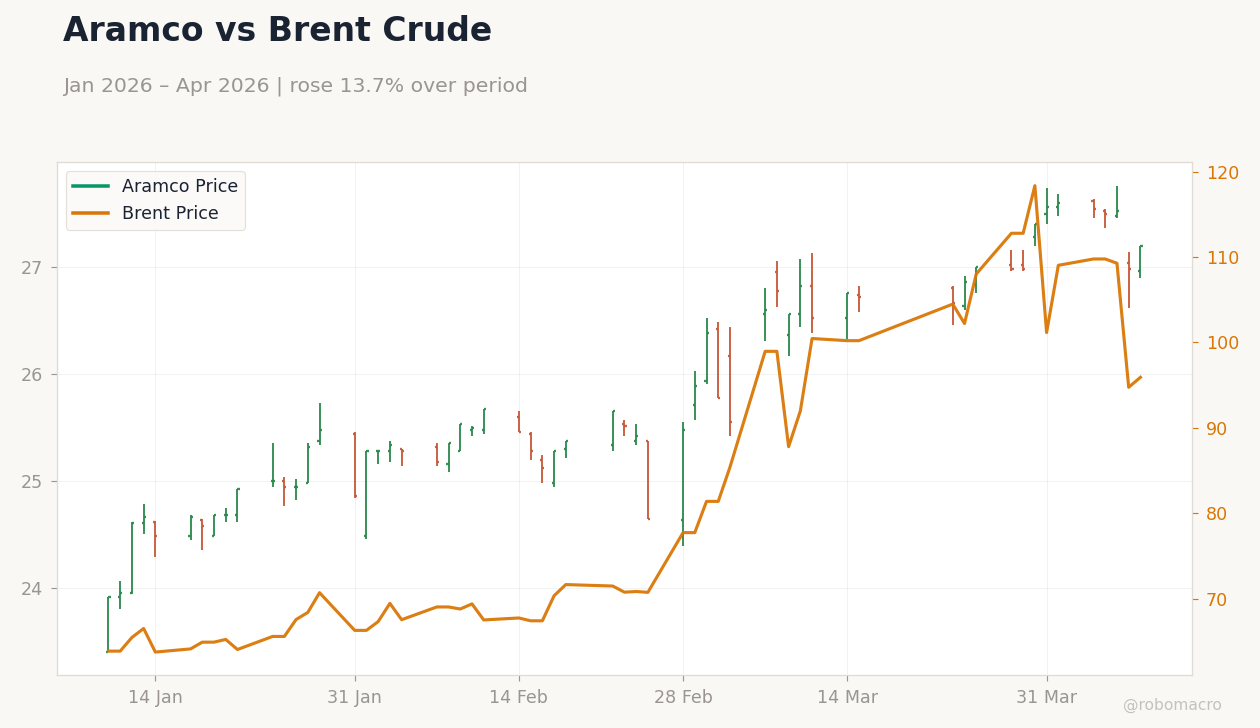
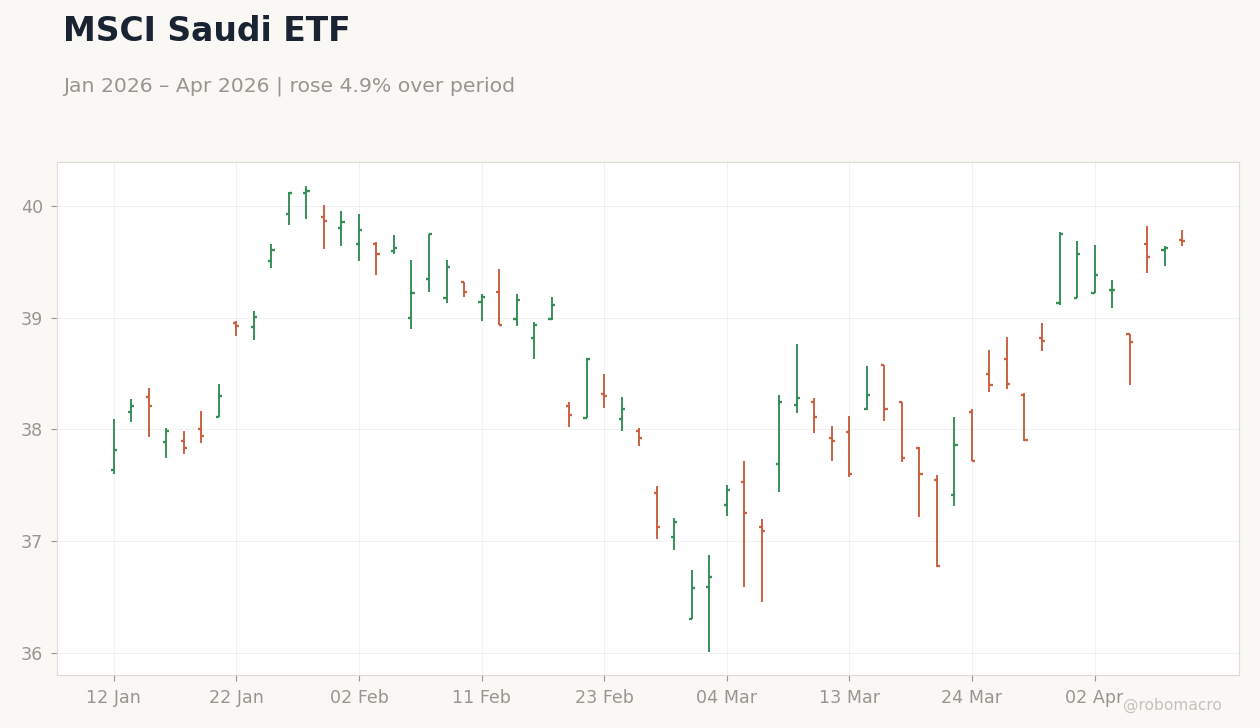
In markets, Saudi Aramco climbed 0.82% to 27.20, boosting the MSCI Saudi index by 0.15%. The DFM General in UAE rose 0.38%, but the MSCI UAE index fell 1.49% due to regional volatility. Qatar's MSCI index advanced 1.28%, while Kuwait's dipped 0.13%.
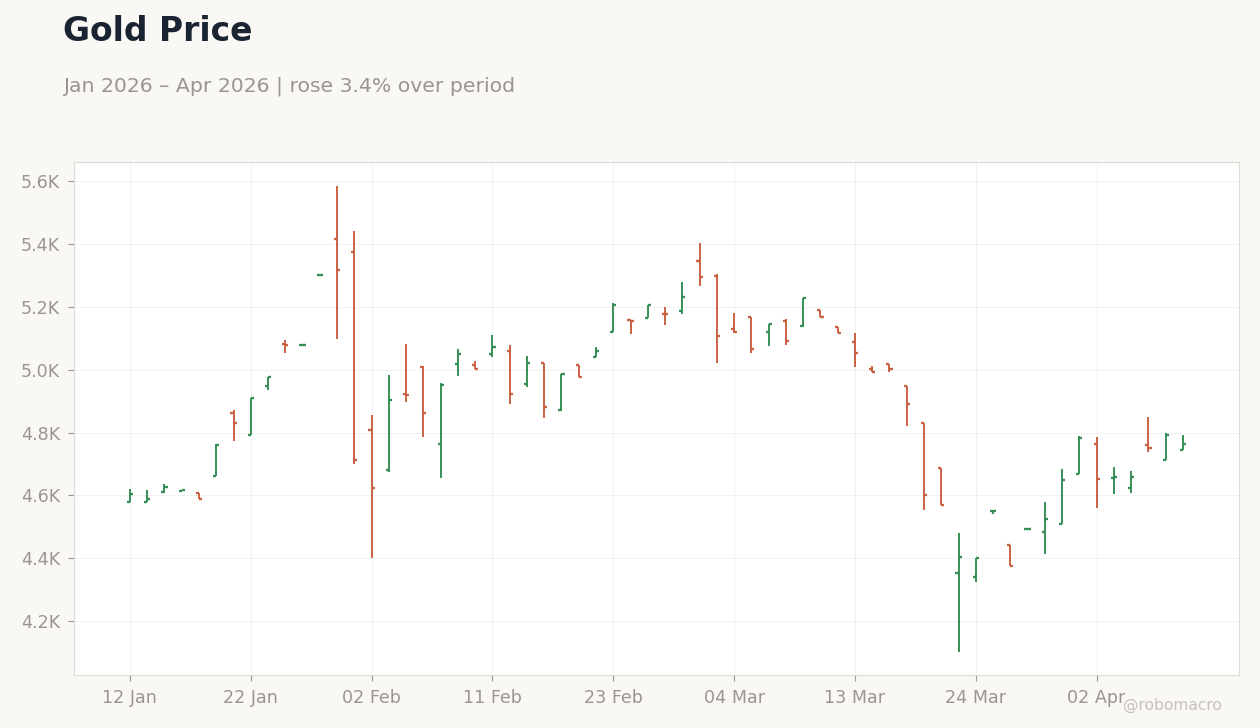
Brent crude declined 0.75% to 95.20, and WTI fell 1.33% to 96.57, reflecting contained de-escalation signals despite the attack. Gold eased 0.63% to 4,761.90, and Bitcoin gained 0.83% to 73,585.24. Currency pairs were stable, with USD/SAR up 0.11% to 3.75, USD/AED up 0.03% to 3.67, and USD/KWD down 0.75% to 0.31.
Other GCC markets, including Oman and Bahrain, saw limited activity with no major shifts reported.
No economic data releases are scheduled for GCC countries, shifting focus to geopolitical developments. Monitoring of the Strait of Hormuz standoff continues, with potential updates on Iran's naval activities and mine threats that could further impact oil transit. Saudi Arabia may issue statements on pipeline repair timelines and export recovery, influencing Aramco sentiment and Vision 2030 diversification.
UAE authorities could discuss tourism mitigation strategies amid projected $32bn regional losses from the Iran conflict, alongside flight resumptions to Dubai, Abu Dhabi, and Amman. Qatar's tourism sector may highlight responses to competition from Saudi Arabia and UAE, including visa extensions for stranded travelers to support recovery in Doha. Kuwait could see minor FX adjustments tied to its dinar basket peg, while Oman and Bahrain monitor energy supply chains.
Markets will watch for Yemen-related escalations or Red Sea shipping issues that might elevate risk premia.
Subscribe to GCC Macro Daily and get each new issue delivered to your inbox.
Already a member? Visit robomacro.com to log in and manage subscriptions, or use Forgot Password to set a password.
Aramco vs Brent Crude | Type: market_hloc | Aramco Price: 27.2 (2026-04-09) | Range: 23.92–27.6 | Trend(6pt): 23.92,25.48,25.28,26.82,27.52,27.2 | Brent Price: 95.2 (2026-04-10) | Range: 63.76–118.3 | Trend(6pt): 63.87,67.33,70.85,107.4,95.92,95.2
MSCI Saudi ETF | Type: market_hloc | MSCI Saudi: 39.69 (2026-04-10) | Range: 36.58–40.14 | Trend(6pt): 37.82,39.57,37.92,37.74,39.63,39.69
Gold Price | Type: market_hloc | Gold Price: 4762 (2026-04-10) | Range: 4376–5318 | Trend(6pt): 4604,4904,5206,4890,4792,4762
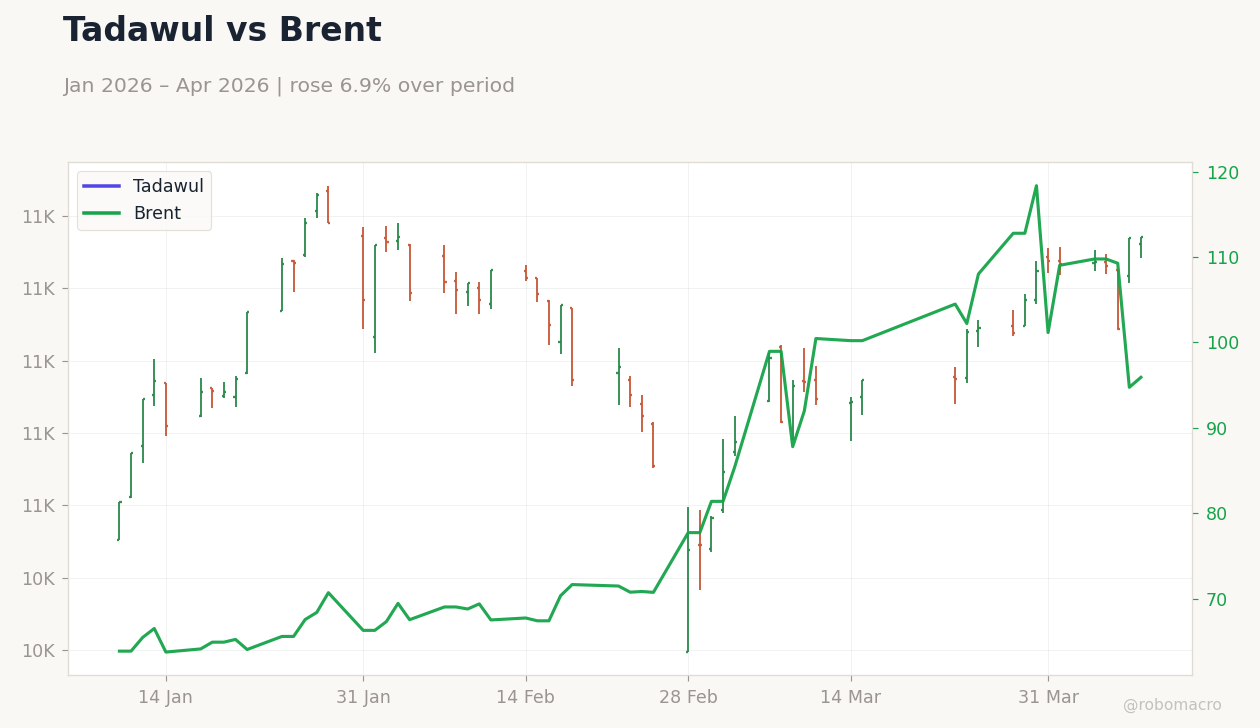
Tadawul vs Brent | Type: market_hloc | Tadawul: 1.134e+04 (2026-04-09) | Range: 1.048e+04–1.146e+04 | Trend(6pt): 1.061e+04,1.138e+04,1.116e+04,1.094e+04,1.109e+04,1.134e+04 | Brent: 95.2 (2026-04-10) | Range: 63.76–118.3 | Trend(6pt): 63.87,67.33,70.85,107.4,95.92,95.2
GCC economies emphasize diversification beyond oil, with Saudi Arabia's Fashion Fund rebranding as the kingdom's first fashion investment entity, supporting Vision 2030 goals. Tourism faces headwinds from regional conflicts, with Qatar responding to competition from Saudi Arabia and UAE through strategic developments and visa extensions for stranded travelers, alongside similar measures in Kuwait, Bahrain, and Jordan. Estimated losses could reach $32bn for Gulf states like UAE, Saudi Arabia, and Qatar due to the Iran conflict.
Defense ties strengthened, with a Pakistani air force contingent arriving in Saudi Arabia under a mutual defense pact, and another military force deployment noted by Asharq Al-Awsat. UAE highlights include resumed Air Arabia flights to 49 destinations, non-surgical liver tumor treatments in Abu Dhabi, and a rain alert urging safe driving. Saudi Arabia tightened Hajj hospitality rules in Makkah and Madinah.
Türkiye and Saudi Arabia resolved a decade-long transit visa dispute. India-UAE ties advanced with Foreign Minister Jaishankar's visit to review the strategic partnership.
Oil markets stayed volatile amid the Strait of Hormuz standoff, with US warships transiting the area as per Arab News, bolstering security but raising tensions with Iran. Brent at 95.20 and WTI at 96.57 dipped on de-escalation cues but remain elevated, affecting GCC export revenues. Qatar affirmed its role as a reliable energy supplier to India, while global LNG concerns eased slightly, with natural gas still vital for power generation despite Middle East disruptions, according to Bangkok Post.
The EU's €2.88bn payment for Russian Arctic LNG in Q1 underscores shifting supply dynamics, pressuring GCC producers to adhere to OPEC+ quotas. Abu Dhabi and Qatar raised billions via private bond sales amid war-induced volatility, as noted by Financial Post. The IMF and World Bank selected Abu Dhabi for annual meetings, signaling confidence in UAE stability.
Tourism impacts from the Iran conflict could cost Gulf countries up to $32bn, per Travel And Tour World. Gold at 4,761.90 and Bitcoin at 73,585.24 reflected mixed risk sentiment.
GCC central banks—SAMA (Saudi Arabia), CBUAE (UAE), QCB (Qatar), CBK (Kuwait), CBO (Oman), and CBB (Bahrain)—held rates steady in line with the US Federal Reserve, maintaining USD pegs for most. Kuwait's dinar basket peg resulted in a 0.75% USD/KWD decline to 0.31 via liquidity adjustments. Interbank rates like SAIBOR and EIBOR remained stable despite oil fluctuations, backed by strong FX reserves that buffer events like the pipeline attack.
(cont...)
No policy divergences occurred, with pegs limiting independent actions. QCB and CBUAE tracked tourism inflows potentially hit by Hormuz issues, while SAMA supported non-oil initiatives like fashion investments. CBO and CBB prioritized energy security in Oman and Bahrain.
Overall, reserve adequacy helps mitigate global shocks, though Kuwait's peg offered minor appreciation benefits against import costs amid tensions.