GCC Macro Daily(Beta Mode)
Saudi Pipeline Recovers, Oil Jumps
Market Snapshot
| Asset | Level | Change |
|---|---|---|
| Saudi Aramco | 27.20 | +0.82% |
| MSCI Saudi | 39.69 | +0.15% |
| MSCI UAE | 19.19 | -1.49% |
| DFM General | 5,715.47 | +0.38% |
| MSCI Qatar | 19.37 | +1.28% |
| MSCI Kuwait | 37.31 | -0.13% |
| Brent Crude | 102.23 | +7.38% |
| WTI Crude | 105.01 | +8.74% |
| Gold | 4,733.20 | -0.60% |
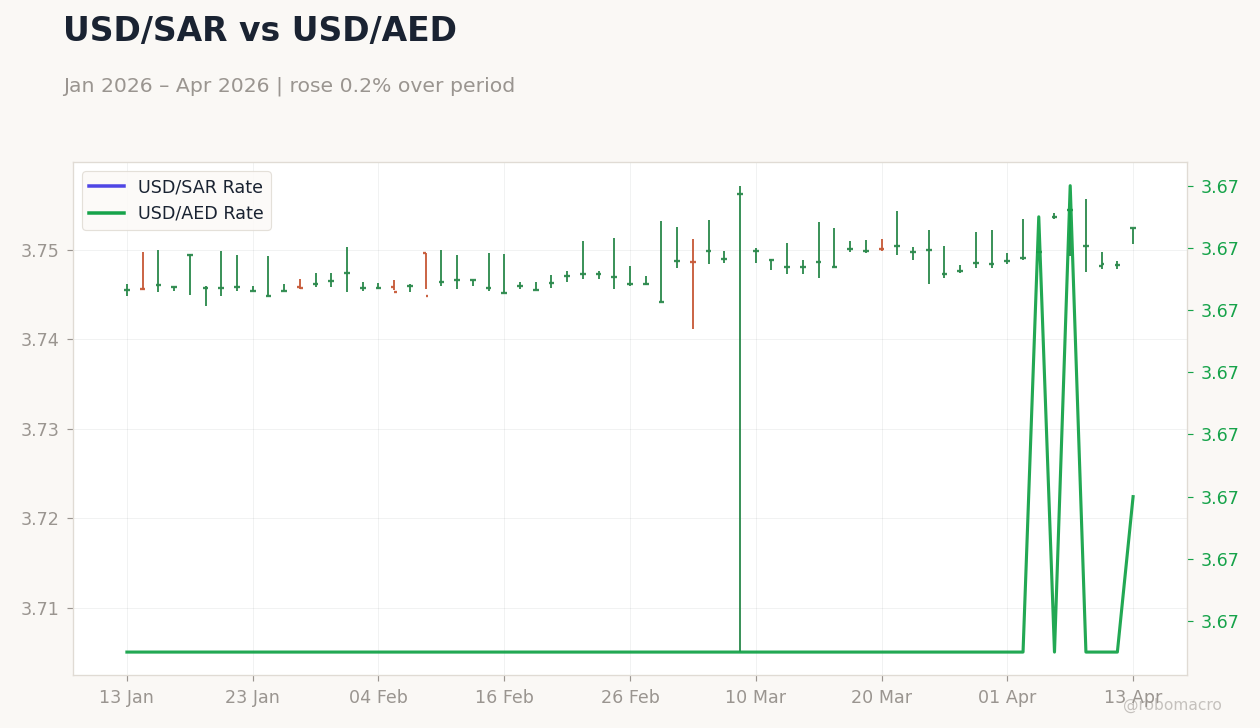
| USD/SAR | 3.75 | +0.11% |
| USD/AED | 3.67 | +0.01% |
| USD/KWD | 0.31 | -0.69% |
| Bitcoin | 71,080.95 | -2.70% |
Prior Economic Events
| Data | Prior | Cons | Actual |
|---|---|---|---|
| No events available | |||
 US Fed Funds Rate (GCC Proxy) | Type: macro_line | Rate (%): 3.64 (2026-03-01) | Range: 0.06–5.33 | Trend(5pt): 0.06,1.68,5.33,4.64,3.64
Today's Economic Events
| Data | Prior | Cons | Time |
|---|---|---|---|
| No events available | |||
- Saudi Arabia restores key oil pipeline capacity after attacks, stabilizing exports amid rising Brent prices.
- GCC equities mixed; UAE markets dip while Qatar gains on energy rebound.
- Regional cooperation strengthens with tourism and economic ties across GCC members.
Yesterday's Recap
Geopolitical tensions eased as Saudi Arabia announced the full restoration of its East-West oil pipeline following drone attacks that temporarily wiped out 10% of the kingdom's export capacity, with Aramco shares rising 0.82% to 27.20 amid Brent crude surging 7.38% to 102.23. UAE markets saw the MSCI UAE index fall 1.49% to 19.19, pressured by unsettled weather alerts in Abu Dhabi and broader risk aversion, though the DFM General index edged up 0.38% to 5,715.47. Qatar equities performed strongly with the MSCI Qatar index up 1.28% to 19.37, supported by positive LNG supply outlooks.
Saudi Arabia's MSCI index gained modestly by 0.15% to 39.69, reflecting investor relief over energy infrastructure resilience. Kuwait showed minor declines in the MSCI Kuwait index by 0.13% to 37.31, while broader GCC FX remained stable with USD/SAR at 3.75 (+0.11%). No major macro data releases occurred across the GCC, but ongoing non-oil diversification efforts in Saudi Arabia highlighted progress in creator economy initiatives.
The Day Ahead
With no scheduled economic data releases across the GCC tomorrow, attention turns to potential updates on Saudi Arabia's oil export flows following pipeline restoration, which could influence fiscal projections under Vision 2030. UAE may see continued focus on weather-related disruptions in Abu Dhabi, alongside monitoring of resumed flights to key destinations like Dubai and Amman. Qatar anticipates boosts to consumer sentiment in non-oil sectors from stable LNG exports.
Broader GCC events include tracking regional cooperation initiatives for tourism and economic growth involving all members, including Oman and Bahrain. Investors will watch for any spillover from global energy markets, particularly LNG dynamics affecting Qatar and UAE exports.
Other Economic Notes
GCC economies remain heavily reliant on oil, with Brent's sharp rise to over $100/bbl bolstering fiscal balances across Saudi Arabia, UAE, and Qatar, though diversification pushes like Saudi Arabia's creator economy and tourism expansion aim to reduce vulnerability. Sovereign credit profiles strengthened as Saudi Arabia's rapid pipeline recovery reinforces reliability, potentially lowering CDS spreads amid stable Red Sea shipping. Non-oil sectors showed resilience, with UAE's private bond sales raising billions to navigate market volatility from regional conflicts.