GCC Macro Daily(Beta Mode)
Oil Rally Lifts Aramco Amid Steady GCC Markets
Market Snapshot
| Asset | Level | Change |
|---|---|---|
| Saudi Aramco | 26.86 | +1.36% |
| MSCI Saudi | 36.97 | -0.38% |
| MSCI UAE | 19.08 | -0.37% |
| DFM General | 5,990.88 | -0.18% |
| MSCI Qatar | 17.76 | +0.05% |
| MSCI Kuwait | 36.23 | +0.10% |
| Brent Crude | 85.91 | +3.13% |
| WTI Crude | 80.21 | +2.65% |
| Gold | 4,043.90 | +1.17% |
| USD/SAR | 3.76 | +2.99% |
| USD/AED | 3.67 | +0.03% |
| USD/KWD | 0.31 | +0.05% |
| Bitcoin | 64,568.93 | +3.74% |
Prior Economic Events
| Data | Prior | Cons | Actual |
|---|---|---|---|
| No events available | |||
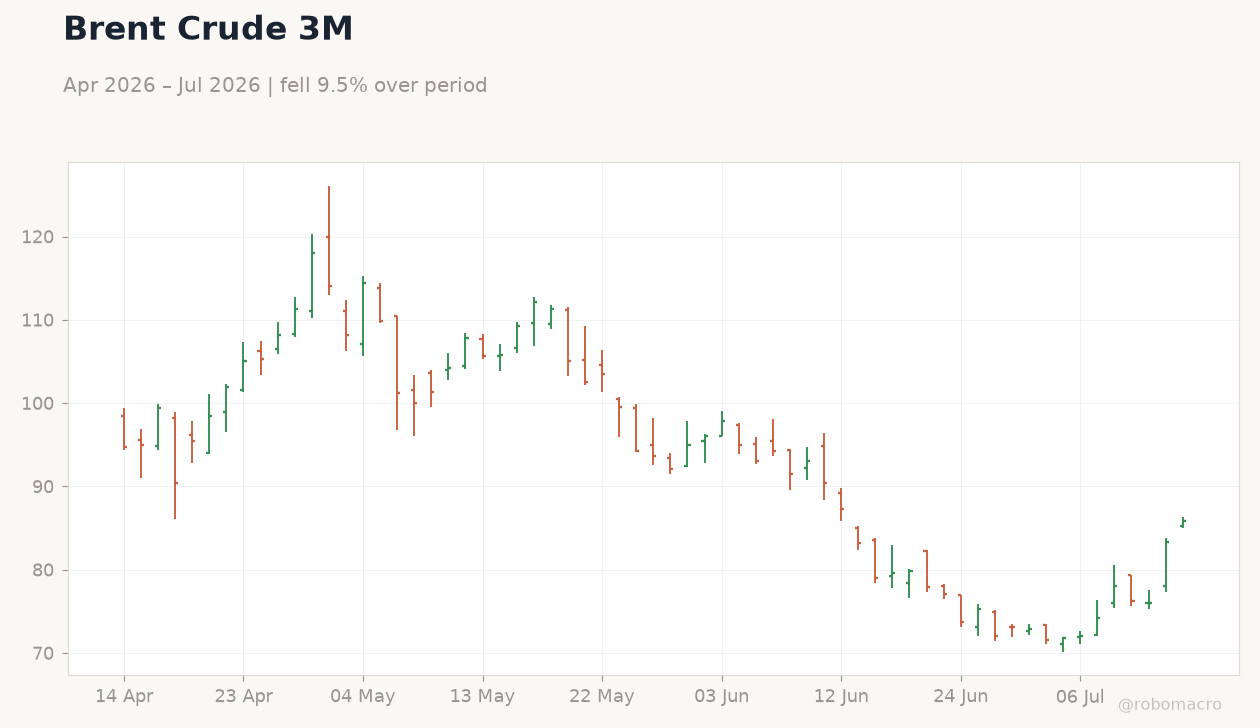 Brent Crude 3M | Type: market_hloc | USD/bbl: 85.82 (2026-07-14) | Range: 71.57–118 | Trend(6pt): 94.79,109.9,94.29,79.55,76.01,85.82
Today's Economic Events
| Data | Prior | Cons | Time |
|---|---|---|---|
| No events available | |||
- Saudi Aramco gains 1.36% as Brent jumps 3.13% to $85.91 on supply concerns
- UAE condemns Houthi attacks on Saudi; regional missile threats emerge
- Saudi advances AI and space ties with China while presenting UN sustainability review
Yesterday's Recap
Saudi equity markets showed resilience despite modest MSCI Saudi declines of 0.38%, with Aramco shares advancing on stronger realised oil prices and downstream margins. UAE benchmarks eased, with MSCI UAE falling 0.37% and the DFM General Index down 0.18% as real-estate offsets limited banking gains. Qatar and Kuwait equities posted small advances of 0.05% and 0.10% respectively amid stable LNG contract flows.
Brent crude surged 3.13% to $85.91 per barrel while WTI rose 2.65%, reflecting heightened supply-risk premia from Yemen tensions and Iranian naval activity near the Strait of Hormuz. Saudi Arabia presented its third voluntary national review on sustainable development goals at the UN, linking progress directly to Vision 2030 targets. The UAE informed OPEC of an 80% month-on-month oil production increase, citing workarounds around regional disruptions.
Fitch affirmed Saudi Arabia’s top sovereign rating, underscoring fiscal buffers that shielded the economy from recent conflict spillovers. Gold climbed 1.17% to $4,043.90 on safe-haven demand, while Bitcoin rose 3.74% to $64,568.93. USD/SAR held at 3.76 and USD/AED at 3.67, with regional FX pegs showing minimal movement.
The Day Ahead
No major data releases are scheduled across the GCC today or tomorrow. Markets will monitor OPEC+ compliance signals and any escalation in Red Sea or Hormuz shipping risks that could further support crude prices. Saudi diversification projects, including PIF green-hydrogen initiatives, continue to advance without interruption.
UAE solar and LNG expansion pipelines remain on track, with QatarEnergy’s North Field South Phase 2 FID already confirmed. Regional equity volumes are expected to stay average absent fresh catalysts. Sovereign CDS spreads and interbank rates should hold steady given unchanged geopolitical risk premia overnight.
Contractor qualification drives in Saudi Arabia, now encompassing up to 117,000 firms, are accelerating project execution under the current five-year plan.
Other Economic Notes
Saudi non-oil PMI strength and UAE expansionary readings continue to signal durable private-sector momentum outside hydrocarbons. Fiscal buffers in Riyadh have proven effective at absorbing external shocks while maintaining Vision 2030 capital expenditure. <i>↓ p.2</i>