| Asset | Level | Change |
|---|---|---|
| Shanghai Composite | 4,095.45 | -0.82% |
| CSI 300 | 4,669.14 | -0.39% |
| Hang Seng | 25,465.60 | -0.98% |
| TAIEX | 33,400.32 | -0.54% |
| USD/CNY | 6.90 | +0.39% |
| USD/HKD | 7.83 | -0.01% |
| Copper | 5.76 | -1.16% |
| Brent Crude | 98.91 | -1.54% |
| Gold | 5,061.70 | -1.06% |
| Bitcoin | 72,064.57 | +1.19% |
| China 2Y Govt Yield | - | - |
| China 10Y Govt Yield | - | - |
| Data | Prior | Cons | Actual |
|---|---|---|---|
| Exports Year-over-Year | 6.60 | 7.10 | 21.80 |
| Imports Year-over-Year | 5.70 | 6.30 | 19.80 |
| Trade Balance | 114,110m | 179,600m | 213,620m |
| New Yuan Loans | 4,710,000m | 979,000m | 900,000m |
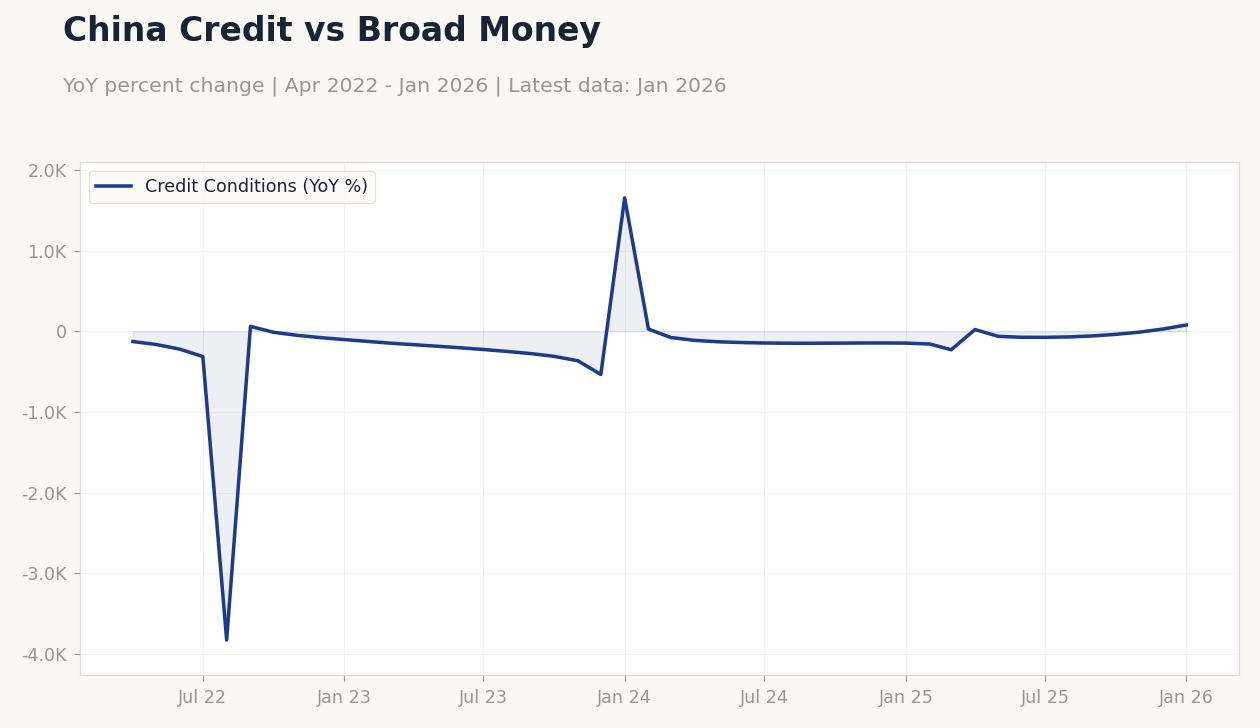
China Credit vs Broad Money | Type: macro_line | Credit Conditions: -1.642 (2026-01-01) | Range: -3.671–13.22 | Trend(6pt): 13.22,-3.432,4.15,-1.829,-1.558,-1.642
| Data | Prior | Cons | Time |
|---|---|---|---|
| No events available | |||
China's February trade data stole the spotlight, with exports jumping 21.8% YoY versus a 7.1% consensus, fueled by robust shipments to ASEAN and Europe, while imports climbed 19.8% YoY against 6.3% expected, driven by commodity stockpiling for upcoming demand. This led to a trade surplus of CNY 213.62 billion, surpassing the CNY 179.6 billion forecast, highlighting mainland resilience in international trade despite geopolitical strains. However, new yuan loans hit CNY 900 billion, under the CNY 979 billion estimate and down from January's CNY 4.71 trillion, signaling banks' caution on real estate exposure.
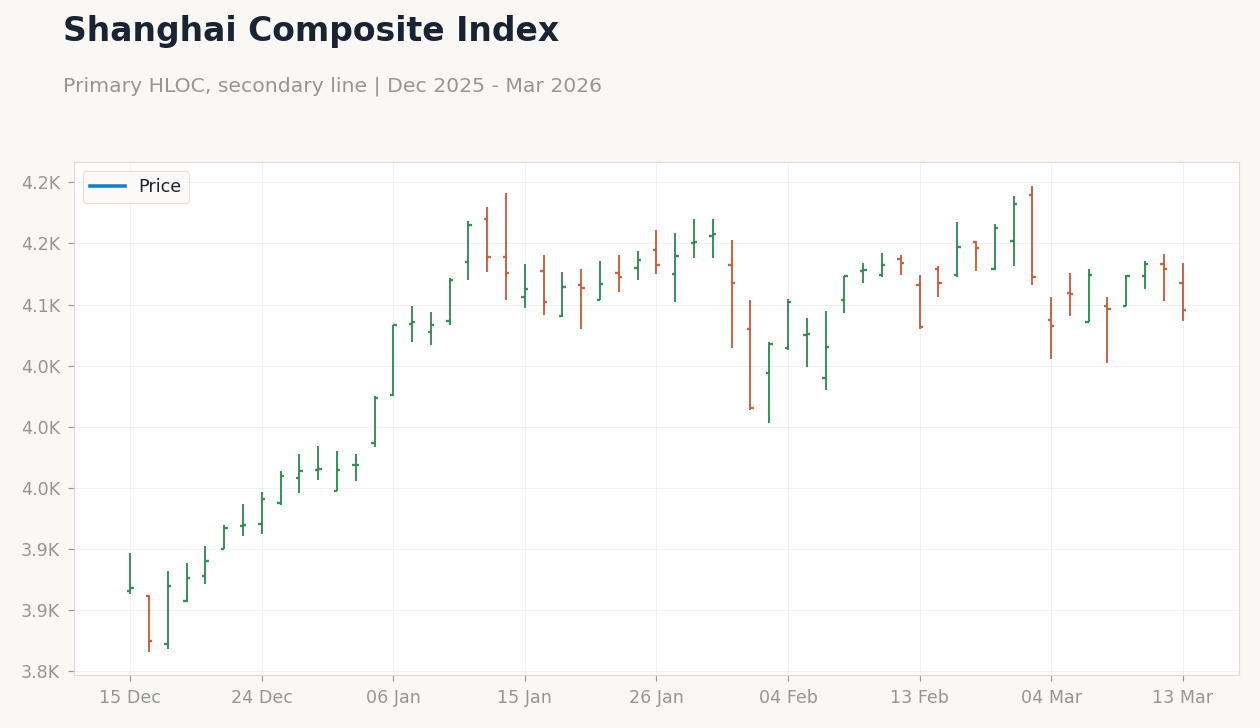
Mainland stocks ended lower despite the trade strength, as the Shanghai Composite fell 0.82% to 4,095.45 and CSI 300 dipped 0.39% to 4,669.14, with investors concerned over weak credit figures and declining copper prices. In Hong Kong, the Hang Seng slid 0.98% to 25,465.60, dragged by tech and real estate amid steady USD/HKD at 7.83. Taiwan's TAIEX dropped 0.54% to 33,400.32, pressured by semiconductor chain issues tied to US-China tensions.
USD/CNY rose 0.39% to 6.90, aiding exporters through controlled depreciation by the PBoC. Commodities weakened, with copper down 1.16% to 5.76, Brent crude off 1.54% to 98.91, gold falling 1.06% to 5,061.70, and Bitcoin up 1.19% to 72,064.57.
No major economic releases are slated for Greater China today, including mainland China, Hong Kong, or Taiwan, giving markets time to absorb yesterday's solid trade performance and subdued lending data. Attention may turn to any PBoC liquidity moves or State Council remarks on stimulus, especially given recent property support hints. Tomorrow's calendar is also empty, directing focus to external factors like US inflation readings that might sway yuan movements.
Discussions on cross-strait trade could intensify following China's "two sessions" emphasis on tech rivalry. Geopolitical updates, including Iran's proposal for yuan-based oil transits via the Hormuz Strait, may influence Hong Kong's position as a financial center. Trading is likely to remain quiet absent surprises from Middle East developments.
Subscribe to Greater China Macro Daily and get each new issue delivered to your inbox.
Already a member? Visit robomacro.com to log in and manage subscriptions, or use Forgot Password to set a password.
Copper Futures | Type: market_hloc | Price: 5.757 (2026-03-13) | Range: 5.287–6.175 | Trend(5pt): 5.339,5.809,6.175,5.831,5.757
USD/CNY Exchange Rate | Type: market_hloc | Rate: 6.896 (2026-03-15) | Range: 6.841–7.054 | Trend(5pt): 7.054,6.997,6.948,6.908,6.896
Shanghai Composite Index | Type: market_hloc | Price: 4095 (2026-03-13) | Range: 3825–4183 | Trend(5pt): 3868,4084,4133,4082,4095
Hang Seng Index | Type: market_hloc | Price: 2.547e+04 (2026-03-13) | Range: 2.524e+04–2.797e+04 | Trend(6pt): 2.563e+04,2.646e+04,2.713e+04,2.671e+04,2.59e+04,2.547e+04
China's investments in electric vehicles and renewables are cushioning against oil price shocks, reducing reliance on foreign energy amid potential disruptions from Iran tensions. Outcomes from the "two sessions" indicate heightened China-US tech competition, with policies prioritizing domestic semiconductor and AI progress, which could support Taiwan's exports despite associated risks. Key themes include restrained credit in mainland China, where property issues limit lending and may lead to further reserve requirement ratio tweaks.
Global markets contend with US economic slowdown, as February jobs data showed a loss of 92,000 positions, missing forecasts and lifting unemployment to 4.4%, stoking recession worries that may curb demand for Greater China goods. Canada echoed this trend, shedding 84,000 jobs with unemployment at 6.7%, pointing to North American weakness affecting trade with mainland China and Taiwan. Iran conflict escalation is driving oil volatility, with Brent crude down 1.54% to 98.91, but proposals for yuan-priced oil passages through Hormuz could advance China's currency global role and aid Hong Kong finance.
The Fed navigates growth slowdown and inflation pressures, possibly postponing rate cuts and pushing USD/CNY upward. UK economy stalled in January, pressuring the pound and bolstering Greater China export edges. Australia's expected cash rate increase contributes to worldwide tightening, while semiconductor sector expansion toward $1 trillion by 2026 highlights Taiwan's supply chain importance amid US inquiries into Chinese labor that could affect regional dynamics.
A US probe on China labor practices may impact India, with ripple effects on Asian trade.
The People's Bank of China (PBoC) adopted a cautious liquidity approach, with new yuan loans at CNY 900 billion below expectations, implying no near-term changes to medium-term lending facility or loan prime rates, though reserve requirement cuts are possible if lending stays weak; "two sessions" signals stress targeted support for tech and infrastructure without wide easing. The Hong Kong Monetary Authority (HKMA) upheld the USD/HKD peg at 7.83 with negligible shift, tracking balances amid global yield strains, with no interventions noted. Taiwan's Central Bank (CBC) prioritized FX steadiness, as TAIEX declines underscore semiconductor export risks from global demand; no rate moves are pending, but interventions could occur if cross-strait issues worsen.
Regionally, central banks manage US slowdown threats, with PBoC allowing mild yuan weakening to 6.90 for trade benefits. HKMA's peg holds firm, while CBC monitors tech ties for adjustments.