| Asset | Level | Change |
|---|---|---|
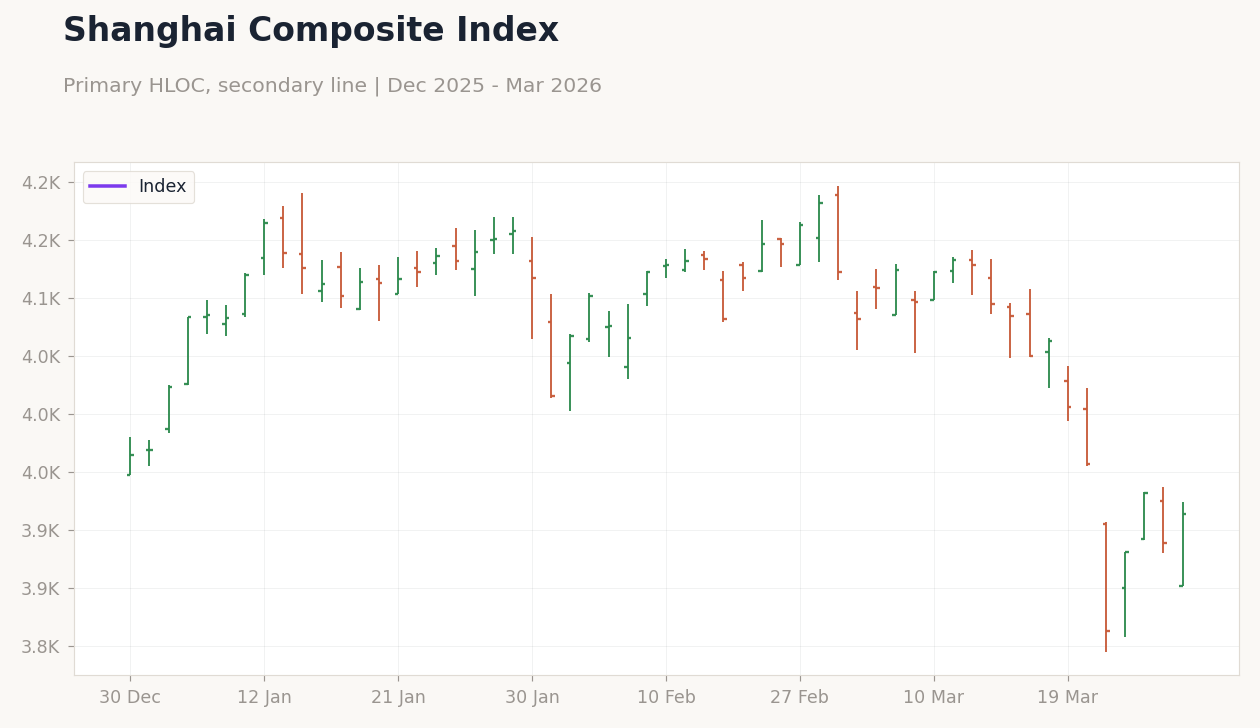
| Shanghai Composite | 3,913.72 | +0.63% |
| CSI 300 | 4,502.57 | +0.56% |
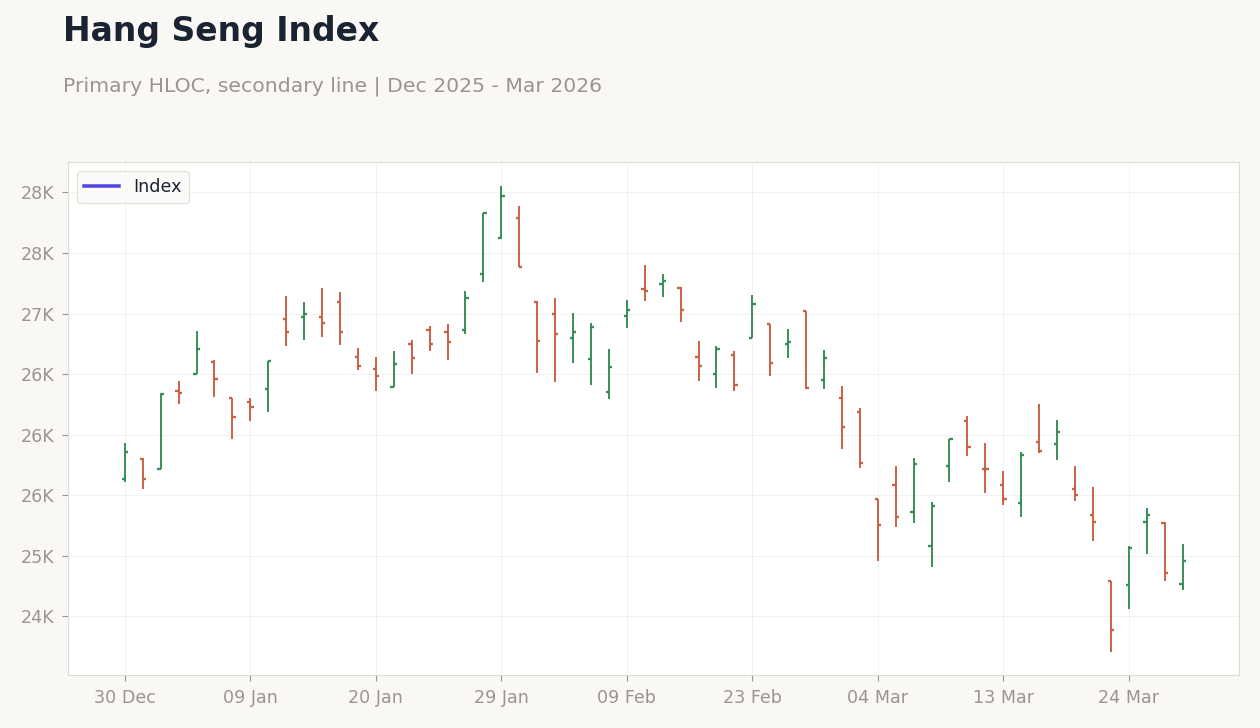
| Hang Seng | 24,951.88 | +0.38% |
| TAIEX | 33,112.59 | -0.68% |
| USD/CNY | 6.91 | +0.01% |
| USD/HKD | 7.84 | +0.12% |
| Copper | 5.49 | +0.37% |
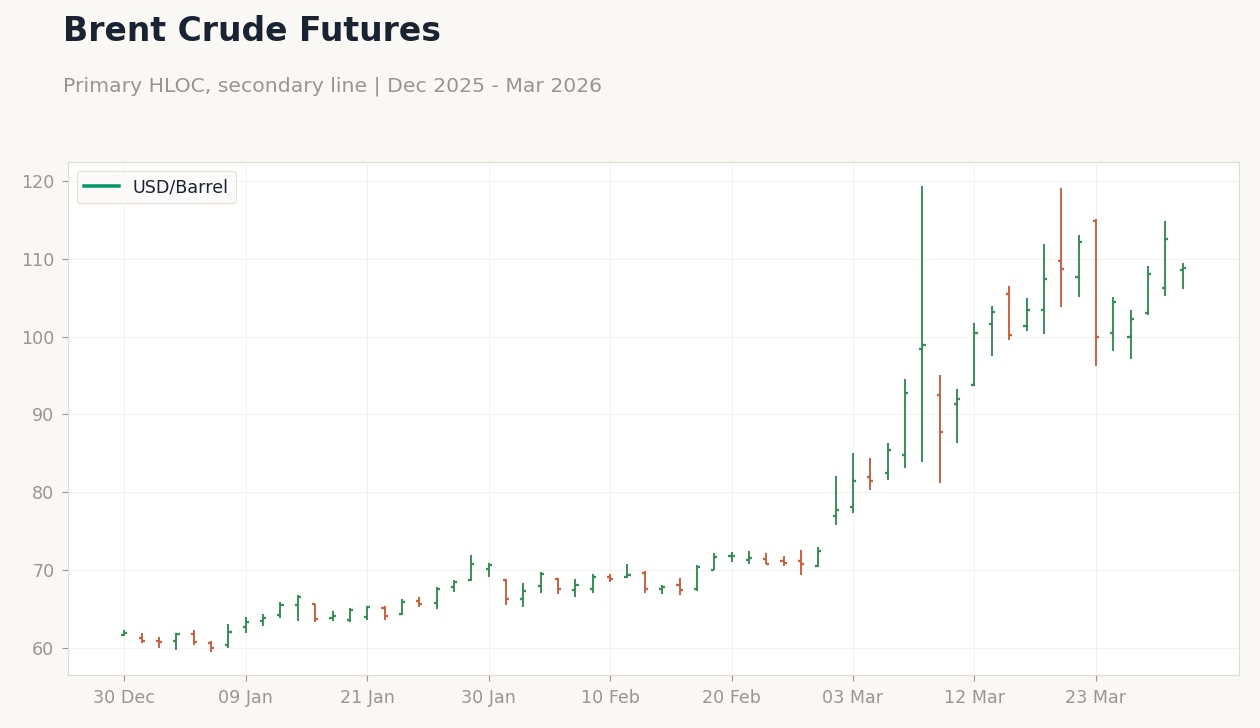
| Brent Crude | 108.79 | -3.36% |
| Gold | 4,540.40 | +1.08% |
| Bitcoin | 66,785.45 | +1.26% |
| China 2Y Govt Yield | - | - |
| China 10Y Govt Yield | - | - |
| Data | Prior | Cons | Actual |
|---|---|---|---|
| No events available | |||
China Exports Growth | Type: macro_line | YoY %: 3.238e+11 (2025-12-01) | Range: 2.679e+11–3.248e+11 | Trend(5pt): 2.728e+11,3.197e+11,2.757e+11,3.103e+11,3.238e+11
| Data | Prior | Cons | Time |
|---|---|---|---|
| NBS Manufacturing PMI | 49 | 50 | 17:30 |
| NBS Non-Manufacturing PMI | 49.50 | 49.90 | 17:30 |
| RatingDog Manufacturing PMI | 52.10 | 51.90 | 17:45 |
| RatingDog Services PMI | 56.70 | 53.70 | 17:45 |
Mainland China's Shanghai Composite rose 0.63% to 3,913.72, driven by gains in industrial and materials stocks despite lingering property sector concerns, as copper prices edged up 0.37% to 5.49 amid steady demand proxies. The CSI 300 advanced 0.56% to 4,502.57, supported by financials and consumer cyclicals, reflecting mild optimism in cross-strait trade flows. Hong Kong's Hang Seng Index climbed 0.38% to 24,951.88, buoyed by banking sector resilience despite USD/HKD peg pressures rising 0.12% to 7.84.
Taiwan's TAIEX fell 0.68% to 33,112.59, weighed down by semiconductor export uncertainties linked to global AI demand fluctuations. The USD/CNY pair ticked up 0.01% to 6.91, indicating controlled yuan depreciation amid PBoC liquidity management. Brent crude plunged 3.36% to 108.79, exacerbating strains on China's oil-dependent industries like teapot refineries, while gold rose 1.08% to 4,540.40 as a safe-haven asset.
Bitcoin climbed 1.26% to 66,785.45. Overall, Greater China markets navigated global volatility with mainland equities outperforming on domestic stability cues.
Mainland China's NBS Manufacturing PMI is due at 17:30 ET today, with consensus at 50 following a previous 49.0, potentially indicating a shift from contraction to expansion amid industrial rebound signals. The NBS Non-Manufacturing PMI follows at the same time, expected at 49.9 versus prior 49.5, offering insights into services sector resilience against deflationary pressures. Tomorrow brings the RatingDog Manufacturing PMI at 17:45 ET, forecasted at 51.9 after 52.1, which could highlight private sector manufacturing trends diverging from official data.
Later this week, RatingDog Services PMI on April 2 at 17:45 ET is anticipated at 53.7 from 56.7, reflecting potential slowdowns in non-manufacturing activity due to oil price volatility. No major Hong Kong or Taiwan data releases are scheduled immediately, but cross-strait trade updates may emerge amid geopolitical tensions. Investors should watch for any PBoC signals on liquidity in response to these indicators.
Subscribe to Greater China Macro Daily and get each new issue delivered to your inbox.
Already a member? Visit robomacro.com to log in and manage subscriptions, or use Forgot Password to set a password.
Brent Crude Futures | Type: market_hloc | USD/Barrel: 108.8 (2026-03-30) | Range: 59.96–112.6 | Trend(6pt): 61.92,64.06,67.52,92.69,112.6,108.8
Shanghai Composite Index | Type: market_hloc | Index: 3914 (2026-03-27) | Range: 3813–4183 | Trend(5pt): 3965,4117,4128,4123,3914
Taiwan TAIEX Index | Type: market_hloc | Index: 3.311e+04 (2026-03-27) | Range: 2.871e+04–3.541e+04 | Trend(6pt): 2.871e+04,3.164e+04,3.18e+04,3.36e+04,3.344e+04,3.311e+04
Hang Seng Index | Type: market_hloc | Index: 2.495e+04 (2026-03-27) | Range: 2.438e+04–2.797e+04 | Trend(5pt): 2.585e+04,2.659e+04,2.727e+04,2.541e+04,2.495e+04
China's teapot oil refineries face mounting pressures from surging crude prices tied to the Iran conflict, threatening their thin margins and potentially curbing fuel output that supports broader economic activity. Hog prices in mainland China have hit an eight-year low due to supply gluts from massive pig farms, underscoring agricultural overcapacity and deflation risks, with CPI YoY at -0.10% highlighting persistent price weakness. Hong Kong's tech sector sees mainland firms expanding operations as a global springboard, boosted by AI drug deals like Eli Lilly's $2.75 billion pact with Insilico, signaling cross-border investment flows amid regulatory easing.
Hong Kong schools are urged to address falling student numbers, while national security law updates clarify implementation without expanding powers.
The ongoing Iran war has disrupted oil shipments through the Strait of Hormuz, driving Brent crude down 3.36% and raising supply chain concerns for Chinese manufacturers, who warn of higher prices for U.S. exports. This conflict has damaged Gulf smelters, potentially tightening global aluminium supplies and strengthening China's trade position in the metal, as Middle Eastern disruptions create opportunities for mainland exporters.
India's growth outlook dims with wider deficits from elevated energy costs, indirectly affecting Greater China's export markets and fertilizer supply chains via West Asia linkages. Greece's political polls and drone industry developments add to global uncertainty, though less directly impacting Asia, while airlines suffer from fuel price volatility. China's digital yuan expansion, with more banks handling it, positions the economy for resilient retail payments amid geopolitical risks.
Hong Kong benefits from mainland tech firms racing to establish bases, testing products for global expansion despite local challenges like falling student numbers and national security updates. Overall, these dynamics heighten safe-haven flows into gold, up 1.08%, and bitcoin, up 1.26% to 66,785.45, as investors hedge against inflation clouded by Mideast tensions.
The People's Bank of China (PBoC) is expected to maintain key lending rates steady, as Mideast war clouds inflation outlooks and tempers urgency for cuts despite CPI at -0.10% YoY, with focus on potential RRR adjustments to support liquidity amid oil price strains. No recent MLF or LPR decisions were announced, but State Council signals suggest targeted easing for sectors like property and manufacturing if PMI data disappoints. Hong Kong Monetary Authority (HKMA) monitors USD/HKD peg dynamics closely, with the pair at 7.84 showing stability, supported by ample aggregate balance and no immediate intervention needs despite mild appreciation pressures.
(cont...)
Taiwan's Central Bank (CBC) remains attentive to FX interventions amid TAIEX volatility, linking policy to semiconductor export outlooks, which face headwinds from global AI demand but no rate changes signaled recently. Across Greater China, central banks prioritize stability over aggressive moves, with PBoC eyeing commodity impacts on yuan, HKMA focused on peg mechanics, and CBC balancing trade flows.