| Asset | Level | Change |
|---|---|---|
| Shanghai Composite | 4,051.43 | -0.10% |
| CSI 300 | 4,728.67 | -0.17% |
| Hang Seng | 26,352.76 | -0.03% |
| TAIEX | 37,685.28 | +1.97% |
| USD/CNY | 6.81 | -0.03% |
| USD/HKD | 7.83 | -0.00% |
| Copper | 6.01 | -1.49% |
| Brent Crude | 95.14 | +5.27% |
| Gold | 4,817.70 | -0.82% |
| Bitcoin | 75,558.15 | +2.30% |
| China 2Y Govt Yield | - | - |
| China 10Y Govt Yield | - | - |
| Data | Prior | Cons | Actual |
|---|---|---|---|
| No events available | |||
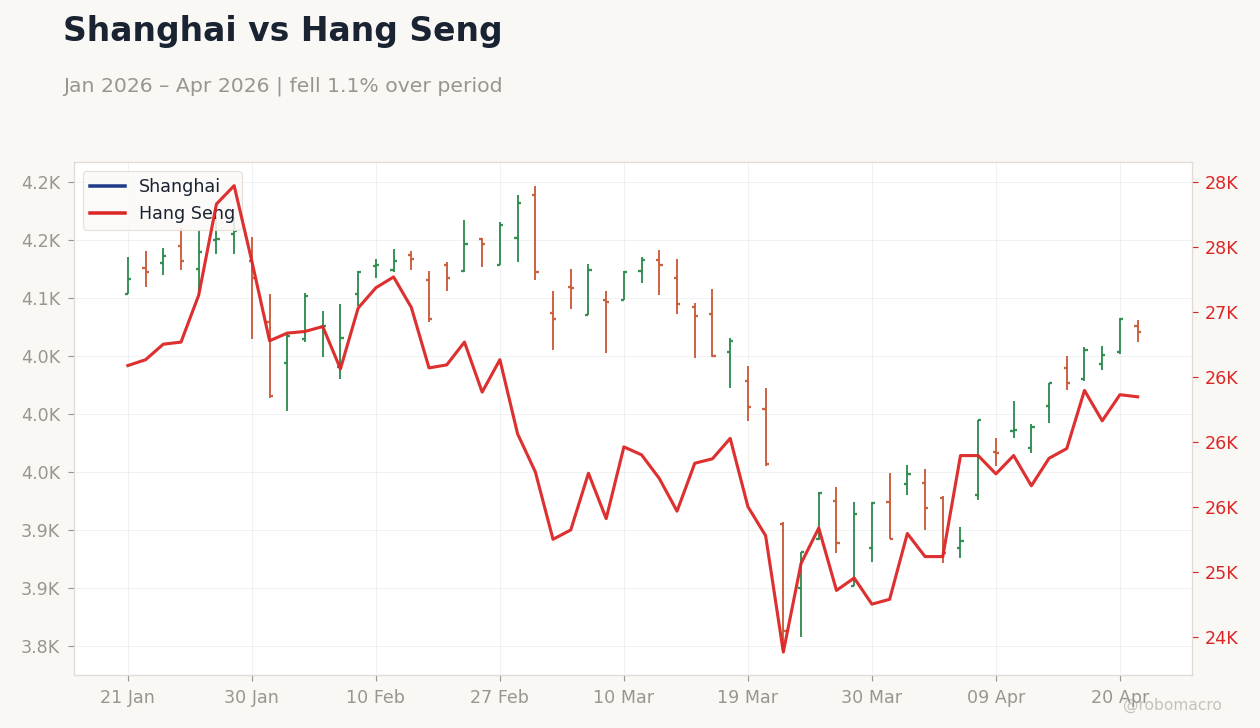
Shanghai vs Hang Seng | Type: market_hloc | Shanghai: 4071 (2026-04-21) | Range: 3813–4183 | Trend(6pt): 4117,4128,4123,3923,4082,4071 | Hang Seng: 2.634e+04 (2026-04-21) | Range: 2.438e+04–2.797e+04 | Trend(6pt): 2.659e+04,2.718e+04,2.532e+04,2.534e+04,2.616e+04,2.634e+04
| Data | Prior | Cons | Time |
|---|---|---|---|
| No events available | |||
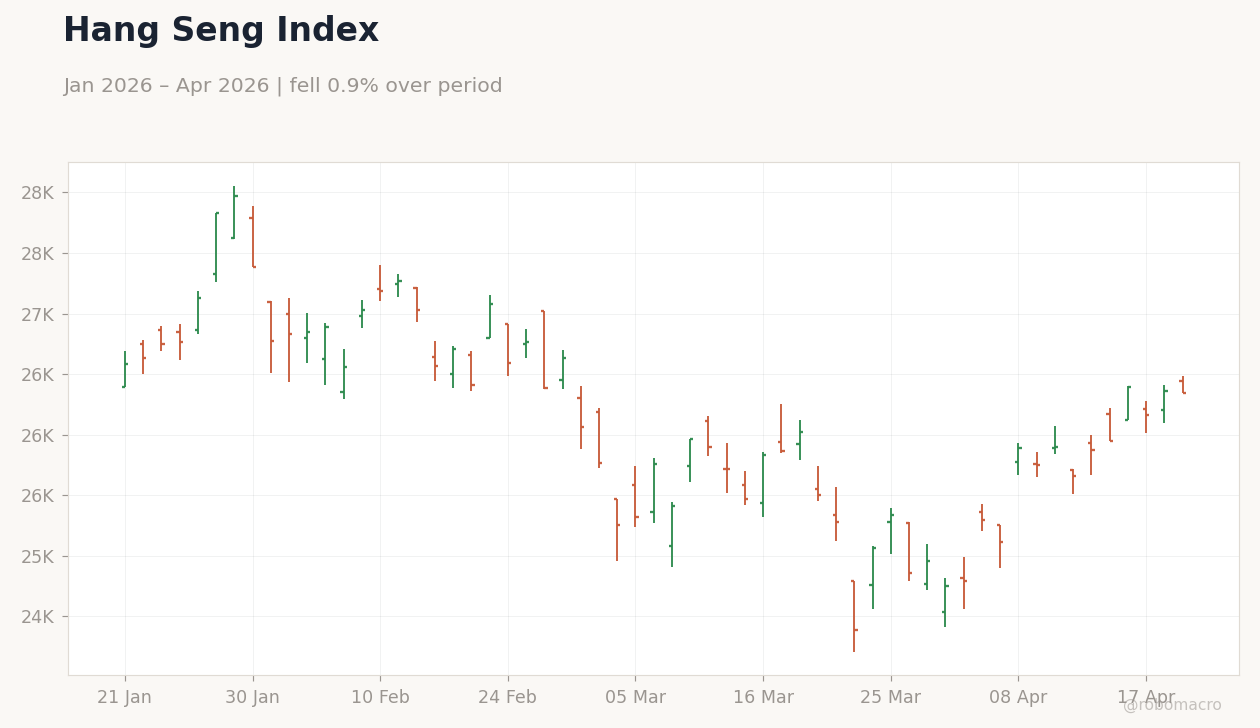
Greater China equities displayed mixed results amid tempered stimulus hopes and global volatility. Mainland China's Shanghai Composite slipped 0.10% to 4,051.43, while the CSI 300 declined 0.17% to 4,728.67, reflecting caution over yuan management and commodity pressures. Hong Kong's Hang Seng dipped 0.03% to 26,352.76, weighed by property and tech sectors despite record foreign trading of Chinese bonds through the city.
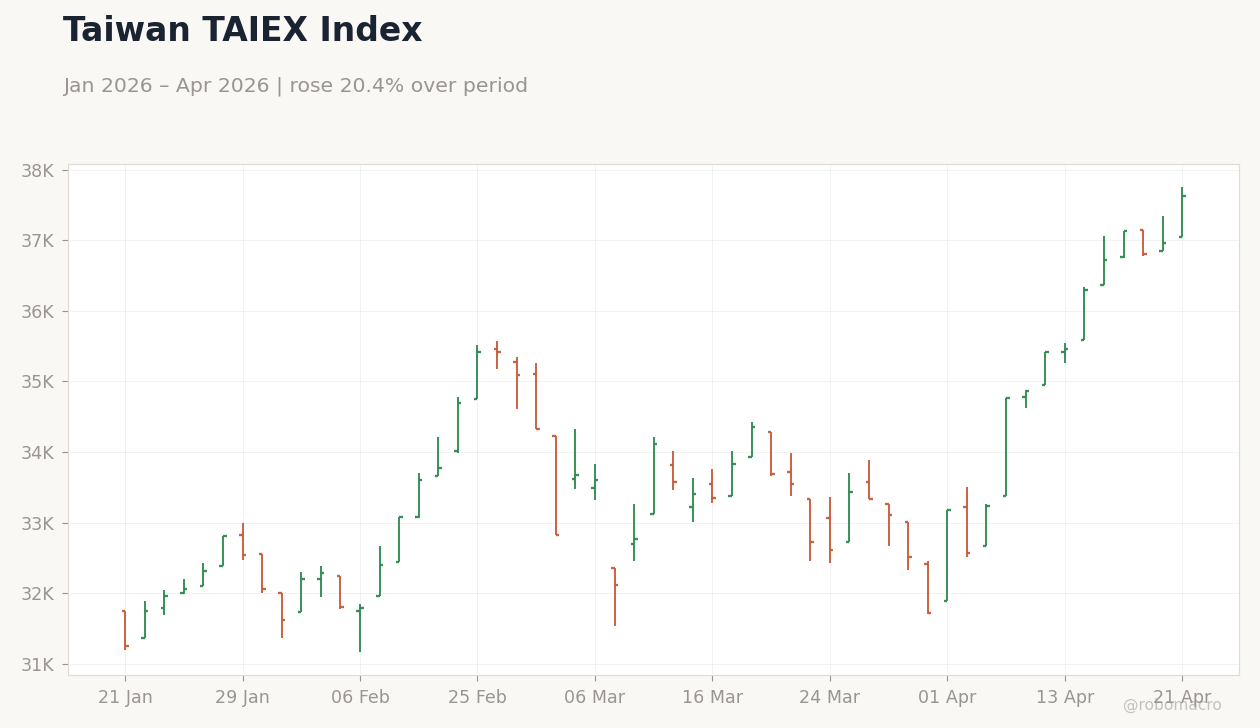
Taiwan's TAIEX outperformed with a 1.97% rise to 37,685.28, supported by positive per capita GDP projections exceeding South Korea's by NT$315,000 in five years, tied to strong semiconductor demand and ADB's 7.6% GDP growth forecast. Currency markets were steady, with USD/CNY down 0.03% to 6.81 as the PBOC set its reference rate at 6.8622, higher than the prior 6.8616 and market estimate of 6.8206, to moderate the yuan's rally driven by its resilience during the Iran war. USD/HKD held flat at 7.83.
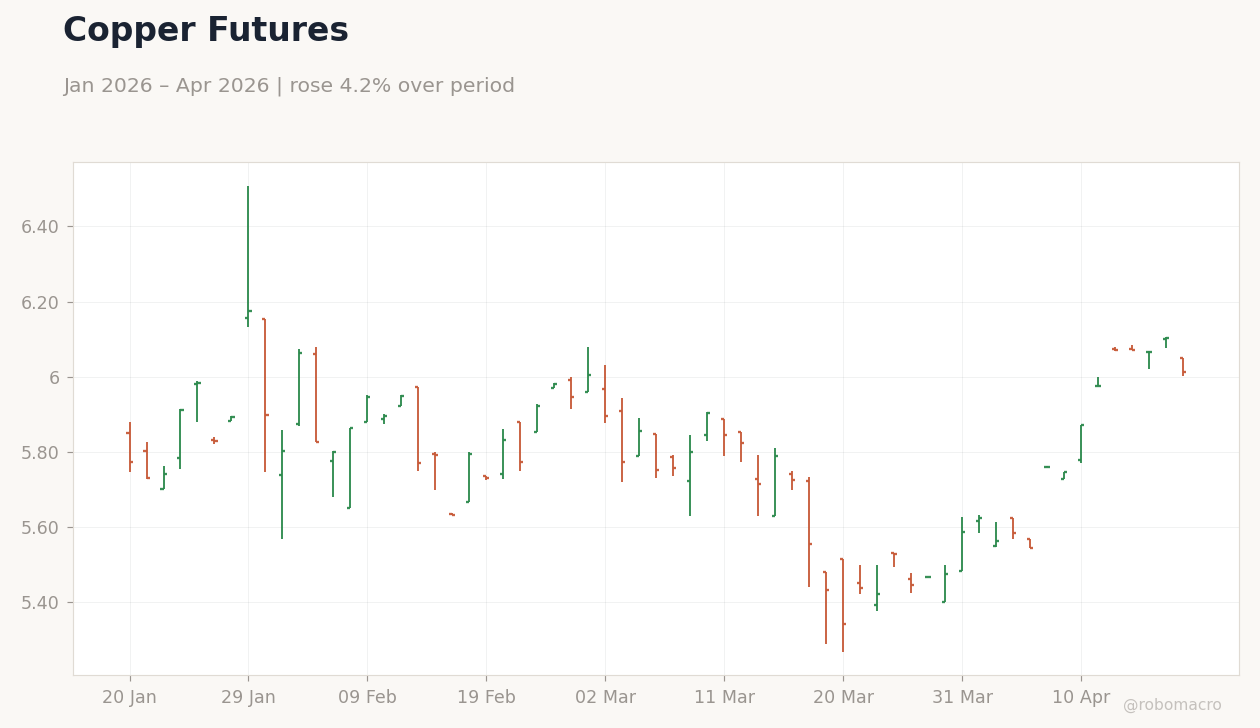
Commodities varied: copper fell 1.49% to 6.01, signaling demand concerns for China's economy, while Brent crude climbed 5.27% to 95.14 on energy disruptions. Gold eased 0.82% to 4,817.70, and Bitcoin rose 2.30% to 75,558.15. No key macro data was released, but China's verified CPI YoY stood at -0.10% as of 2025-04-01, indicating persistent mild deflation.
Taiwan's chip sector resilience bolstered sentiment, contrasting mainland caution.
The calendar shows no scheduled economic releases or events for Greater China today, providing space for markets to absorb recent yuan adjustments and commodity movements. Focus may shift to potential unscheduled PBOC actions on liquidity or yuan guidance, alongside any State Council updates on economic support. Hong Kong's HKTDC lifestyle fairs, including gifts and home products, could spotlight creative industries and cross-border trade.
Taiwan markets may track semiconductor supply chain news amid global demand. Geopolitical factors, like Iran war effects on energy and trade, remain key. Trading could stay subdued absent surprise policy moves.
Subscribe to Greater China Macro Daily and get each new issue delivered to your inbox.
Already a member? Visit robomacro.com to log in and manage subscriptions, or use Forgot Password to set a password.
USD/CNY FX Pair | Type: market_hloc | USD/CNY: 6.815 (2026-04-21) | Range: 6.815–6.973 | Trend(5pt): 6.96,6.912,6.897,6.912,6.815
Taiwan TAIEX Index | Type: market_hloc | TAIEX: 3.763e+04 (2026-04-21) | Range: 3.125e+04–3.763e+04 | Trend(6pt): 3.125e+04,3.24e+04,3.277e+04,3.311e+04,3.68e+04,3.763e+04
Hang Seng Index | Type: market_hloc | Hang Seng: 2.634e+04 (2026-04-21) | Range: 2.438e+04–2.797e+04 | Trend(6pt): 2.659e+04,2.718e+04,2.532e+04,2.534e+04,2.616e+04,2.634e+04
Copper Futures | Type: market_hloc | Copper Price: 6.013 (2026-04-20) | Range: 5.343–6.175 | Trend(6pt): 5.773,5.896,5.855,5.529,6.067,6.013
China's clean tech exports rose sharply in March, benefiting from global energy disruptions and demand for alternatives, strengthening manufacturing amid external shocks. Silver imports reached a record, fueled by retail investors and solar sector needs, highlighting China's role in renewables. Seven nuclear reactors are set for commissioning this year, per CCTV, advancing energy independence.
Increased US ethane imports, projected at record levels this month, underscore petrochemical vulnerabilities due to the Iran war. Manycore shares surged up to 185% on Hong Kong debut, reflecting investor enthusiasm for tech listings. Foreign trading of Chinese bonds via Hong Kong hit a high, driven by yuan appeal amid geopolitical tensions.
The Iran war has intensified China's dependence on US ethane for petrochemicals, with record imports anticipated, exposing supply chain risks. Brent crude's 5.27% gain supports China's clean tech exports but raises import costs. ADB's chief warned of yen weakness from Japan's slow rate hikes, potentially influencing Greater China trade and FX via regional links.
South Korea's finance minister called for won strengthening to meet market expectations, while IMF and ADB projections show Taiwan's per capita GDP overtaking South Korea's by NT$315,000 in five years, fueled by semiconductors and 7.6% GDP growth. French finance minister advocated euro-based stablecoins, signaling digital finance shifts that could affect Hong Kong's fintech landscape. Remi's deployment of programmable compliance aligns with HKMA stablecoin standards, enhancing regulatory frameworks.
These developments highlight evolving global dynamics, with Taiwan's chip strength drawing investment amid Korea contrasts.
The PBOC fixed the USD/CNY midpoint at 6.8622, above the previous 6.8616 and forecast 6.8206, to temper the yuan's rally amid its strong performance in the Iran war, focusing on fixing volatility without rate adjustments. No MLF or LPR changes occurred, and property support signals continue without new RRR cuts or injections. The onshore yuan broke the 6.82 level, reflecting managed appreciation.
HKMA kept the USD/HKD peg stable at 7.83 with zero change, bolstered by record Chinese bond trading through Hong Kong and new stablecoin compliance measures. Taiwan's central bank maintained rates, emphasizing FX stability and export competitiveness, supported by positive GDP outlooks tied to semiconductors. No vote splits or policy shifts were detailed in recent announcements.