India Macro Daily(Beta Mode)
PMIs Miss, Stocks Plunge
Market Snapshot
| Asset | Level | Change |
|---|---|---|
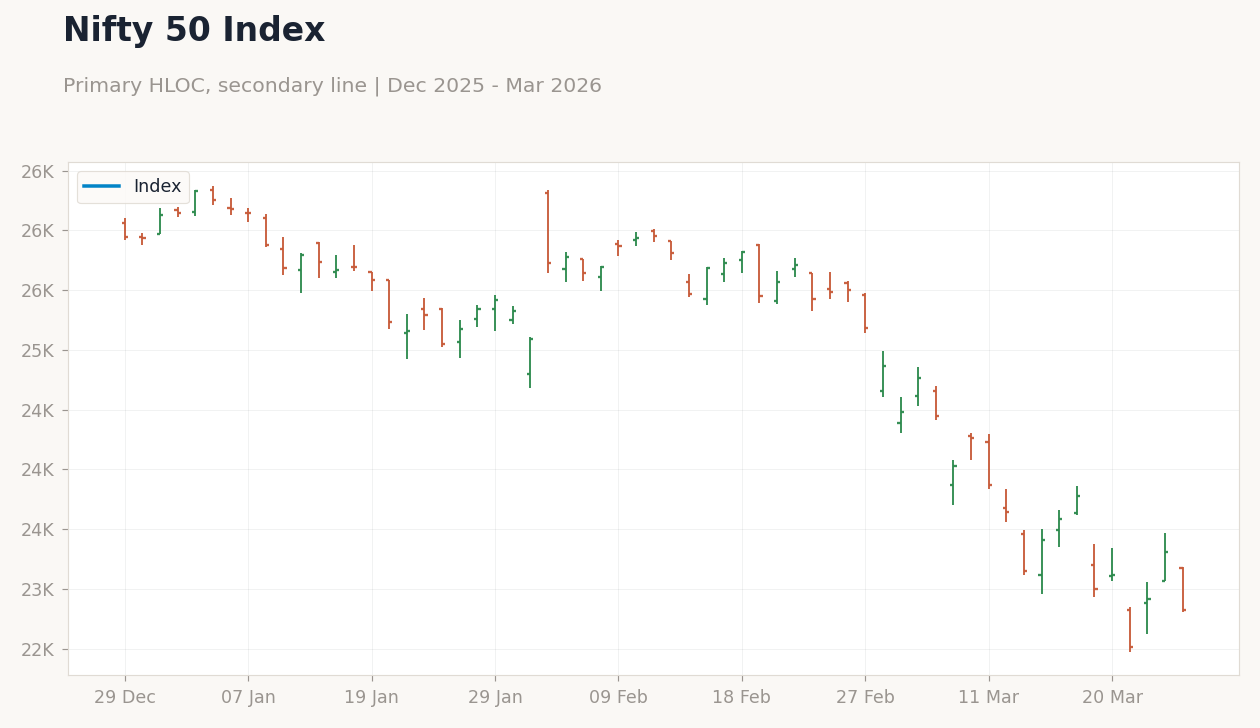
| Nifty 50 | 22,819.60 | -2.09% |
| Sensex | 73,583.22 | -2.25% |
| USD/INR | 94.76 | +0.47% |
| EUR/INR | 109.07 | +0.53% |
| Reliance | 1,348.10 | -4.60% |
| HDFC Bank | 756.20 | -3.34% |
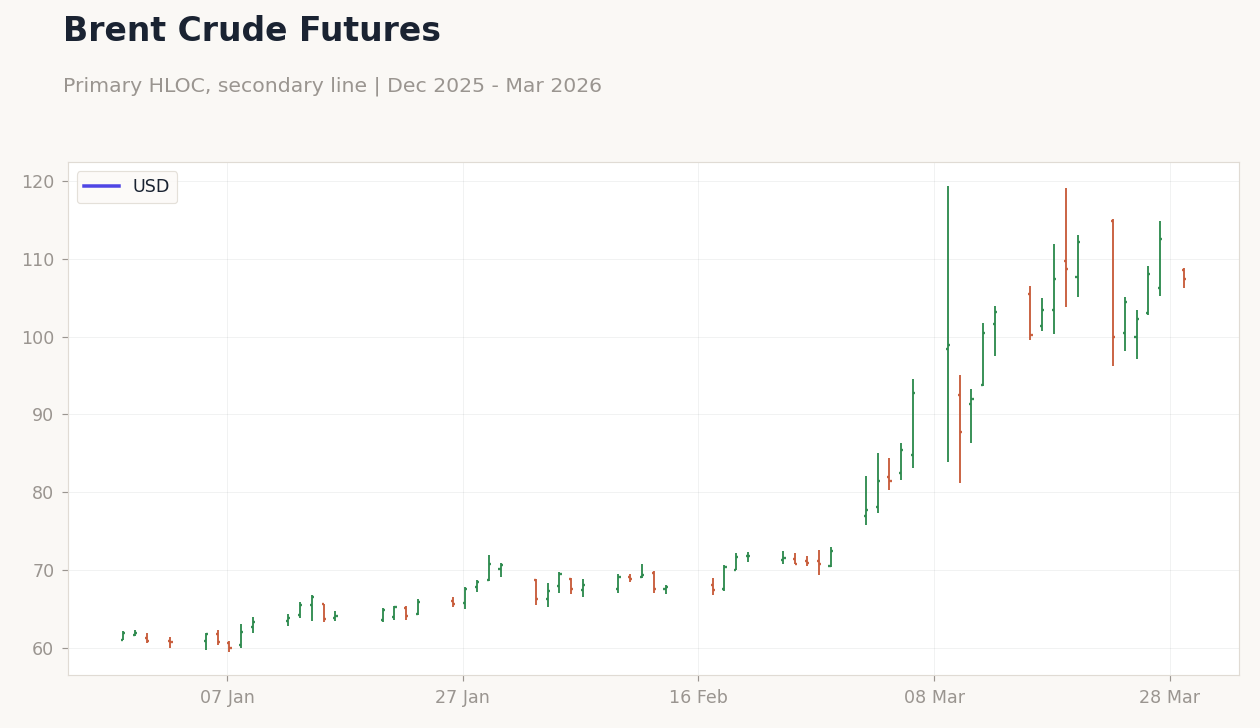
| Brent Crude | 107.05 | -4.90% |
| Gold | 4,476.70 | -0.34% |
| Bitcoin | 66,729.11 | +0.62% |
| India Short-term Rate | 5.50% | +0.00% |
| India Long-term Rate | - | - |
Prior Economic Events
| Data | Prior | Cons | Actual |
|---|---|---|---|
| HSBC Composite PMI Flash | 58.90 | 58.70 | 56.50 |
| HSBC Manufacturing PMI Flash | 56.90 | 56.80 | 53.80 |
| HSBC Services PMI Flash | 58.10 | 58.30 | 57.20 |
 Brent Crude Oil Prices | Type: macro_line | USD/Barrel: 103.8 (2026-03-23) | Range: 59.93–133.2 | Trend(6pt): 63.52,120.8,97.1,73.19,118.4,103.8
Today's Economic Events
| Data | Prior | Cons | Time |
|---|---|---|---|
| No events available | |||
- Flash PMIs disappointed, signaling slowdown in manufacturing and services amid global headwinds.
- Equities tumbled over 2% on oil shock fears, with rupee weakening to 94.76.
- RBI faces pressure to hold rates steady as West Asia conflict risks inflation spike.
Yesterday's Recap
India's flash PMI data released yesterday showed a sharper-than-expected slowdown, with HSBC Composite PMI at 56.50 against consensus of 58.7, Manufacturing PMI at 53.8 versus 56.8, and Services PMI at 57.2 compared to 58.3. These misses highlighted weakening momentum in key sectors, driven by rising input costs and global uncertainty. Indian equities suffered heavy losses, as Nifty 50 closed at 22,819.60 with a 2.09% decline, while Sensex fell 2.25% to 73,583.22, led by sharp drops in Reliance at 4.60% and HDFC Bank at 3.34%.
The rupee depreciated 0.47% to 94.76 against the USD, pressured by capital outflows and elevated oil prices. Brent crude slid 4.90% to 107.05, offering some relief, but gold held steady with a minor 0.34% dip to 4,476.70. Bitcoin bucked the trend, rising 0.62% to 66,729.11, amid broader risk aversion.
India short-term rate remained unchanged at 5.50%, reflecting stable liquidity conditions despite market volatility.
The Day Ahead
Today marks a quiet calendar with no major economic releases or events scheduled for India, allowing markets to digest yesterday's PMI disappointments and global news flow. Attention may shift to any ad-hoc RBI commentary on currency stability, given the rupee's recent slide. Tomorrow also lacks key data points, potentially keeping focus on external factors like oil price movements.
Traders should monitor for any unscheduled announcements on fiscal measures amid West Asia tensions. This lull could provide breathing room for equities to stabilize after sharp losses. Overall, expect sentiment-driven trading without domestic catalysts.
Other Economic Notes
India's growth trajectory faces downside risks from the West Asia conflict, with Chief Economic Adviser Nageswaran warning of impacts on inflation and fiscal deficit, potentially trimming 2026-27 GDP forecasts from 7-7.4%. The rupee's steep fall to near 95 levels, as flagged by Goldman Sachs, tests macro fundamentals despite strong underlying growth. Electric vehicle adoption surges in the Rs 10-30 lakh segment, up 77% year-on-year, signaling consumer resilience amid energy crunches.
(cont...)