Japan Macro Daily(Beta Mode)
Yields Surge, Nikkei Falls
Market Snapshot
| Asset | Level | Change |
|---|---|---|
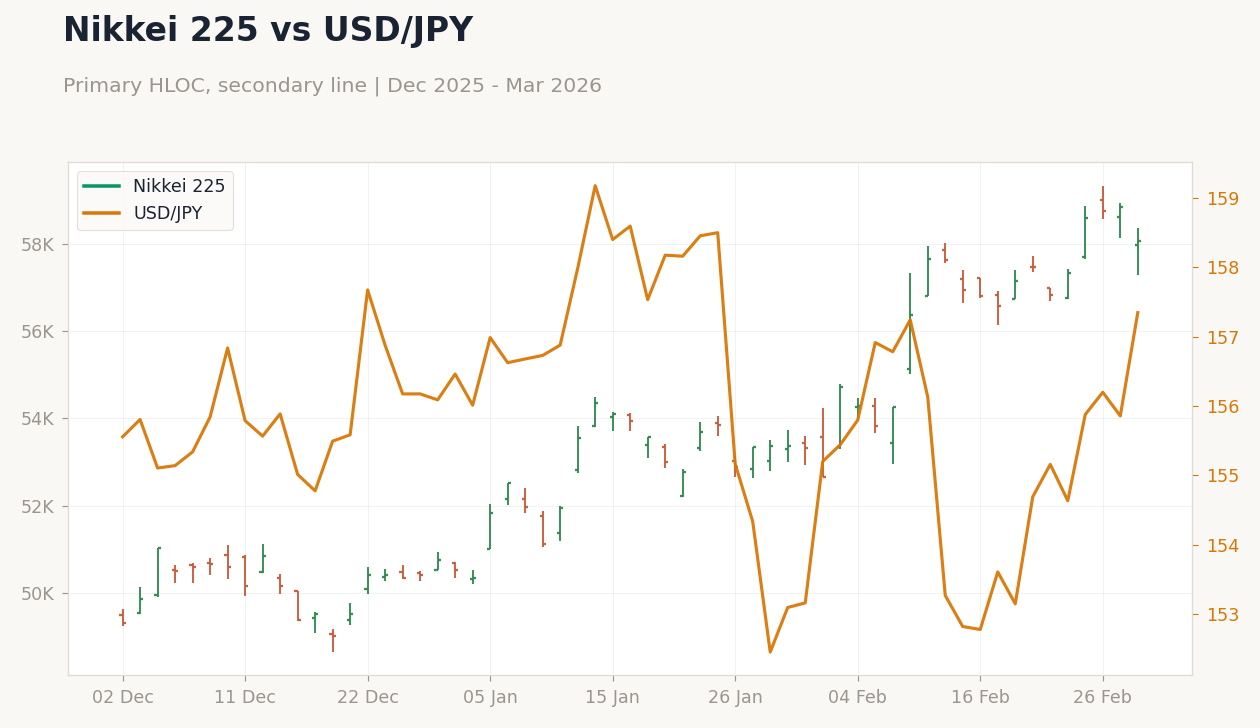
| Nikkei 225 | 58,057.24 | -1.35% |
| USD/JPY | 157.41 | +0.99% |
| EUR/JPY | 184.00 | +0.03% |
| GBP/JPY | 211.15 | +0.42% |
| Gold | 5,342.30 | +2.14% |
| Brent Crude | 78.26 | +7.97% |
| Bitcoin | 69,417.84 | +5.60% |
| Japan 2Y Govt Yield | 0.73% | +30.70% |
| Japan 10Y Govt Yield | 2.24% | +8.74% |
Prior Economic Events
| Data | Prior | Cons | Actual |
|---|---|---|---|
| No events available | |||

Today's Economic Events
| Data | Prior | Cons | Time |
|---|---|---|---|
| Headline Unemployment Rate | 2.60 | 2.60 | 13:30 |
| Capital Spending Year-over-Year | 2.90 | 3 | 13:50 |
| BoJ Gov Ueda Speech | - | - | 18:00 |
| Wednesday (2026-03-04) | |||
| Consumer Confidence Index | 37.90 | 38.20 | 19:00 |
| Sunday (2026-03-08) | |||
| Current Account Balance | 7,288,000m | - | 15:50 |
- Japanese yields climbed sharply amid policy normalization bets, with 2Y up 30.7% and 10Y up 8.7%.
- Nikkei 225 dropped 1.35% to 58,057.24 on global volatility and yen strength.
- USD/JPY rose 0.99% to 157.41, reflecting broader dollar gains.
Yesterday's Recap
Japanese markets experienced notable volatility yesterday, with the Nikkei 225 index closing down 1.35% at 58,057.24, pressured by rising global commodity prices and concerns over Middle East tensions impacting export sectors. The yen weakened against major currencies, as USD/JPY advanced 0.99% to 157.41, while EUR/JPY edged up 0.03% to 184.00 and GBP/JPY gained 0.42% to 211.15, driven by dollar strength amid U.S. tariff uncertainties.
Government bond yields surged, with the 2-year yield jumping 30.7% to 0.73% and the 10-year yield rising 8.7% to 2.24%, reflecting heightened expectations for Bank of Japan policy shifts. No major economic data releases occurred, allowing markets to focus on external factors like Brent crude's 7.97% spike to 78.26, which bolstered energy-related stocks but weighed on broader equities. Gold rallied 2.14% to 5,342.30, enhancing safe-haven flows that partially supported the yen later in the session.
Bitcoin's 5.60% gain to 69,417.84 highlighted crypto optimism, indirectly influencing tech-heavy Nikkei components.
The Day Ahead
Today's calendar features the headline unemployment rate at 13:30 ET, expected to hold steady at 2.6%, providing insights into labor market resilience amid wage pressures. Capital spending year-over-year follows at 13:50 ET, with consensus at 3%, signaling corporate investment trends crucial for growth outlooks. Bank of Japan Governor Ueda's speech at 18:00 ET holds high impact, potentially offering clues on rate paths and yield curve control.
Looking further, consumer confidence index releases on March 3 at 19:00 ET, forecasted at 38.2 from 37.9, gauging household sentiment amid inflation dynamics. Current account balance arrives on March 8 at 15:50 ET, with prior at 7.288 trillion yen, influencing currency expectations.
Other Economic Notes
Broader Japanese economic themes center on the yen's persistent depreciation, which has reduced its purchasing power to one-third over 30 years, exacerbating living costs and import inflation. Government initiatives, like holding 11% voting rights in Rapidus Corp, aim to boost domestic chip production and counter global tech dependencies. Competition for AI talent intensifies, as firms launch job seminars for 2027 graduates, highlighting shifts toward science and engineering amid technological advancements.