Japan Macro Daily(Beta Mode)
BoJ Hawkish Hold Boosts Yen Bets
Market Snapshot
| Asset | Level | Change |
|---|---|---|
| Nikkei 225 | 60,537.36 | +1.38% |
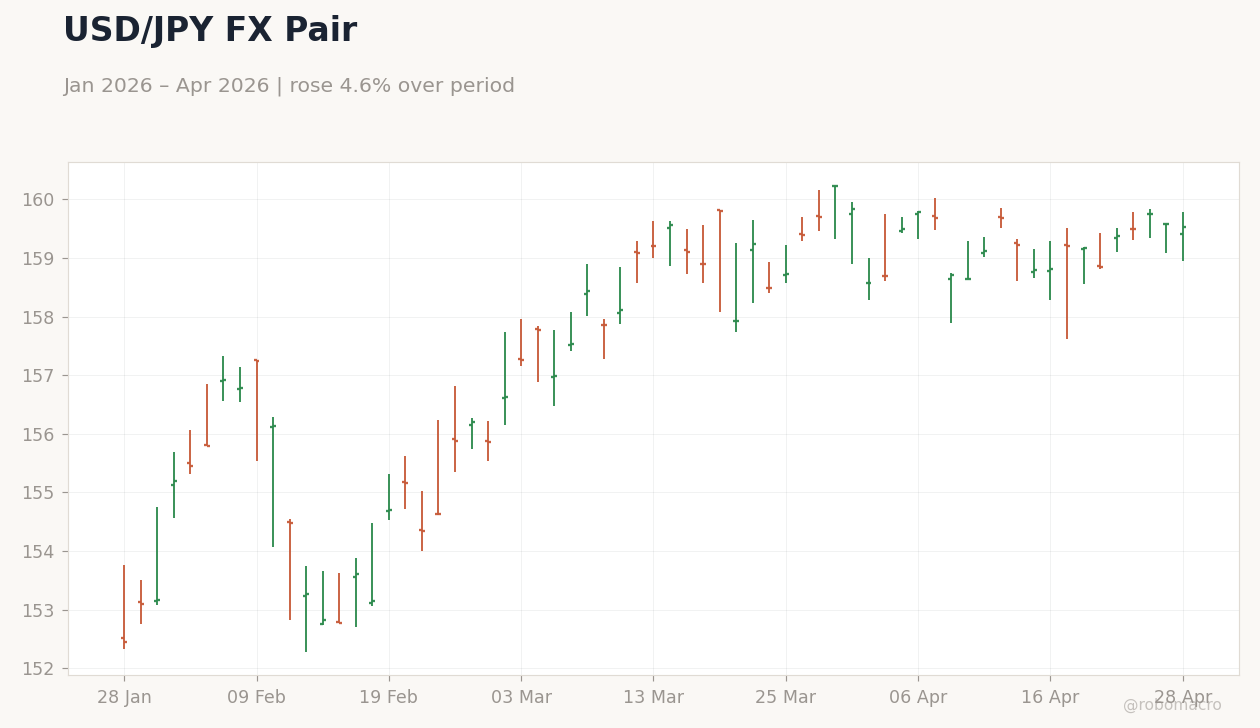
| USD/JPY | 159.54 | +0.11% |
| EUR/JPY | 186.76 | -0.02% |
| GBP/JPY | 215.66 | -0.03% |
| Gold | 4,607.70 | -1.45% |
| Brent Crude | 104.18 | -3.74% |
| Bitcoin | 76,463.68 | -1.17% |
| Japan 2Y Govt Yield | 0.73% | +0.00% |
| Japan 10Y Govt Yield | 2.35% | +11.14% |
Prior Economic Events
| Data | Prior | Cons | Actual |
|---|---|---|---|
| Headline Unemployment Rate | 2.60 | 2.60 | 2.70 |
| BoJ Interest Rate Decision | 0.75 | 0.75 | 0.75 |
| BoJ Quarterly Outlook Report | - | - | - |
 Japan Unemployment Rate | Type: macro_line | Unemployment Rate (%): 2.6 (2026-02-01) | Range: 2.4–2.9 | Trend(6pt): 2.9,2.5,2.6,2.5,2.7,2.6
Today's Economic Events
| Data | Prior | Cons | Time |
|---|---|---|---|
| BoJ Gov Ueda Speech | - | - | 15:59 |
| Wednesday (2026-04-29) | |||
| Housing Starts Year-over-Year | -4.90 | -28.50 | 21:00 |
| Industrial Production Month-over-Month Preliminary | -2 | 1.10 | 15:50 |
| Retail Sales Year-over-Year | -0.20 | 0.80 | 15:50 |
| Thursday (2026-04-30) | |||
| Consumer Confidence Index | 33.30 | 33.10 | 21:00 |
- BoJ holds rates at 0.75% with hawkish tone, three dissents signal potential hikes amid inflation upgrades.
- Unemployment rises to 2.7%, Nikkei gains 1.38% on exporter strength despite mixed yen performance.
- Quarterly Outlook Report lifts inflation view, JGB 10Y yield surges 11.14% on tighter policy expectations.
Yesterday's Recap
Japan's headline unemployment rate unexpectedly increased to 2.7% in March, surpassing the consensus of 2.6% and indicating mild labor market softening amid wage pressures. The Bank of Japan kept its policy rate at 0.75%, matching expectations, but the hold carried a hawkish tone with three board members dissenting in favor of a hike, according to reports. The BoJ's Quarterly Outlook Report raised inflation forecasts, highlighting energy risks and yen weakness, which bolstered market bets for gradual tightening.
Equities advanced, with the Nikkei 225 rising 1.38% to 60,537.36, fueled by tech and exporter gains from global risk appetite. In currencies, USD/JPY inched up 0.11% to 159.54, showing slight dollar resilience despite yen backing from the hawkish decision. JGB yields climbed sharply, with the 10-year increasing 11.14% to 2.35%, as traders positioned for policy shifts.
Markets absorbed the releases with low volatility, prioritizing BoJ signals over the unemployment rise.
The Day Ahead
Today includes a high-impact speech by BoJ Governor Ueda at 15:59 ET, where investors will parse for clues on rate trajectories given recent dissents and inflation revisions. Housing starts year-over-year data arrives at 21:00 ET, with consensus anticipating a steep -28.5% decline from -4.9% prior, which could weigh on construction and property sectors if realized. Tomorrow features preliminary industrial production month-over-month at 15:50 ET, expected at 1.1% compared to -2.0% previous, providing views on manufacturing rebound.
Retail sales year-over-year releases concurrently, forecasted at 0.8% from -0.2%, crucial for assessing consumer spending amid wage trends. Thursday's consumer confidence index at 21:00 ET is projected at 33.1 from 33.3, a key high-impact indicator that may shape the BoJ's domestic assessments. These events could drive fluctuations in yen crosses and JGB yields.
Other Economic Notes
Japanese economic trends underscore ongoing deflationary challenges, with verified CPI at -0.50% year-over-year as of June 2021, complicating the BoJ's goal of sustainable 2% inflation despite outlook improvements. (cont...)