Korea Macro Daily(Beta Mode)
KOSPI Crashes on Won Plunge
Market Snapshot
| Asset | Level | Change |
|---|---|---|
| KOSPI | 5,405.75 | -6.49% |
| KOSDAQ | 1,096.89 | -5.56% |
| USD/KRW | 1,486.30 | -0.24% |
| Samsung | 199,400.00 | -0.55% |
| SK Hynix | 1,007,000.00 | -0.59% |
| Brent Crude | 100.49 | -10.43% |
| Gold | 4,410.40 | -3.50% |
| Bitcoin | 70,827.12 | +4.40% |
| Korea Short-term Rate | 2.54% | +0.40% |
| Korea Long-term Rate | 3.61% | +3.64% |
Prior Economic Events
| Data | Prior | Cons | Actual |
|---|---|---|---|
| No events available | |||
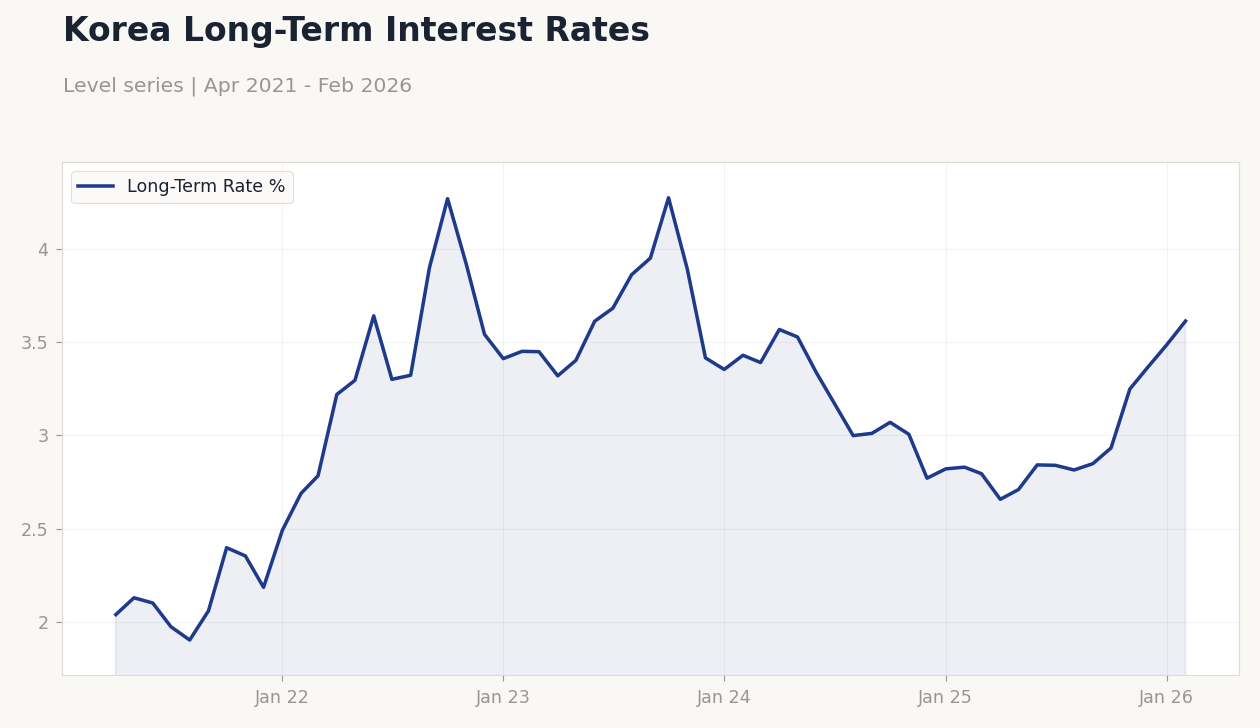 Korea Long-Term Interest Rates | Type: macro_line | Long-Term Rate %: 3.612 (2026-02-01) | Range: 1.905–4.272 | Trend(6pt): 2.041,3.64,3.86,3.07,3.366,3.612
Today's Economic Events
| Data | Prior | Cons | Time |
|---|---|---|---|
| Tuesday (2026-03-24) | |||
| Consumer Confidence Index | 112.10 | - | 13:00 |
| Thursday (2026-03-26) | |||
| Business Confidence Index | 72 | - | 13:00 |
- Korean stocks tumbled amid Mideast tensions, with KOSPI down 6.49% and KOSDAQ off 5.56%.
- Won hits 17-year low versus dollar, testing new BoK chief's hawkish stance.
- Debt surges past 6,500 trillion won as workers' pay exceeds 50 million won annually.
Yesterday's Recap
Korean markets faced severe turbulence yesterday as geopolitical risks from the Mideast conflict escalated, triggering a sharp selloff in equities. The KOSPI index closed at 5,405.75, down 6.49%, with circuit breakers activated amid heavy foreign outflows. KOSDAQ fell to 1,096.89, a 5.56% drop, driven by tech sector weakness.
Major stocks like Samsung Electronics declined to 199,400 won, off 0.55%, while SK Hynix dropped to 1,007,000 won, down 0.59%. The USD/KRW pair settled at 1,486.30, though broader reports highlighted the won reaching a 17-year low amid persistent Iran crisis pressures and dollar gains. No major data releases occurred, but the lack of positive catalysts amplified market volatility.
Bond yields rose, with Korea's long-term rate climbing to 3.61%, up 3.64%, reflecting inflation fears.
The Day Ahead
Investors eye tomorrow's Consumer Confidence Index release at 13:00 ET, with prior reading at 112.1 and no consensus forecast available. This medium-impact data could signal shifts in household sentiment amid won weakness and rising living costs. Later in the week, Thursday's Business Confidence Index at 13:00 ET follows a previous 72, potentially influencing export-oriented sectors like semiconductors.
No events are scheduled for today, allowing markets to digest yesterday's rout. Broader attention remains on any BoK interventions to stabilize the currency. Expect volatility in KOSPI and USD/KRW as global risks persist.
Other Economic Notes
South Korea's total debt has exceeded 6,500 trillion won, with the government debt ratio hitting a record high, raising concerns over fiscal sustainability amid export slowdowns. Workers' average annual pay surpassing 50 million won highlights wage growth but also fuels inflationary pressures in a high-debt environment. The expansion of youth microfinance to 300 billion won aims to support younger demographics, potentially boosting consumption in tech and service sectors.


