Korea Macro Daily(Beta Mode)
KOSPI Surges Amid Record Debt
Market Snapshot
| Asset | Level | Change |
|---|---|---|
| KOSPI | 5,377.30 | +2.74% |
| KOSDAQ | 1,063.75 | +0.70% |
| USD/KRW | 1,508.81 | -0.03% |
| Samsung | 186,200.00 | +11.36% |
| SK Hynix | 882,000.00 | +9.29% |
| Brent Crude | 109.58 | +0.50% |
| Gold | 4,676.50 | +0.54% |
| Bitcoin | 69,758.79 | +1.13% |
| Korea Short-term Rate | 2.54% | +0.40% |
| Korea Long-term Rate | 3.61% | +3.64% |
Prior Economic Events
| Data | Prior | Cons | Actual |
|---|---|---|---|
| No events available | |||
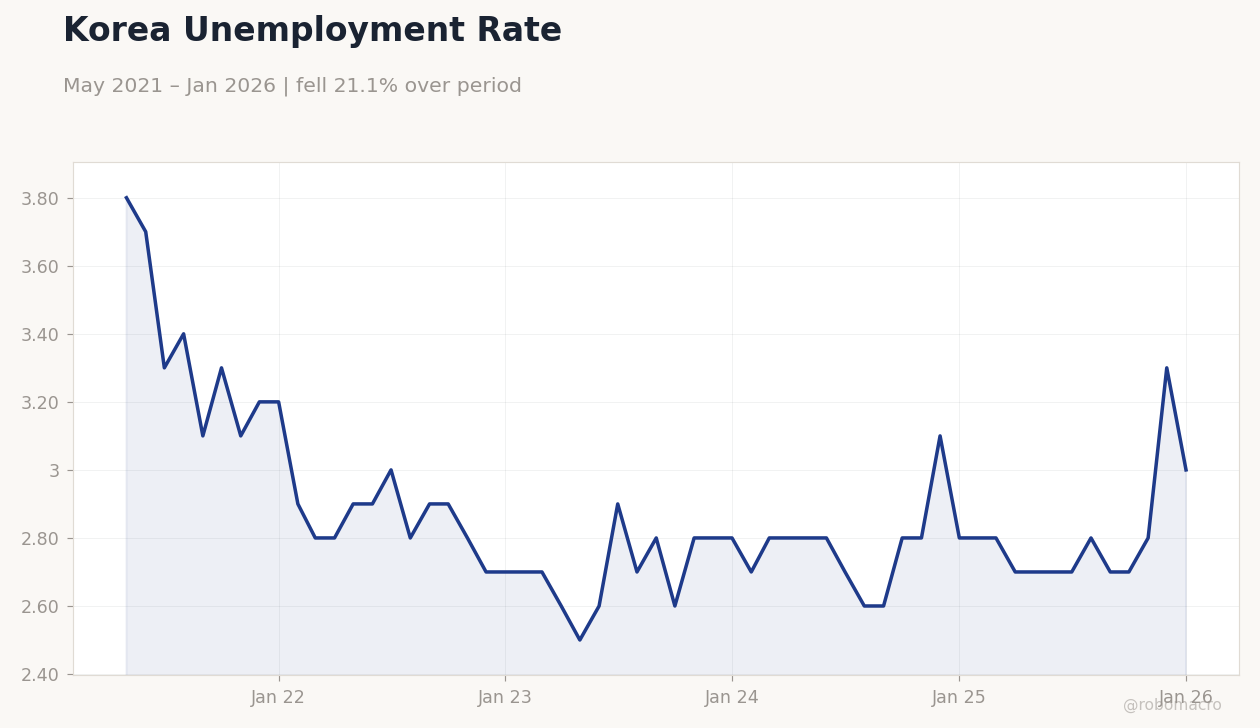 Korea Unemployment Rate | Type: macro_line | Unemployment %: 3 (2026-01-01) | Range: 2.5–3.8 | Trend(5pt): 3.8,3,2.8,2.8,3
Today's Economic Events
| Data | Prior | Cons | Time |
|---|---|---|---|
| Friday (2026-04-10) | |||
| Central Bank Interest Rate Decision | 2.50 | 2.50 | 21:00 |
- Korean stocks rallied on semiconductor strength despite Middle East tensions.
- National debt reached record 1,304.5 trillion won, raising fiscal concerns.
- Inflation accelerated from energy shocks, pressuring the won.
Yesterday's Recap
Korean markets posted strong gains on April 5, with the KOSPI closing at 5,377.30 after a +2.74% rise, fueled by semiconductor advances. The KOSDAQ advanced to 1,063.75 with a +0.70% increase, showing broad equity support. USD/KRW dipped to 1,508.81, a -0.03% change, maintaining won stability on export strength.
Samsung shares soared to 186,200.00 with +11.36% gains, while SK Hynix rose to 882,000.00 on +9.29% amid robust memory demand. No key data releases occurred, but headlines noted South Korea's national debt hitting a record 1,304.5 trillion won, heightening fiscal worries. Korea's short-term rate increased to 2.54% with a +0.40% change, and long-term rate climbed to 3.61% on +3.64%, indicating tightening bias.
Markets overlooked reports of a prior Kospi drop over 12% from Iran war tensions, emphasizing tech-led rebound.
The Day Ahead
April 6 features no major economic releases, allowing markets to process recent fluctuations. Focus shifts to the Bank of Korea interest rate decision on April 9 at 21:00 ET, with consensus anticipating a hold at 2.5%. Investors will track BoK statements on inflation and currency stability.
Global oil price movements may affect Korean import costs. Previews of semiconductor earnings, including Samsung's Q1 outlook, could shape stock sentiment. Updates on Middle East conflicts might influence the won-dollar exchange rate.
Other Economic Notes
South Korea's consumer inflation has quickened due to Middle East energy disruptions, challenging the export-oriented economy dependent on steady oil access. Household debt strains are intensifying, with war-driven mortgage hikes burdening families and older Koreans pushing margin loans to 7.7 trillion won. Fiscal deficits surpassed 100 trillion won for the second year, despite a moderating ratio, while won weakening revives foreign-currency budget risks.
Global Macro News
Iran war escalations have boosted the USD/KRW rate, increasing South Korea's energy import expenses and renewing foreign-currency concerns. Asian markets fell sharply amid the conflict, with reports of a Kospi decline over 12%, though latest figures indicate recovery. Brent crude edged up to 109.58 with +0.50% gains, fueling Korean inflation.
(cont...)


