Korea Macro Daily(Beta Mode)
BoK Holds Amid Iran Risks
Market Snapshot
| Asset | Level | Change |
|---|---|---|
| KOSPI | 5,858.87 | +1.40% |
| KOSDAQ | 1,093.63 | +1.64% |
| USD/KRW | 1,483.09 | +0.67% |
| Samsung | 206,000.00 | +0.98% |
| SK Hynix | 1,027,000.00 | +2.91% |
| Brent Crude | 95.20 | -0.75% |
| Gold | 4,787.40 | -0.10% |
| Bitcoin | 71,434.15 | -2.22% |
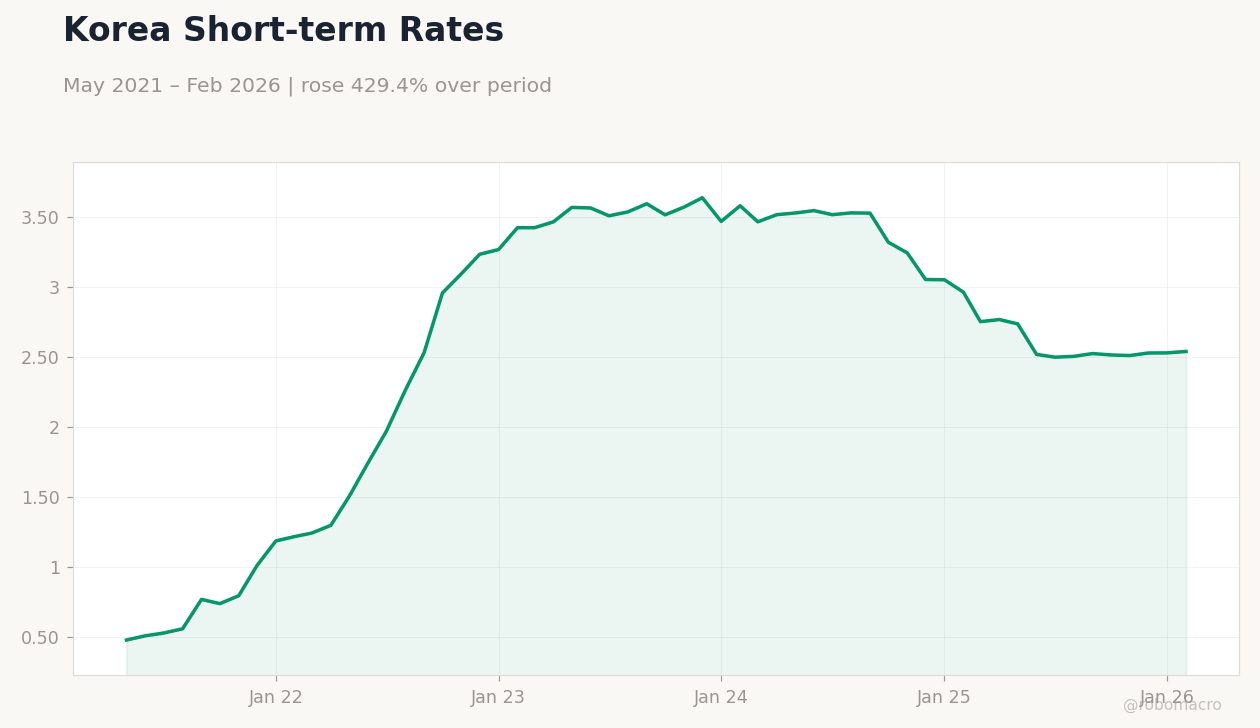
| Korea Short-term Rate | 2.54% | +0.40% |
| Korea Long-term Rate | 3.61% | +3.64% |
Prior Economic Events
| Data | Prior | Cons | Actual |
|---|---|---|---|
| No events available | |||
 Korea Long-term Rates | Type: macro_line | Long-term Rate (%): 3.612 (2026-02-01) | Range: 1.905–4.272 | Trend(6pt): 2.131,3.3,3.949,3.006,3.485,3.612
Today's Economic Events
| Data | Prior | Cons | Time |
|---|---|---|---|
| Tuesday (2026-04-14) | |||
| Headline Unemployment Rate | 2.90 | - | 19:00 |
- Bank of Korea maintains base rate at 2.54% for seventh straight meeting, citing Iran war-driven inflation pressures.
- Korean equities rally on semiconductor strength, with KOSPI up 1.40% and KOSDAQ gaining 1.64%.
- Government announces cash relief and flags rising debt-to-GDP ratio toward 60% by 2030.
Yesterday's Recap
Korean markets advanced amid positive semiconductor momentum, with the KOSPI closing at 5,858.87 after a 1.40% gain, driven by tech heavyweights. KOSDAQ surged 1.64% to 1,093.63, reflecting optimism in AI and chip sectors. Samsung Electronics rose 0.98% to 206,000.00, while SK Hynix jumped 2.91% to 1,027,000.00 on strong demand expectations.
USD/KRW strengthened 0.67% to 1,483.09, pressured by geopolitical tensions. Korea's short-term rate edged up 0.40% to 2.54%, and long-term rate climbed 3.64% to 3.61%, signaling inflation concerns. No major data releases occurred, but news of government expenditure topping 830 trillion won highlighted fiscal expansion.
The Day Ahead
Attention turns to the upcoming headline unemployment rate release on April 14 at 19:00 ET, with previous reading at 2.9% and no consensus forecast available. This medium-impact indicator could influence perceptions of labor market resilience amid export-driven growth. Markets may react if the figure deviates significantly, potentially affecting KOSPI sentiment in the semiconductor sector.
No events are scheduled for today or tomorrow, leaving room for global news to drive intraday moves in USD/KRW. Broader focus remains on any BoK commentary ahead of future MPC meetings.
Other Economic Notes
South Korea's government expenditure exceeding 830 trillion won underscores aggressive fiscal stimulus to support growth, particularly in exports and semiconductors. The debt-to-GDP ratio is projected to reach 60% by 2030, raising concerns over long-term fiscal sustainability amid rising interest rates. Cash relief measures aim to counter inflation, targeting vulnerable households, while the semiconductor boom is expected to persist into the first half of next year, bolstering key players like Samsung and SK Hynix.
Global Macro News
Geopolitical tensions from the Iran war are fueling inflation concerns, anchoring USD/KRW in the 1,450–1,550 range and pressuring Korean export dynamics. Brent crude dipped 0.75% to 95.20, but ongoing Middle East conflicts could sustain upward oil price risks, impacting Korea's energy imports. (cont...)