Korea Macro Daily(Beta Mode)
Record Surplus Amid Won Weakness
Market Snapshot
| Asset | Level | Change |
|---|---|---|
| KOSPI | 7,498.00 | +0.11% |
| KOSDAQ | 1,207.72 | +0.71% |
| USD/KRW | 1,461.35 | +0.45% |
| Samsung | 268,500.00 | -1.10% |
| SK Hynix | 1,686,000.00 | +1.93% |
| Brent Crude | 101.29 | +1.23% |
| Gold | 4,730.70 | +0.66% |
| Bitcoin | 80,827.53 | +0.20% |
| Korea Short-term Rate | 2.53% | -0.55% |
| Korea Long-term Rate | 3.73% | +3.21% |
Prior Economic Events
| Data | Prior | Cons | Actual |
|---|---|---|---|
| No events available | |||
 Korea Short-term Rates | Type: macro_line | Short-term Rate (%): 2.527 (2026-03-01) | Range: 0.51–3.639 | Trend(6pt): 0.51,2.263,3.517,3.055,2.541,2.527
Today's Economic Events
| Data | Prior | Cons | Time |
|---|---|---|---|
| Tuesday (2026-05-12) | |||
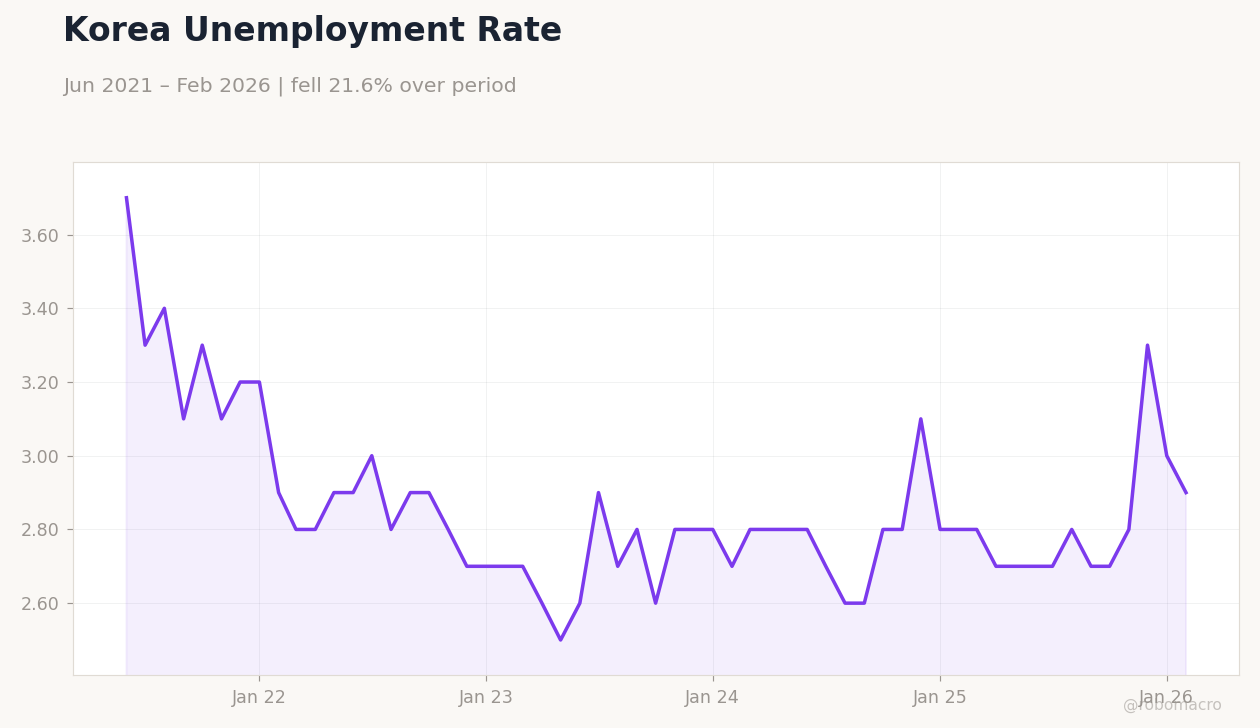
| Headline Unemployment Rate | 2.70 | - | 19:00 |
- South Korea logged its largest-ever current account surplus in March, driven by strong semiconductor and export performance.
- Korean won weakened sharply on Middle East tensions and foreign selling, closing at 1,461.35 despite intraday plunge to 1,471.7.
- KOSPI hit fresh high with modest gains, supported by AI memory boom; Citi lifts growth forecast to 2.9% and KOSPI target to 8,500.
Yesterday's Recap
South Korea reported its largest-ever current account surplus for March, according to Bank of Korea data, fueled by robust exports in semiconductors and other sectors. This reinforced the external sector's resilience amid global uncertainties. KOSPI advanced 0.11% to 7,498.00, achieving a fresh high driven by semiconductor strength, while KOSDAQ rose 0.71% to 1,207.72.
USD/KRW increased 0.45% to 1,461.35, under pressure from Middle East risks and foreign outflows, with reports indicating an intraday drop of 17.7 won to 1,471.7. Samsung Electronics declined 1.10% to 268,500.00, while SK Hynix gained 1.93% to 1,686,000.00 on AI memory demand. Korea's short-term rate fell 0.55% to 2.53%, contrasting with a 3.21% rise in the long-term rate to 3.73%, highlighting yield curve shifts.
The Day Ahead
No significant Korean economic data releases are scheduled for May 10, 2026, following yesterday's current account report. Markets will watch for the Headline Unemployment Rate on May 12 at 19:00 ET, with the previous figure at 2.7% and no consensus estimate available, which could shape views on labor conditions. Attention may turn to potential Bank of Korea commentary on won volatility.
Global factors, including oil price fluctuations and Middle East developments, remain key, especially with Gulf interest in Korean oil storage amid the closed Strait of Hormuz. Investors should monitor export implications from these geopolitical risks.
Other Economic Notes
The Export-Import Bank of Korea strengthened ties with India's State Bank of India and Exim Bank to enhance trade and export opportunities in emerging markets. The government has invested about 200 billion won in the Green Growth Fund to promote sustainable development and economic diversification. Additionally, the financial sector plans to allocate 2 trillion won to social solidarity economy organizations this year, advancing inclusive finance and efforts to mitigate domestic inequalities.
Global Macro News
Middle East tensions, including the ongoing closure of the Strait of Hormuz, have prompted Gulf oil producers to seek storage at South Korea's petroleum reserves, potentially securing energy supplies for the import-heavy economy. <i>↓ p.2</i>