Korea Macro Daily(Beta Mode)
Hawkish BoK Tilt Supports Won Amid FX Warning
Market Snapshot
| Asset | Level | Change |
|---|---|---|
| KOSPI | 7,847.71 | +0.41% |
| KOSDAQ | 1,161.13 | +4.99% |
| USD/KRW | 1,520.60 | +1.08% |
| Samsung | 292,500.00 | -2.34% |
| SK Hynix | 1,941,000.00 | +0.05% |
| Brent Crude | 100.21 | -2.31% |
| Gold | 4,523.20 | -0.37% |
| Bitcoin | 76,606.03 | -0.09% |
| Korea Short-term Rate | 2.52% | -0.40% |
| Korea Long-term Rate | 3.74% | +0.24% |
Prior Economic Events
| Data | Prior | Cons | Actual |
|---|---|---|---|
| No events available | |||
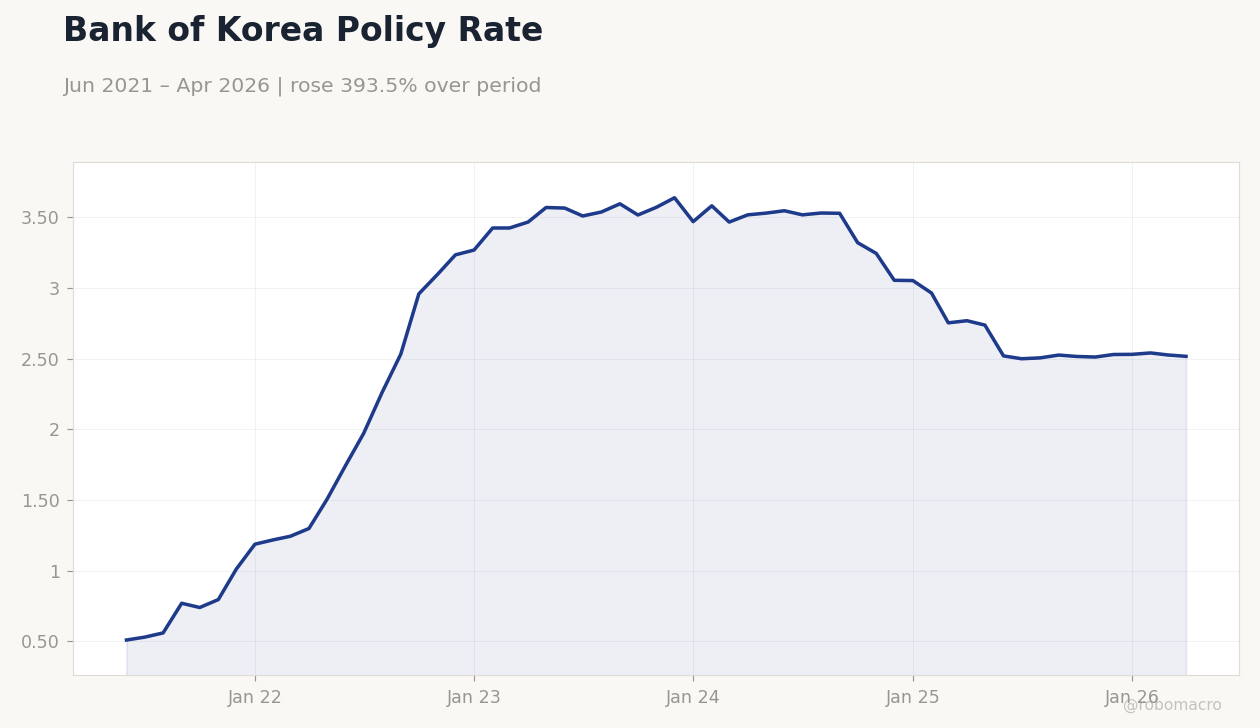 Bank of Korea Policy Rate | Type: macro_line | Policy Rate %: 2.517 (2026-04-01) | Range: 0.51–3.639 | Trend(6pt): 0.51,2.263,3.517,3.055,2.541,2.517
Today's Economic Events
| Data | Prior | Cons | Time |
|---|---|---|---|
| Tuesday (2026-05-26) | |||
| Business Confidence Index | 74 | - | 17:00 |
| Thursday (2026-05-28) | |||
| Central Bank Interest Rate Decision | 2.50 | - | 21:00 |
- Hawkish BoK stance bolsters KRW as authorities flag excessive won moves
- KOSDAQ jumps 4.99% while KOSPI rises 0.41% despite foreign outflows
- USD/KRW climbs to 1,520.60 after closing at 1,517.2 with verbal intervention
Yesterday's Recap
South Korean markets saw KOSPI finish at 7,847.71, up 0.41 percent, while KOSDAQ surged 4.99 percent to 1,161.13. The won weakened sharply, pushing USD/KRW to 1,520.60, a 1.08 percent daily gain, after foreign investors dumped 46 trillion won, focusing sales on Samsung and SK Hynix. Samsung shares fell 2.34 percent to 292,500 won even as SK Hynix edged 0.05 percent higher.
Authorities issued a verbal FX warning, stating won moves had become excessive and signaling readiness for market actions. Korea’s short-term rate stood at 2.52 percent while the long-term rate rose 0.24 percent to 3.74 percent. No major data releases occurred on May 23.
The Day Ahead
Markets will monitor the May 26 Business Confidence Index release at 17:00 ET. Attention then shifts to the Bank of Korea’s May 27 interest-rate decision at 21:00 ET, with the base rate currently at 2.52 percent. Traders expect the MPC to hold policy steady while reiterating vigilance on inflation and financial stability.
Any forward guidance on won volatility will likely influence near-term FX positioning. Equity flows may remain sensitive to foreign positioning ahead of the decision.
Other Economic Notes
BTS fandom spending is projected to add 0.35 percentage points to GDP by 2040 through sustained consumption and tourism. Samsung C&T secured a 2.1 trillion won contract for Apgujeong District 4 redevelopment, supporting construction activity. Export-oriented semiconductor firms continue to drive growth despite short-term foreign selling pressure.
These structural supports offset near-term volatility in equity and currency markets.
Global Macro News
Middle East tensions lifted safe-haven demand and contributed to won pressure near 1,520. Brent crude fell 2.31 percent to 100.21 dollars while gold slipped 0.37 percent to 4,523.20 dollars. Global risk sentiment remained mixed, with Bitcoin little changed at 76,606 dollars.
ING analysts noted that the BoK’s hawkish tilt provides a buffer for the won against external shocks. Foreign outflows from Korean equities reflect broader rotation away from high-valuation tech names. <i>↓ p.2</i>


