Korea Macro Daily(Beta Mode)
KOSPI Plunges as Won Tests Intervention Line
Market Snapshot
| Asset | Level | Change |
|---|---|---|
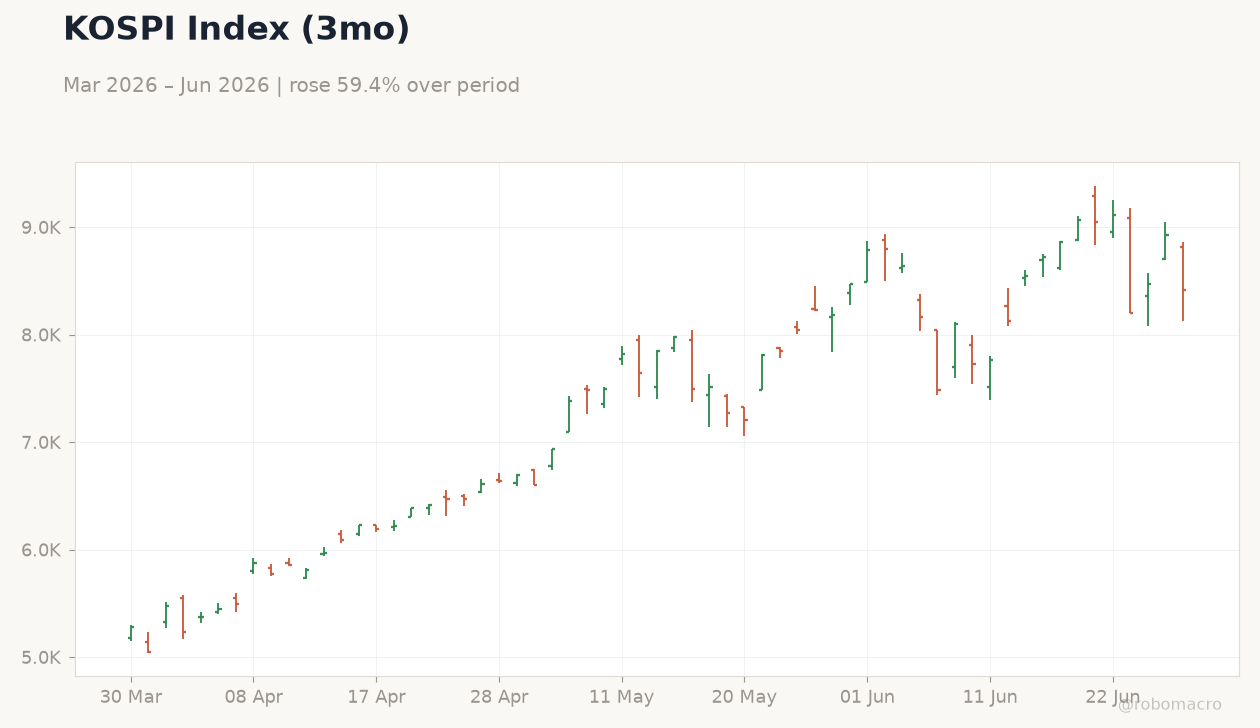
| KOSPI | 8,411.21 | -5.81% |
| KOSDAQ | 851.37 | -4.10% |
| USD/KRW | 1,542.04 | -0.29% |
| Samsung | 339,500.00 | -5.30% |
| SK Hynix | 2,673,000.00 | -8.36% |
| Brent Crude | 73.55 | +2.17% |
| Gold | 4,027.70 | -1.25% |
| Bitcoin | 60,321.44 | +1.33% |
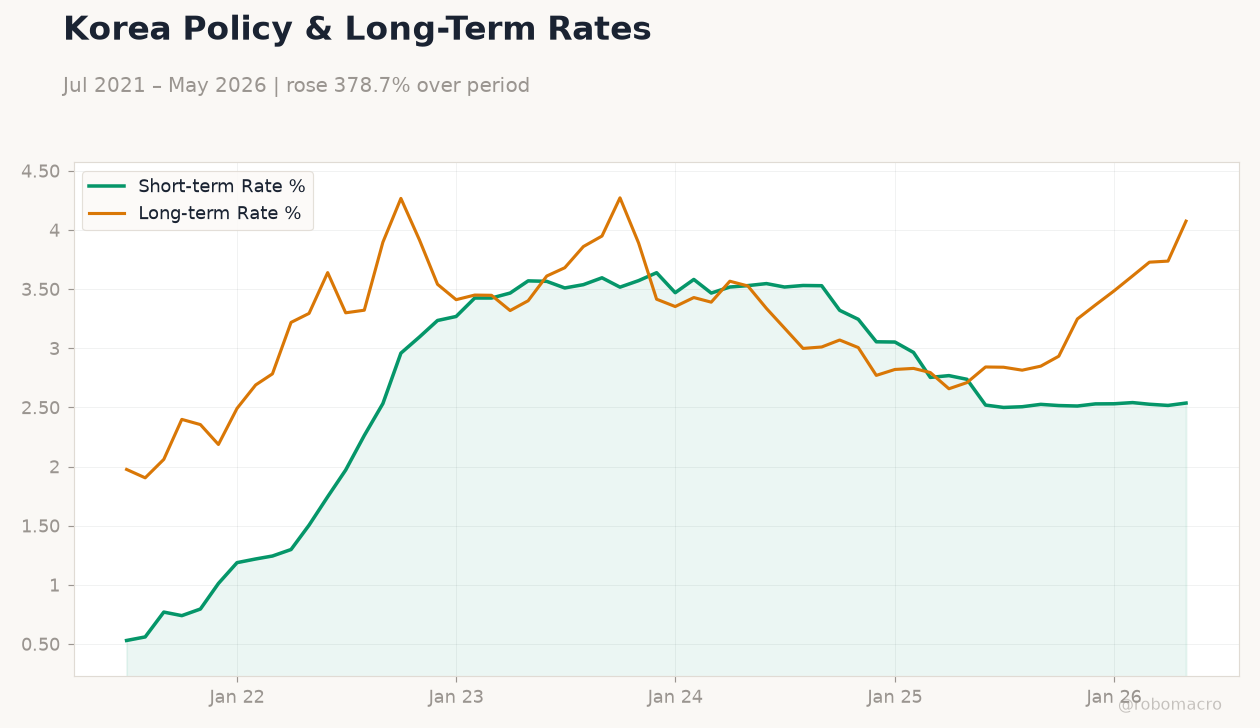
| Korea Short-term Rate | 2.54% | +0.79% |
| Korea Long-term Rate | 4.08% | +9.04% |
Prior Economic Events
| Data | Prior | Cons | Actual |
|---|---|---|---|
| No events available | |||
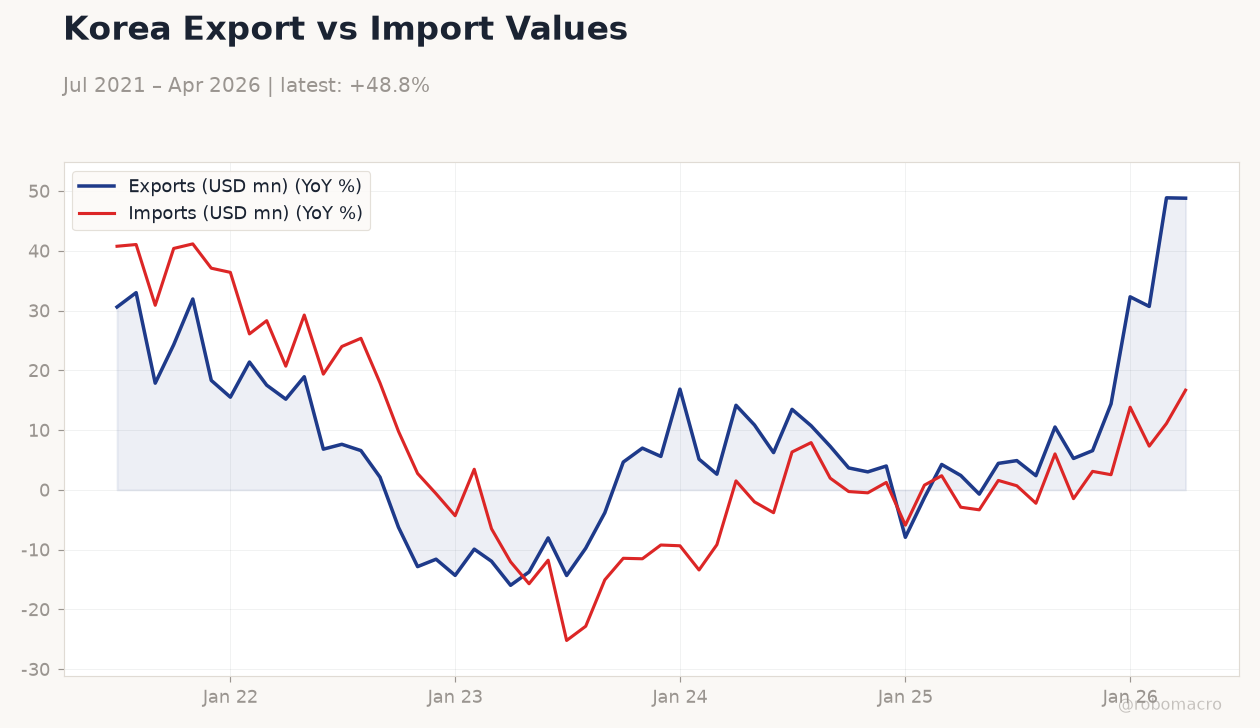 Korea Export vs Import Values | Type: macro_line | Exports (USD mn): 48.8 (2026-04-01) | Range: -15.96–48.86 | Trend(6pt): 30.6,2.129,6.987,-7.928,48.86,48.8 | Imports (USD mn): 16.69 (2026-04-01) | Range: -25.19–41.16 | Trend(6pt): 40.76,17.89,-11.52,-5.901,11.12,16.69
Today's Economic Events
| Data | Prior | Cons | Time |
|---|---|---|---|
| Tuesday (2026-06-30) | |||
| Exports Year-over-Year | 53.20 | - | 16:00 |
| S&P Global Manufacturing PMI Index | - | - | 16:30 |
| Wednesday (2026-07-01) | |||
| Inflation Rate Year-over-Year | 3.10 | 3.20 | 15:00 |
- KOSPI fell 5.81% to 8,411.21 with circuit breakers triggered amid heavy chip profit-taking.
- USD/KRW held near 1,542 after rebounding from 1,550 lows on suspected Bank of Korea intervention.
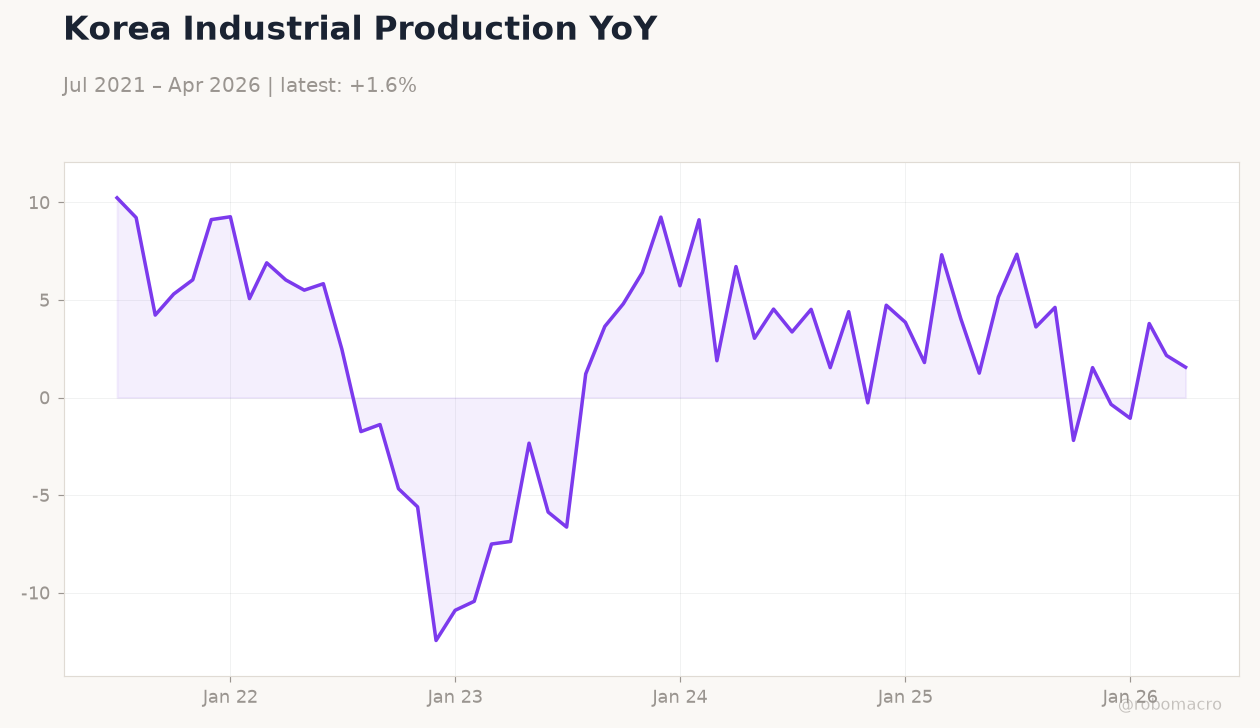
- Exports remain robust while inflation above 3% keeps BoK rate-hike expectations alive.
Yesterday's Recap
South Korean equities suffered a sharp reversal as foreign selling intensified in semiconductors. KOSPI dropped 5.81% to close at 8,411.21 while KOSDAQ fell 4.10% to 851.37, triggering automatic circuit breakers. Samsung Electronics declined 5.30% to 339,500 won and SK Hynix plunged 8.36% to 2,673,000 won.
The won touched fresh 17-year lows near 1,550 per dollar before recovering to 1,542.04 on reports of official intervention. Korea’s short-term rate rose to 2.54% and the long-term rate jumped to 4.08%, reflecting tighter financial conditions. News that Seoul expanded tariff-rate quotas on food imports highlighted efforts to contain price pressures.
The Day Ahead
Markets will focus on tomorrow’s Exports Year-over-Year release, expected to confirm continued strength in shipments. The S&P Global Manufacturing PMI is also due, providing an early read on June factory activity. On Wednesday, the June Inflation Rate Year-over-Year print is forecast at 3.2%, up from 3.1%.
Any hotter-than-expected figure would reinforce the case for further BoK tightening. Traders will monitor won trading ranges closely for signs of renewed intervention.
Other Economic Notes
Samsung and SK Hynix reaffirmed plans to invest hundreds of billions of dollars in new chip capacity over the next decade to meet AI-driven demand. The government’s decision to widen food import quotas aims to ease domestic price pressures without relying solely on monetary policy. Prolonged won weakness is raising concerns about imported inflation and the sustainability of the current export-led recovery.
Equity analysts warn that further sharp declines in chip stocks could trigger broader risk-off flows across Asian markets.
Global Macro News
Global semiconductor demand remains elevated, supporting Korea’s export outlook despite domestic equity weakness. Brent crude rose 2.17% to $73.55, adding mild upside pressure to Korea’s energy import bill. Gold fell 1.25% to $4,027.70 as investors rotated into higher-yielding assets.
<i>↓ p.2</i>