Korea Macro Daily(Beta Mode)
BOK Signals Hikes as Stocks and Won Diverge
Market Snapshot
| Asset | Level | Change |
|---|---|---|
| KOSPI | 5,663.24 | -5.98% |
| KOSDAQ | 662.68 | -6.12% |
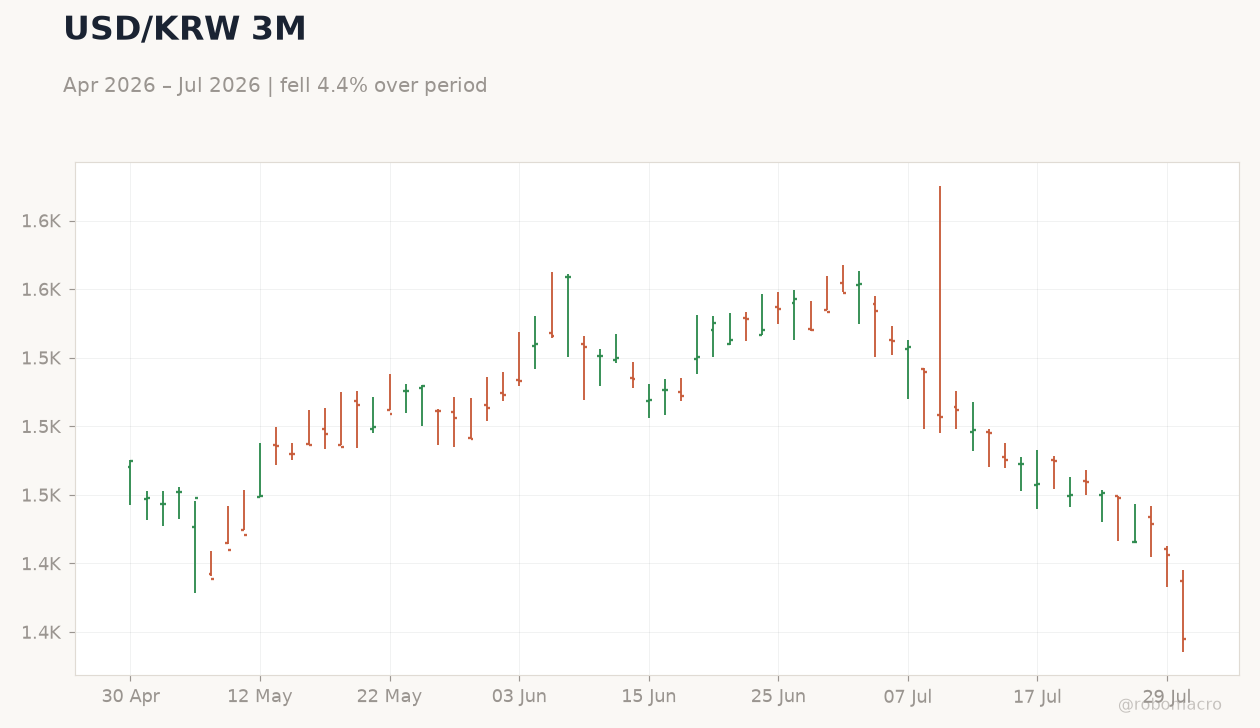
| USD/KRW | 1,422.58 | -2.10% |
| Samsung | 207,000.00 | -0.72% |
| SK Hynix | 1,322,000.00 | -5.64% |
| Brent Crude | 89.45 | -1.42% |
| Gold | 4,162.10 | +3.16% |
| Bitcoin | 64,697.98 | +1.24% |
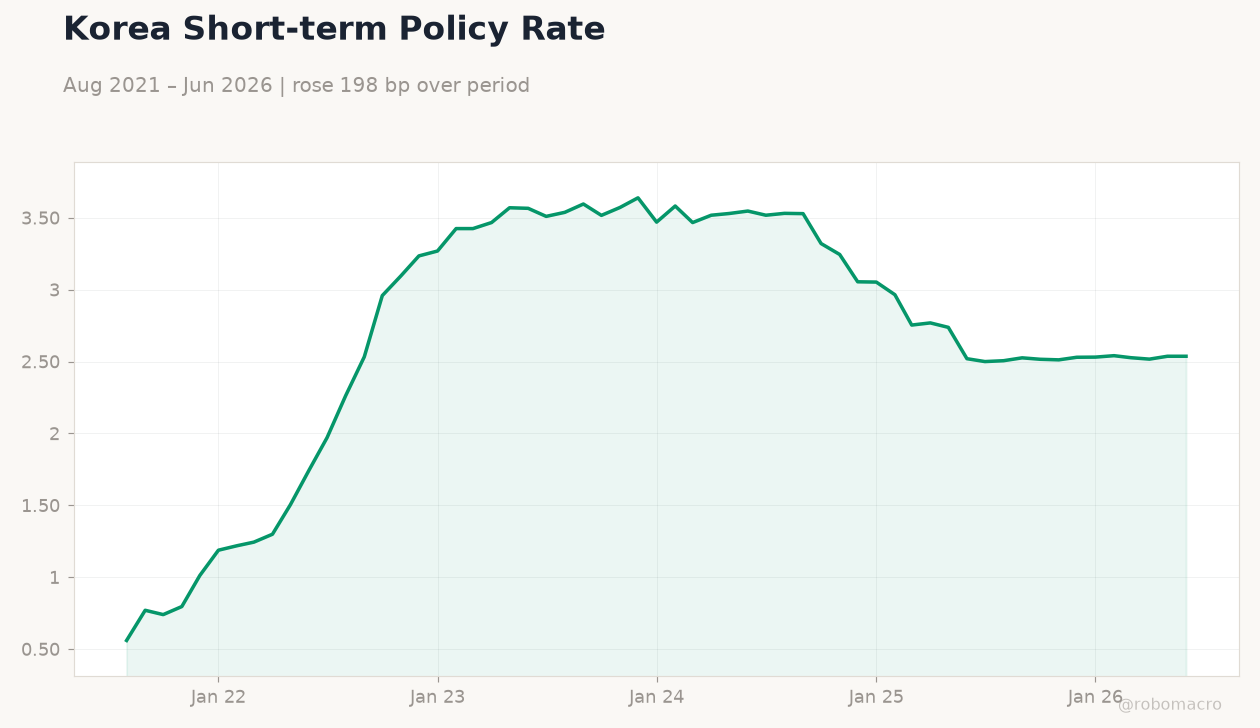
| Korea Short-term Rate | 2.54% | +0.00% |
| Korea Long-term Rate | 4.18% | +2.60% |
Prior Economic Events
| Data | Prior | Cons | Actual |
|---|---|---|---|
| Consumer Confidence Index | 106.60 | - | 106.80 |
| Business Confidence Index | 78 | - | 82 |
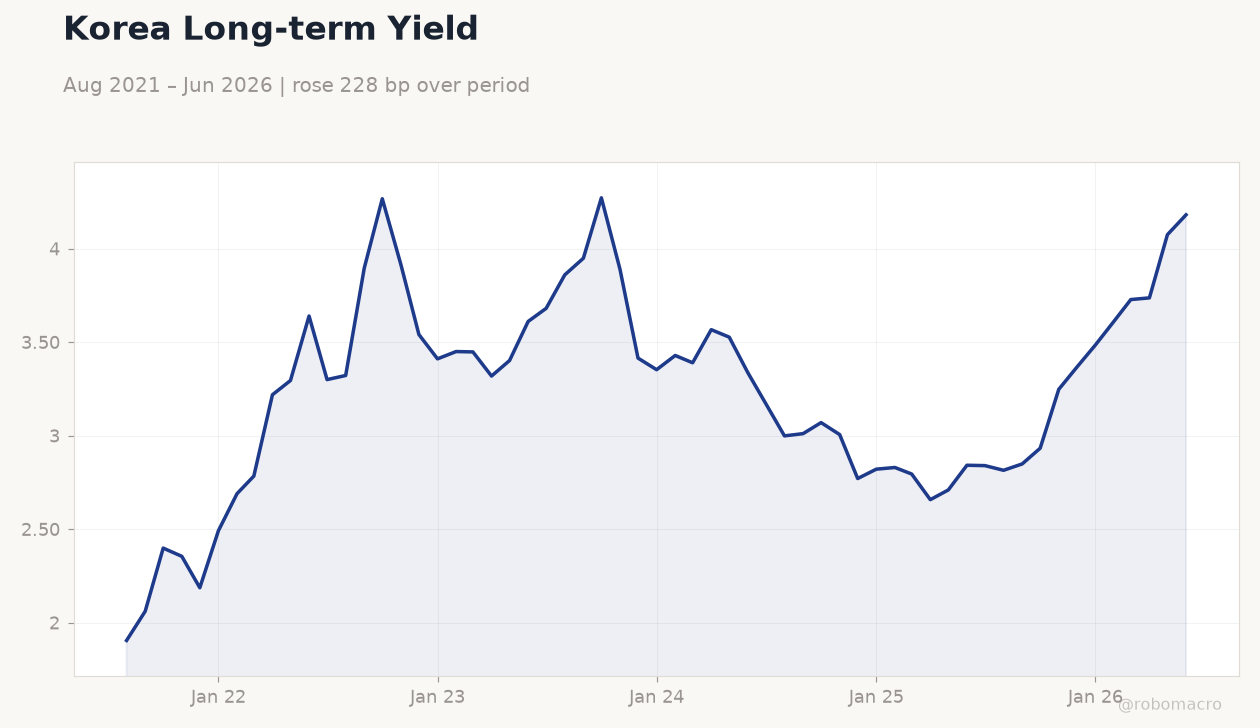 Korea Long-term Yield | Type: macro_line | Percent: 4.181 (2026-06-01) | Range: 1.905–4.272 | Trend(6pt): 1.905,4.267,3.415,2.83,3.737,4.181
Today's Economic Events
| Data | Prior | Cons | Time |
|---|---|---|---|
| Friday (2026-07-31) | |||
| Exports Year-over-Year | 70.70 | 59 | 16:00 |
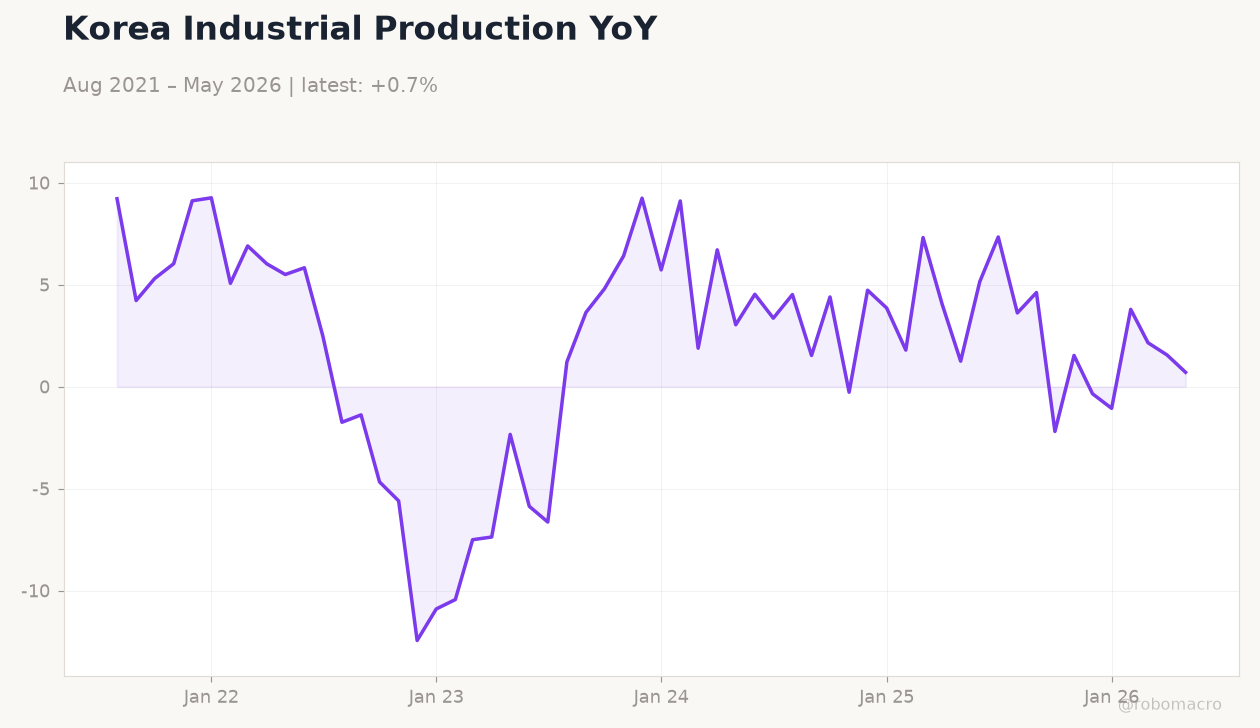
- Business confidence jumped to 82 in July while consumer confidence edged up to 106.8, signaling manufacturing-led rebound.
- KOSPI fell 5.98% to 5,663.24 and KOSDAQ dropped 6.12% amid 864 trillion won outflows and exporter dollar sales.
- USD/KRW fell 2.10% to 1,422.58 as the won advanced after the Fed held rates steady.
Yesterday's Recap
South Korea released July business confidence data showing a sharp rebound to 82 from 78, driven by manufacturing optimism according to Bank of Korea surveys. Consumer confidence improved modestly to 106.8 from 106.6. Equity markets sold off sharply with KOSPI declining 5.98% to close at 5,663.24 and KOSDAQ falling 6.12% to 662.68 as foreign outflows reached 864 trillion won.
Samsung Electronics dropped 0.72% while SK Hynix fell 5.64% on softening memory prices. The won strengthened markedly with USD/KRW declining 2.10% to 1,422.58 after the Federal Reserve held policy rates unchanged. Korea short-term rates stayed at 2.54% while long-term rates rose 2.60% to 4.18%.
Exporters dumping dollars added downward pressure on the currency pair despite the overall advance.
The Day Ahead
Markets await July exports year-over-year data due at 16:00 on 31 July with consensus at 59.0% versus the prior 70.7%. The print will test resilience of semiconductor and auto shipments amid global tech demand concerns. No Bank of Korea monetary policy committee meetings or senior speeches are scheduled.
Attention will focus on any follow-up comments from the emergency meeting addressing capital outflows. CEPA signing with Bangladesh on Tuesday could support longer-term export diversification. Investors will monitor any updates on Kia’s planned $649 million EV investment in Mexico.
Other Economic Notes
Semiconductor export growth reached 18% year-over-year in June, the fastest pace in 14 months, underscoring Korea’s reliance on memory chip cycles. Shipbuilding new orders hit $4.2 billion while Hyundai Motor posted Q2 operating profit 9% above consensus at 5.1 trillion won. IBK Industrial Bank extended 100 billion won in support to Hyundai-Kia semiconductor partners to stabilize supply chains.
Broader themes include potential tokenized cross-border payment efficiencies after the Bank of Korea completed an 80-second trial. These developments reinforce export-driven growth while highlighting vulnerability to global tech and auto demand shifts.