Korea Macro Daily(Beta Mode)
PMI Rises as Korea Awaits CPI Data
Market Snapshot
| Asset | Level | Change |
|---|---|---|
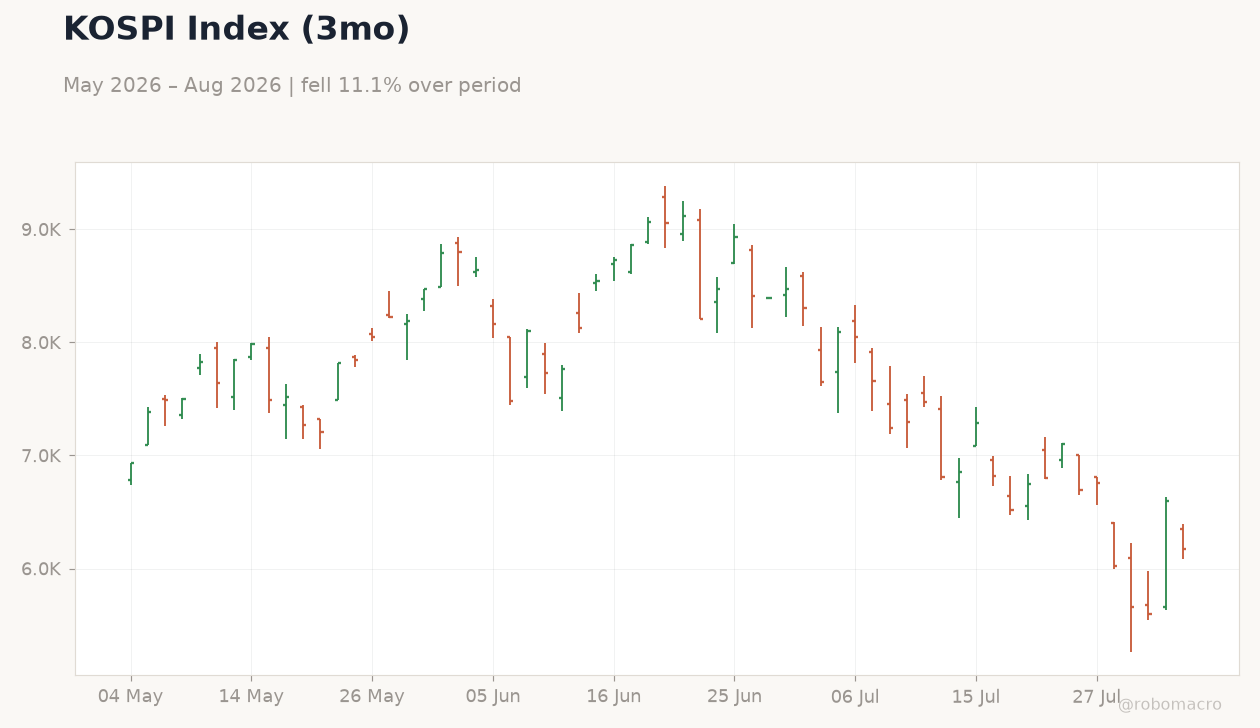
| KOSPI | 6,155.77 | -6.67% |
| KOSDAQ | 767.60 | +6.65% |
| USD/KRW | 1,428.38 | -0.51% |
| Samsung | 262,500.00 | +26.81% |
| SK Hynix | 1,718,000.00 | +29.95% |
| Brent Crude | 84.82 | -5.88% |
| Gold | 4,115.10 | +1.63% |
| Bitcoin | 63,752.16 | +0.43% |
| Korea Short-term Rate | 2.54% | +0.00% |
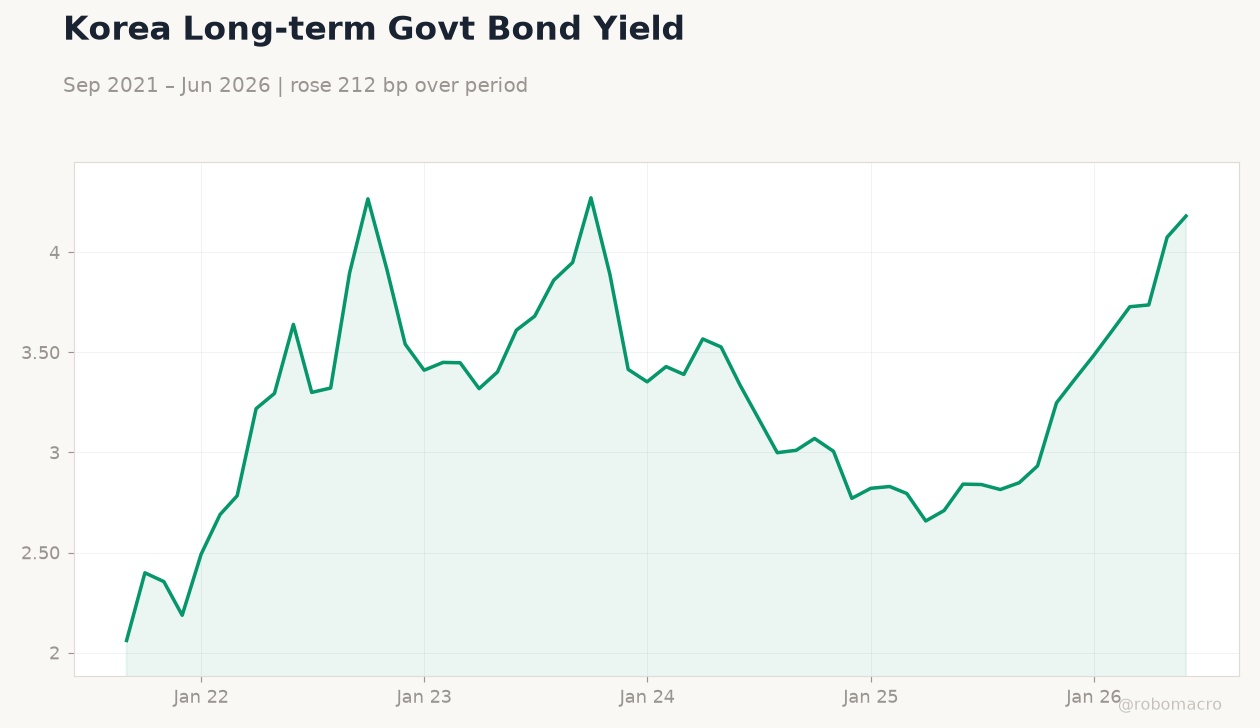
| Korea Long-term Rate | 4.18% | +2.60% |
Prior Economic Events
| Data | Prior | Cons | Actual |
|---|---|---|---|
| S&P Global Manufacturing PMI Index | 52.10 | - | 53.10 |
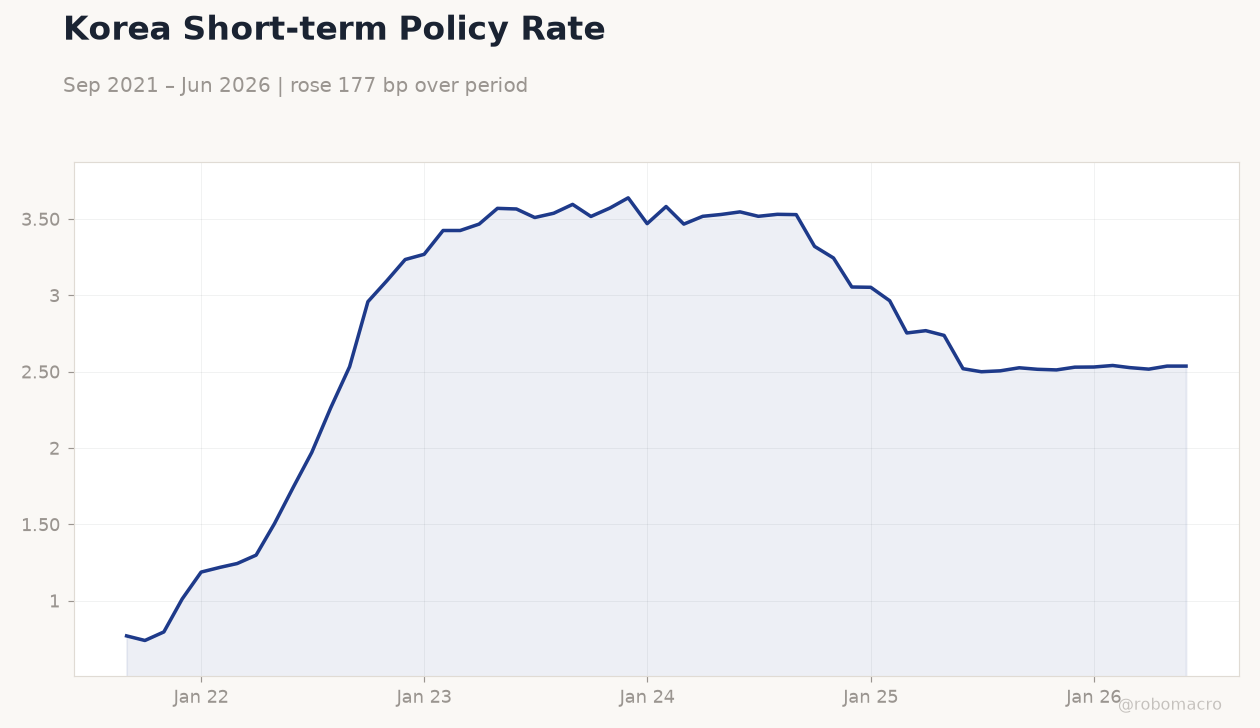 Korea Short-term Policy Rate | Type: macro_line | Policy Rate %: 2.537 (2026-06-01) | Range: 0.74–3.639 | Trend(5pt): 0.77,3.096,3.47,2.754,2.537
Today's Economic Events
| Data | Prior | Cons | Time |
|---|---|---|---|
| Inflation Rate Year-over-Year | 3.20 | 3 | 19:00 |
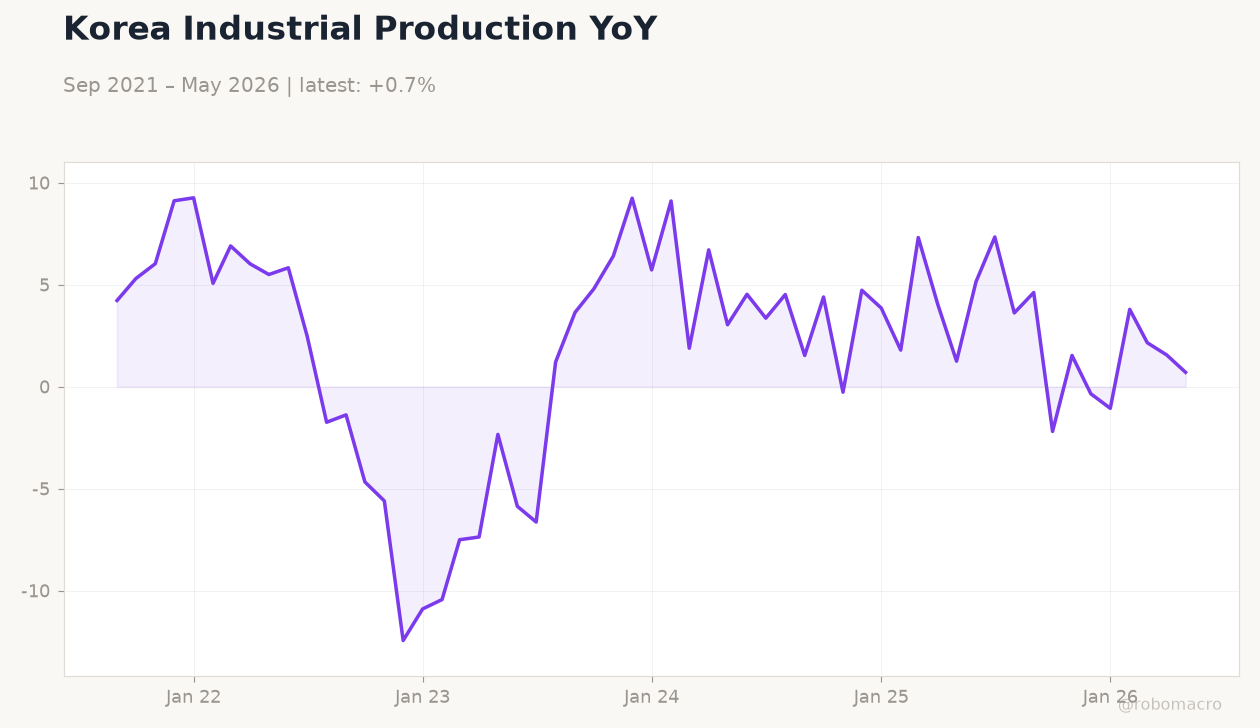
- Manufacturing PMI rose to 53.1 from 52.1, signaling firmer factory momentum.
- KOSPI fell 6.67 percent while Samsung and SK Hynix surged over 26 percent each.
- USD/KRW eased 0.51 percent ahead of today's CPI release.
Yesterday's Recap
South Korea's S&P Global Manufacturing PMI Index climbed to 53.1 in July from 52.1 the prior month, pointing to continued expansion in factory activity. Equity markets diverged sharply, with the KOSPI dropping 6.67 percent to close at 6,155.77 while the KOSDAQ advanced 6.65 percent to 767.60. Semiconductor names led the KOSDAQ rally as Samsung Electronics shares jumped 26.81 percent to 262,500 won and SK Hynix gained 29.95 percent to 1,718,000 won.
The won strengthened modestly, with USD/KRW falling 0.51 percent to 1,428.38. Korea's short-term rate remained steady at 2.54 percent while the long-term rate rose 2.60 percent to 4.18 percent. Brent crude declined 5.88 percent to 84.82 dollars per barrel, offering some relief to import costs.
Gold advanced 1.63 percent to 4,115.10 dollars per ounce amid broader safe-haven demand.
The Day Ahead
Markets will focus on the August 3 release of Korea's inflation rate year-over-year, expected at 3.0 percent after 3.2 percent in June. The 19:00 ET print will provide the latest gauge of price pressures ahead of the next Bank of Korea policy meeting. Authorities have activated a severe heatwave warning system across Seoul and other regions, with temperatures exceeding 40 degrees Celsius for the fifth consecutive day, which may weigh on near-term consumption and construction activity.
Foreign tourist spending continued to surge in the first half of the year, supported by a rebound in Chinese visitors and strong medical tourism inflows. Property-tax proposals that raise levies on expensive homes while easing burdens for single owner-occupiers could influence household spending and housing-market sentiment. No major data releases are scheduled for August 4.
Other Economic Notes
Record heat is forcing authorities to urge residents to halt outdoor activities, raising risks to labor-intensive sectors and electricity demand. POSCO reported stronger second-quarter 2026 earnings despite soft steel prices, underscoring resilience in the industrial base. South Korea's shift away from a denuclearization-first policy toward North Korea introduces new geopolitical uncertainty that could affect regional supply chains and defense spending.
<i>↓ p.2</i>