Mexico Macro Daily(Beta Mode)
Business Confidence Slips, Peso Weakens
Market Snapshot
| Asset | Level | Change |
|---|---|---|
| IPC Bolsa | 68,137.03 | -0.66% |
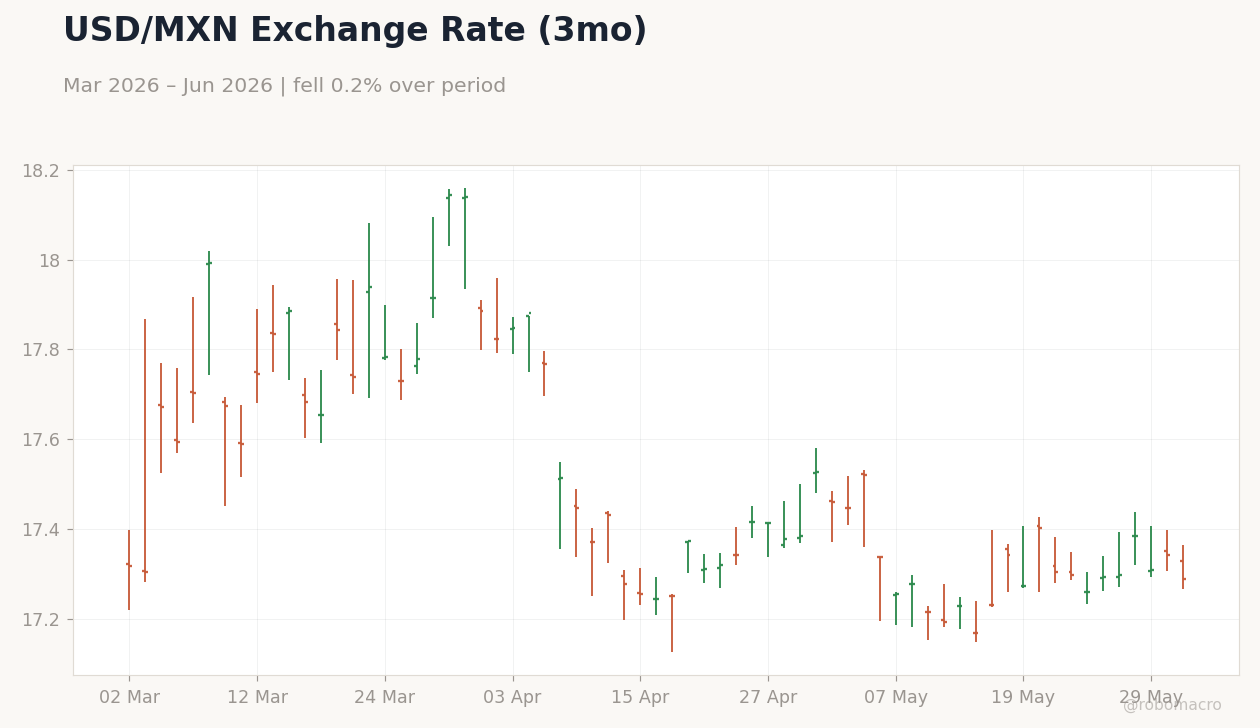
| USD/MXN | 17.34 | +0.20% |
| EUR/MXN | 20.13 | -0.40% |
| WTI Crude | 91.17 | -1.07% |
| Silver | 76.53 | +2.02% |
| Gold | 4,547.10 | +1.61% |
| Brent Crude | 94.06 | -0.97% |
| Bitcoin | 69,048.31 | -3.18% |
| Mexico Short-term Rate | 5.43% | -1.63% |
| Mexico Long-term Rate | 8.88% | +1.60% |
Prior Economic Events
| Data | Prior | Cons | Actual |
|---|---|---|---|
| Business Confidence Index | 47.90 | - | 47.50 |
 Mexico Short-term Policy Rate | Type: macro_line | %: 5.43 (2026-04-01) | Range: 3.11–8.79 | Trend(6pt): 3.11,5.81,8.52,7.88,5.52,5.43
Today's Economic Events
| Data | Prior | Cons | Time |
|---|---|---|---|
| Friday (2026-06-05) | |||
| Consumer Confidence Index | 44.40 | - | 04:00 |
- Business Confidence Index falls to 47.5 from 47.9 on June 1
- IPC Bolsa declines 0.66% to 68,137.03 while USD/MXN rises 0.20% to 17.34
- Mexico short-term rate holds at 5.43% as long-term yields climb to 8.88%
Yesterday's Recap
Mexico’s Business Confidence Index slipped to 47.5 in the latest reading, extending the soft patch in sentiment among firms. The IPC Bolsa closed 0.66% lower at 68,137.03 as investors rotated out of local equities. USD/MXN advanced 0.20% to 17.34 while EUR/MXN eased 0.40% to 20.13.
The short-term policy rate printed at 5.43%, down 1.63% on the day, whereas the long-term rate rose 1.60% to 8.88%. WTI Crude fell 1.07% to 91.17 and Brent declined 0.97% to 94.06, weighing on energy-linked names. Gold and silver posted gains of 1.61% and 2.02% respectively, offering some offset through safe-haven flows.
Bitcoin dropped 3.18% to 69,048.31 amid broader risk-off sentiment.
The Day Ahead
Attention turns to the Consumer Confidence Index scheduled for release on June 5. No high-impact data are due today, leaving markets to digest the recent confidence print and global commodity moves. Analysts will monitor any follow-through in MXN volatility given thin liquidity ahead of the long weekend.
Nearshoring-related supply-chain updates from USMCA partners could also influence sentiment. Banxico officials remain in blackout ahead of the next policy meeting.
Other Economic Notes
Private investment in power generation and grid upgrades continues to accelerate as the government seeks to ease blackout risks. Fiscal compliance has emerged as a key operational hurdle for firms, with tax filings now cited as the primary continuity threat. Remittances and auto exports remain supportive of the external balance despite softer domestic confidence.
Nearshoring momentum persists but faces headwinds from unresolved USMCA rules-of-origin disputes.
Global Macro News
Elevated oil prices are keeping inflation concerns alive across several emerging markets, prompting cautious central-bank rhetoric. South Africa’s rate path is drawing scrutiny for potential spillovers into commodity currencies that compete with the peso. Thailand’s central bank is expected to hold rates steady even as fuel costs push prices higher.
<i>↓ p.2</i>